
Stu So, this aviation adventure I’ve been on has also been a surprising educational journey. It’s taught me so many incredible, useful, and just plain cool things. Sure, there are the obvious things that all pilots learn.
Things like aerodynamics, weather, nav, basic engine theory and the like, all of which are essential starting points. In fact, lots of people show up at ground school with some of that know-how already in hand, particularly the engine stuff.
When I started flying in my early 20’s I knew a lot about aviation in general, but I had no idea about engines, and I mean NO idea. I’d heard of two-strokes and four-strokes, but I didn’t know what that meant. And if one started up in front of me I couldn’t have told you what type it was. So when I got my first airplane, a single-seat Spectrum Beaver with a 2-stroke air-cooled Rotax 447, it was time to learn. I’m pleased to say I learned it pretty well.
Years later I moved to a plane with a Rotax 582, which is of course liquid cooled. Now I had to deal with radiators and coolant and proper airflow. More learning.
Several years later I switched engines types totally, this time to a Continental, a real-life airplane engine. This was my first foray into 4-strokes. Things like oil pressure, mixture and magnetos suddenly became crucial. And what’s all this business about carb ice? I cracked the books once more, both hard copy and virtual. The learning curve spiked again.
Several years later I switched engines types totally, this time to a Continental, a real-life airplane engine. This was my first foray into 4-strokes. Things like oil pressure, mixture and magnetos suddenly became crucial. And what’s all this business about carb ice? I cracked the books once more, both hard copy and virtual. The learning curve spiked again.
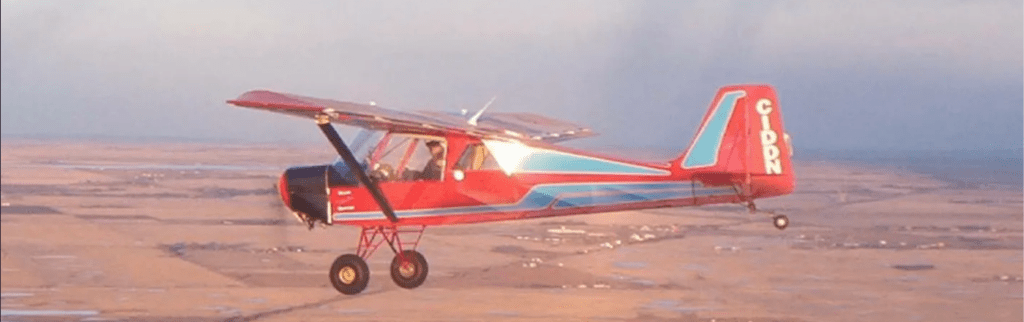
So, aviation taught me about engines. I turned out to be a pretty decent 2-stroke maintainer and I’m still able to offer guys on the airfield some help and insight on their Rotax two-strokes, even though I haven’t sat behind one for nearly 20 years. I’m actually surprised at how much I remember.
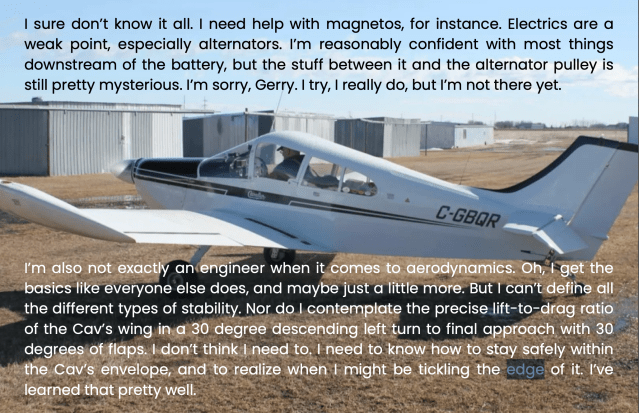
I’m also proud now of my abilities to maintain and operate small Continentals and Lycomings. (I have an O-320 in my Cavalier.) Both brands are actually relatively simple, and mostly not too finnicky once you get to know them. It really gives me a lot of confidence whenever I fly off to other places that if needed, I can do some pretty deep stuff on my engine. Admittedly, I’m largely unfamiliar with some of the other major engine models like the Continental O-470 used in Cessna 182s, or the Lycoming O-540 that powers Bob Kirkby’s Cherokee 235. I know even less about Rotax 912s, but I’d happily own a plane flying on one. And I’d learn all about it pretty quickly, too.
Aviation taught me to build things. I put together a TEAM Himax, back in the 90’s, and thus gained skills in wood working. Of course, wooden airplanes have lots of metal parts like brackets, attach plates, hinges, and landing gear bits. There’s tubing, angles, extrusions and sheet pieces – both steel and aluminum. I’ve made lots of metal airplane things since then.
I covered airplanes with fabric a couple of times. Those were fun and fascinating chapters of my education. My painting could stand some improvement, but if I needed to, I reckon I could learn how to do that better.
All airplanes need hardware. The nuts and bolts, the washers and screws, the cables, pulleys, turnbuckles, the hoses and fittings. There are so many details, like when and where to use (or not use) certain fasteners, what a torque value is, and why it’s crucial. The list is endless, just like the learning.
One thing leads to another. These planes and engines and hardware, they all require tools. Oh, boy, I love my tools! From socket wrenches to spanners, to pliers, cutters, drivers and strippers. Those are just the hand tools. I’ve acquired and learned how to use power tools, too. Drills, saws, grinders, compressors. It’s SO satisfying using them to complete a job, especially if I’ve only just learned how to do it.
I’ve removed and re-installed engines on my planes several times. I re-built a brake cylinder recently, something totally new to me.
I also changed the brake pads on the Cav, and learned to properly service the wheels and bearings. A few years ago I built the mag end of an ignition harness, which was a really exacting process. And I can confidently change out the front crank seal on the Cav, too.
Obviously, I need to be aware of stall characteristics, the effects of wing and airframe ice, how far I can glide with an engine out, and what speed buys me the most time if that happens. But Reynolds numbers and airfoil descriptions can just stay in their text books as far as I’m concerned.
The other big thing that being in aviation has taught me is how to fly. Seems obvious, maybe, but as you know there are lots of subtleties and nuances to flying. I’ve learned how to sense the wind, how to hear my plane, and how to fly it by feel and sight as much as by the instruments.
I’ve learned how to fly to other places, too, and how to cross the border. I’ve learned how the landscape changes in different directions, both far and near. I know how to fly in the mountains and how to look for lift on the prairies.
I can recognize a cold front approaching from the north, and a Chinook arch as it scribes the western sky. I’ve learned what each of them means and what they mean for me and my airplane when we’re flying.
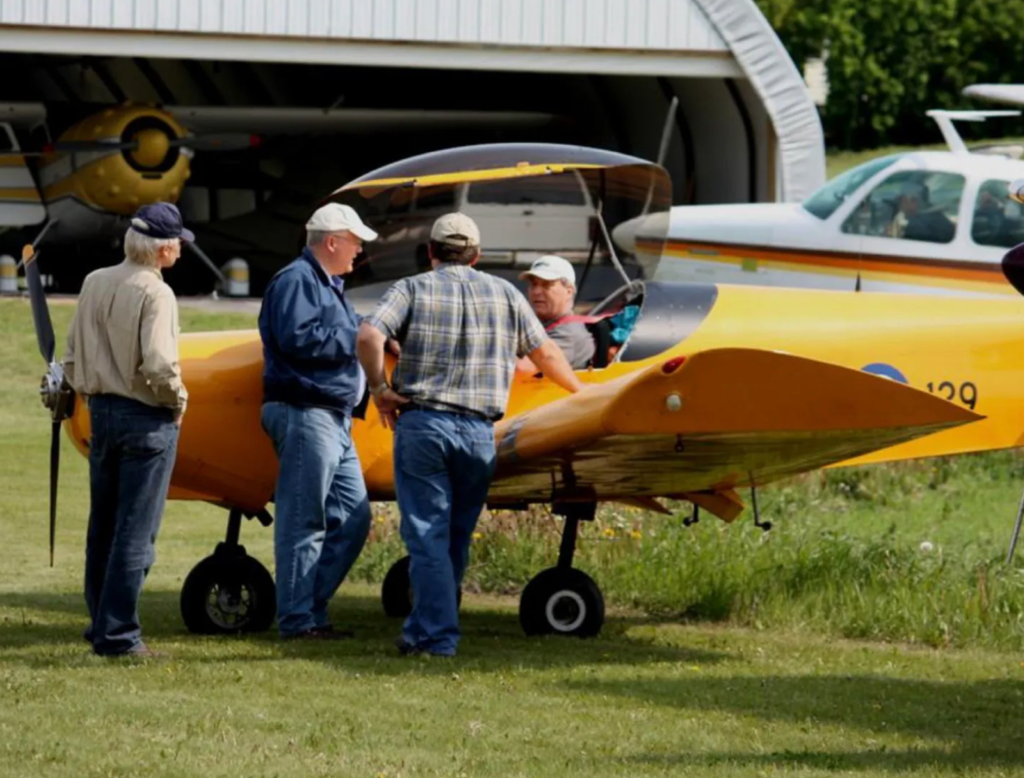
I’ve had so many teachers, with our club members being the most important of my tutors. We have an astounding amount of knowledge in our group! And as others have taught and helped me, I do my best to pass it on and mentor others as I can.
Books have been essential, be they text books with a couple hundred pages, or much simpler manuals with only a few or a dozen pages teaching about parts, procedures or operations. Of course we’re really lucky that what seems to be mankind’s collective knowledge is available online. I can’t count how frequently a web page, a long forgotten forum post, or some guy’s obscure video with only a few views has turned a key to unlock the chains around a perplexing airplane mystery.
And let’s not forget the simple factor of experience, perhaps the most important teacher of all. Learning by doing, by flying, by wrenching, by pulling something apart, offers wisdom like nothing else. You might watch a dozen videos, but the first time you do it yourself, it hits you: “Oh, that’s what it’s like!”
Failure might offer the toughest lessons. Goodness knows I’ve had my share. Luckily, I’ve always learned at least something from tripping and falling.
In considering what I’ve learned, I realize that most of it came about because of simple necessity. When I was flying ultralights, there was no such thing as a two- stroke mechanic that made hangar calls. If something broke, I mostly had to fix it myself. I wanted to be as independent as possible to minimize the chances of being stranded.
By the time I’d moved on to the Continentals and Lycomings, that mindset was so ingrained that it was, and still is, just habit. It’s only for the really big stuff that I’d call in some professional help, and that’s really only happened a handful of times.
It’s a different story with other parts of my plane, especially things electric or electronic.
That’s where I’ve heavily depended on Gerry MacDonald and Bob Kirkby for their patience and mentorship. Because of their tutelage, my understanding is greater, though still minuscule by comparison.
Please don’t get me wrong; I’m not bragging. Rather, I’m celebrating what I’ve learned; the skills and knowledge that I’ve gained since I started flying and owing airplanes. I’m celebrating how trepidation has become confidence; how wonder and ignorance have become wisdom and experience.
It does really bear repeating that this learning adventure hasn’t happened alone. I’ve leaned often on so many other club members for their assistance and guidance. That help, that offering of knowledge and insight is one of the most treasured aspects of my whole flying career. And for all that, I’ve learned to be forever grateful.
 Calgary Recreational Flying Club YYC