

I spent many years of my flying career poo-pooing autopilots. Who needs one? I thought. I got into this game so I could fly the airplane myself, and not let a computer do it. I wanted to be the one with my hand on the stick deciding where the plane goes, and when. “I don’t need no stinkin’ autopilot”, I proclaimed.
Right up until I got one!
I’ll happily proclaim now that I love my Cavalier’s autopilot, and that I fully understand all the fuss about them, why guys want them, and how useful they can be.

So, just to be clear, an autopilot is a computational device that uses inputs from various other sources to adjust the airplane’s controls to operate it within chosen parameters. That’s a fancy way of saying it’ll fly the plane for you and hold heading and altitude. The more advanced the autopilot, the more things it can control, including climb and descent rates, speed, and lots more.
The higher end APs will fly instrument approaches. The most sophisticated ones can even land an airplane totally on their own.
An autopilot is just a little computer that does what a pilot tells it to do. The control head, which sits in the panel, is the part where the pilot tells the computer what he or she wants. The buttons and knobs set things like desired heading or altitude.
The computer sends signals to devices called servos. These are boxes with electric motors whose shafts are connected via gears and levers to either control rods, control cables, or trim cables. As the servos move back and forth, they also move the control surfaces to make them do what the computer commands.
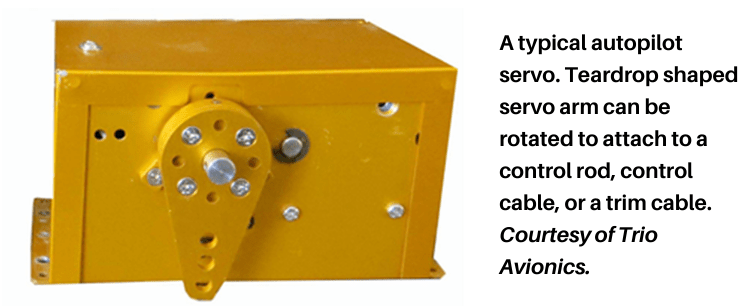
Once you set the parameters, you activate the AP and watch the plane follow those instructions. For example, the servo moves one direction, pulling on an aileron control rod, and that causes the airplane to bank. It’s pretty exciting for me to see that in the Cav, especially since I never thought I’d own a plane with an autopilot.
When I got my Cavalier in 2012 it came with an autopilot already installed, called the Trio EZ Pilot. Trio Avionics, based in El Cajon, California, a suburb of San Diego, started out making APs for homebuilts. But with recent rule changes, the same slightly modified models are now being installed in certified planes, too.
One of the Cav’s previous owners installed the EZ Pilot and did a really good job of it. It’s pretty simple by comparison to higher end units, but it’s very capable for use in homebuilt planes like the Cav.
My EZ Pilot is a really enjoyable tool and toy. It’s the most basic model that Trio produces, being only single axis connected to my ailerons, but the things it’ll do are pretty far beyond basic and I only use a portion of them.
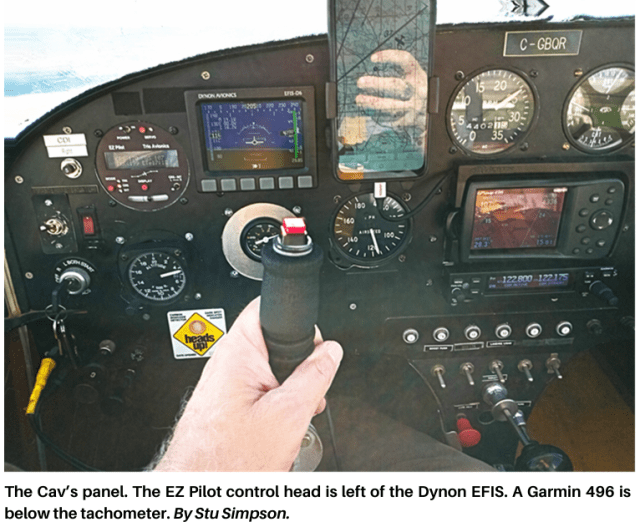
First, it must be connected to a host GPS. The Cav has a Garmin 496 that provides output nav and steering info via wired connection to the EZ Pilot. I can punch in a destination, or even a multi-point route, and once I’m in the air turn over navigation to the AP.
It can fly offset to the left or right of the Garmin’s course line. That’s useful if I’m traveling along a well used air route, perhaps between Three Hills and Red Deer. My AP will allow me to parallel that course line a mile or so to the right side of it, thus avoiding traffic tracking the magenta line from the opposite direction.
I can also intercept an existing course line. For example, let’s say I tell the Garmin I want to go from Red Deer to Kirkby Field, where I hangar east of Calgary. It draws a course line between the centres of each airport. If I take off on runway 29 at YQF, by the time I’m ready to turn left on course, I’m way to the west of the intended course line. But I can simply select the correct command on the EZ Pilot, and it’ll turn the Cav back to the southeast to intercept the established course line, and then turn the Cav onto the correct track to get back home. I only have to look after the altitude trim. This can also be useful if I get bumped off my course line for something like weather, traffic, or terrain.
Naturally, the other approach to the same problem would be to simply reach altitude, tell the GPS to go direct from my current position, and then activate the AP.
The EZ Pilot can also track a route that I enter into the GPS using as many waypoints as I want. I can take off, activate the AP to have it pick up the initial course and it’ll fly the Cav to all the remaining waypoints.
I can do things more simply, too. While cruising en route, I can have the AP maintain my GPS heading, which is different than a selected course line. There’s a small toggle switch on the control head that moves left and right. It changes my heading by one degree at a time, but if I hold the switch it moves through the heading numbers more quickly. I’ll use this occasionally when flying very loose formation with Bob Kirkby in his Cherokee on our longer trips. And it’s really useful if I need to dodge around weather ahead.
Naturally, I’ll eventually have to account for any deviations, but that’s where I can either go direct or simply switch over to the intercept mode and let the EZ Pilot look after the correction.
I love the fact that the EZ Pilot also has a terrific Emergency Course Reversal feature. If I come up against something where I need to turn around and run away, I simply press the MODE button for three seconds. As long as the AP is powered on and talking to the GPS, it’ll turn the Cav 175 degrees in the opposite direction. I don’t even need to be tracking a course line for this feature to work.
There are a number of autopilot systems out there specifically for homebuilts that are much cheaper than those for certified planes. A lot of them are 2-axis models that will also control altitude. And there’s nothing stopping you from putting in a system from a certified airplane. Well, nothing except your credit card limit.
Why even bother with an autopilot? Well, for me there are a bunch of advantages. First of all, it’s really cool to have such a device in the Cav. It’s just fun!
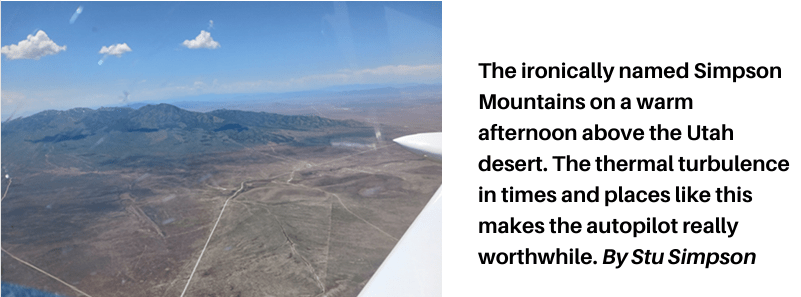
Beyond the cool factor, though, is how the AP really makes longer trips easier and more enjoyable. On hot summer afternoons with lots of turbulent thermal activity, the EZ Pilot just simplifies the flight.
If I have a course punched in, and the wind and thermals are kicking the Cav around, the AP takes all the work out of staying on course so I can look after speed and altitude. The automation makes the flight much less tiring. That becomes more important if I’m at higher, more fatiguing altitudes where I dehydrate faster, or on longer legs where I can’t drink a lot of water. And on days like that, every little bit of help, uh, helps.
Also, if I’m in or approaching marginal weather the AP looks after a bunch of the flying so I can concentrate on other problems such as course and diversion planning, and perhaps terrain or obstacle avoidance.
In September 2023, my wife and I flew the Cav to Memphis, TN. The first day of the trip in particular had marginal visibility in smoke over pretty featureless, thermally terrain. But by using the Cav’s EFIS, GPS’s and the EZ Pilot I was able to fly the trip safely and much more comfortably. My wife even recognized and commented on how valuable the AP was that day.
The last aspect is that it’s simply convenient. If I need to do something in the cockpit, such as remove a jacket, grab a snack, or mess with something else, it’s simple to just flip on the autopilot, manually trim the pitch and complete the task. Easy peezy. It’d be easier peezier, too, if I had altitude control, but I don’t really need that.
How often do I actually use the autopilot? Well, honestly not much in my local flying. I like hand flying the Cav. If I’m going to Lacombe for lunch, or out to Castlegar, BC, to see my folks, I’m unlikely to use the EZ Pilot. But if I get tired of dealing with the daytime thermals, sometimes I’ll punch in the destination and flip on the AP to take a bit of a breather. I won’t use it in formation flying, of course, unless there’s substantial separation, which probably then doesn’t even qualify as formation flying.
I once read an article listing ten things to make you a better pilot. Near the top of the list was the suggestion to use the autopilot as much as possible. The author suggested that it allowed the pilot to concentrate on other tasks to more successfully and safely complete the flight. So I decided to try it.
Turns out that’s BS. The more I used the AP in just day-to-day flying around southern Alberta, which comprises most of my air time, the less I enjoyed my plane. Regular autopilot use ended pretty quickly and I was back to hand flying about 95% of the time.
My autopilot isn’t something I strictly MUST have. But it’s something that really helps with the workload in situations like turbulence, long distances and tougher conditions. And in those cases, it’s a helping hand that’s really, really NICE to have!
 Calgary Recreational Flying Club YYC