

Think about your washing machine on spin cycle with a load of towels that are totally off balance. Now imagine if your plane was making the same sound as that washing machine vibrating itself across the floor.
Earlier this year I was able to purchase the Bishcaddy from Glenn Bishell. The Bishcaddy is a Bushcaddy L164. It’s similar to a Cessna 170 with 180HP and a constant speed prop. I bought it with the intent to upgrade it to a basic IFR flyer so I could build IFR PIC time. The Bishcaddy was desirable because it is a high wing with a lot of power and something that is easy for people to get in and out of.
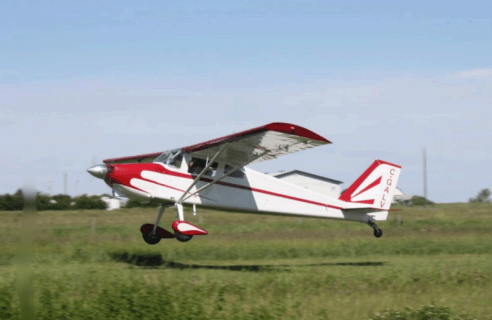
On September 6th, I departed early from Bishell’s and headed out to Three Hills to do some sightseeing. I picked up my dad at the Three Hills airport and we flew over the countryside to see who was combining that day and what else might be happening.
After seeing everything there was to see we landed back at Three Hills for gas and a burger and then I headed off back to Carstairs on my own to put the plane away.
It was a perfect day for flying and there was little if any wind. I had the plane trimmed out at 23″ and 2300 RPM which gave me 120mph hands off. I remember thinking to myself that I was really starting to like this plane. It handled well, was light on the controls and was going to be a nice stable plane for cross countries.
When I was about 5NM east of Bishell’s I started a descent out of 5500 by gently pushing the stick forward. The airspeed slowly came up to 140mph and then the plane started vibrating uncontrollably.
It took me several seconds before I could get ahold of something and get the throttle back, and then several more before I could get ahold of the stick which was moving wildly. I looked out my left window and could see the aileron moving stop to stop very fast. As I got the nose up and the plane slowed to 100mph the vibrations eased a bit and when I got to about 85, they stopped completely. I looked at the right wing to see if the aileron was still attached and that’s when I realized I couldn’t see anything past the wing strut, the wing had already bent up too far to see.
Now that the plane was slowed down, I started looking for places to put down. There was a lot of suitable farmland directly below me which helped me relax a little. I tried a couple of gentle turns to the left and right and the plane was flying OK, so I made the decision to continue to Bishell’s just a few miles away.
The landing was uneventful. I made a nice gentle turn onto final, leaving the flaps up, and made a near perfect landing.
I taxied up to the hangar and shut down, and then got out of the plane to check out the wings more closely. The first thing I noticed was everything was still attached so I wasn’t going to have to drive around looking for airplane parts in a farmer’s field somewhere. The wings did look just a little bit off though.
The thing that really caught my attention was the leading edges of both wings were crumpled just inside of the strut attach point. The bottom skin looked smooth, but the top skin was crushed in all along the top from the front of the wing to the back. This means both the front and rear spars are bent and both wings will have to be completely rebuilt.
It was a perfect day for flying and there was little if any wind. I had the plane trimmed out at 23″ and 2300 RPM which gave me 120mph hands off. I remember thinking to myself that I was really starting to like this plane. It handled well, was light on the controls and was going to be a nice stable plane for cross countries.
Several people who know the Bushcaddy are quick to point out that this same failure has occurred in other planes. After some further analysis this incident has some differences.
The first difference is the Bishcaddy has almost 800 hours of trouble-free flying and that suggests the plane was well built and nothing overlooked.
Of the previous planes that had failures, there were also weak points at the aileron bellcranks and a reinforcement was implemented on later planes.
During preflight on the Bishcaddy the controls moved correctly, and nothing appeared loose. After landing, the ailerons controls are all still attached but with lots of slack. That’s not unexpected given the amount of movement and vibration that occurred. This incident also occurred in smooth air and not at high speed so there wasn’t any obvious trigger for this to happen.
One of the upgrades I had done was to install a Garmin G5 EFIS which logs a lot of data about the flight. One of the first things I did when I got home was to download the logs and look at what happened.
The data confirmed what I remembered. The plane never exceeded 140mph until the flutter started and was recovered at 150mph, still below redline. The G meter only recorded one event at 1.2 G’s, everything else was in the normal range. So, this confirms it wasn’t an overspeed or overstress situation.
For now, I won’t know any more about the cause until the wings are disassembled. My insurance company has asked me to get estimates and I’m waiting for those to determine the next steps.
In any case I’m fortunate that this ended up with nobody hurt and no property damage. The plane is just metal and can be fixed or turned into a lawn ornament.
 Calgary Recreational Flying Club YYC