

Something I’ve always wanted to do was to be able to fly a multi-engined airplane. Now that I’m planning to make flying a career choice I have a good reason to spend the money on a multi rating. This would also let me get a multi IFR or Group 1 IFR rating, something that’s very important if you’re looking to pursue a commercial flying career.
On paper, getting the rating doesn’t look too hard. There’s no minimum number of hours required. You simply need to do the required flight test exercises with an instructor, have them sign a recommendation for a flight test, and then pass the flight test.
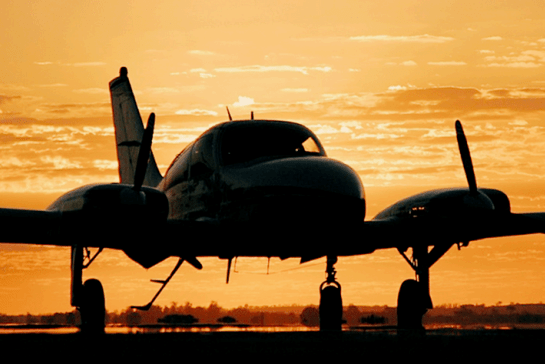
The key difference between the flight test exercises for a PPL and for a multi is that the Piper Seneca II that I trained in is about three times heavier, has three times more power, and has many more buttons and levers than a typical 172. Many of the planes we fly cruise at about 110 KTS. The Seneca that I used for training flies the downwind leg at 110 KTS. As you can imagine, things happen a bit quicker than I’m used to in my CH250.
The flight test exercises are a bit simpler than the PPL as there are fewer items to cover. The difficulty is developing the muscle memory to do the exercises without following a checklist.
The first exercises were circuits. Since these are turbocharged engines you don’t firewall the throttle, you power up to about 25 inches of manifold pressure, and then slowly advance to 35 inches while matching engine power.
This means making sure that both engines are putting out the same amount of power to avoid asymmetric thrust at a crucial phase of flight. It’s very easy to over-boost the engines and there’s very little throttle movement required to go from 25 to 35 inches.
By the time you’ve got the engines matched you’ll be at about 60 KTS and you rotate at 70. The plane starts to climb pretty steeply and almost immediately you’re at gear up speed of 85 KTS and setting up for a climb at 90. When you reach 400 feet, which comes up pretty quickly, you put the nose down to climb at 110 KTS, power back to 31 inches, props to 2450 rpm, and start the turn into the circuit. By now you’ll be at circuit height so it’s power back to 20 inches, complete the climb checklist, call the tower, and start the descent checklist.
With the checklist done you’ll have already turned onto the downwind leg so you pull in flaps 1, and slow to 110. As you pass abeam the runway threshold, select gear down and slow to 100. When the gear is down it’s time to turn onto the base leg, pull in flaps 2, do a GUMPS check (Gas, Undercarriage, Mixture, Pitch, Switches) and bring props and mixtures full forward and get ready for final.
As you turn final, pull in flaps 3, slow to 90 KTS, do another GUMPS check and keep stable until you cross the runway threshold. Touchdown, flaps up, and then on the brakes. Unlike other planes that I’ve flown, the Seneca has fantastic brakes and you can slow down very quickly with the flaps up. If you leave them down the tires make a lot of noise as you drag them down the runway leaving a long trail of black rubber behind you.
The first air exercise is recovering from a failed engine in cruise. For this exercise you identify the failed engine, which is crucial. Then, bring power up on the good engine, get the airplane trimmed while holding course and altitude, and then do the failed engine checklist. Once that’s complete and you confirm the dead engine can’t be restarted, you feather the dead engine. That’s why it’s critical to correctly identify the dead engine; you don’t want to feather the prop on the good one.
The second exercise is a 45 degree turn for two course reversals. It is a relatively simple exercise but with a lot of inertia and cruising at 140 kts you have to be very diligent with pitch. If the plane starts to descend or climb you need to catch it right away or you’ll quickly be a few hundred feet away from where you want to be.
Next up is clean and dirty stalls. The goal is to identify the stall and then recover. The trick is to not over-boost the engines in the recovery, while still making sure to add enough power to recover effectively.
The dirty stall is more complicated because you need to clean up the airplane as you recover, and do it quickly.
Following this is the engine failure on overshoot. This exercise is practiced in the air as it is a bit too dangerous to practice on an actual approach. The goal is to get the airplane fully in the landing configuration at 7500 feet and then start a descent to landing at 90 KTS. At 7200 feet the instructor/examiner gives the command to go around at which point you go to full power and start a climb. The steps are flaps up and gear up without exceeding the gear up speed. Immediately when you start this recovery one engine will be failed so you need to identify and secure the dead engine as part of the recovery. The key requirements are to stay above 7000 feet which is simulated ground, and to establish a climb back to 7500 feet. My favorite mistake is to forget to feather the dead engine while I’m also trying to get the gear up and flaps up and not overboost the good engine.
The final exercise is to head back to the airport and land the plane. It’s at this point that you’ll be given a simulated emergency and you need to identify the correct steps to take, all of which will eventually involve shutting down one engine intentionally. You then complete the approach on one engine while flying a bit faster than usual. The difficulty is that the plane is very sluggish when it’s slow and flying on just one engine. And then, when you pull the power back to flare, the opposite rudder you’ve been flying with starts turning the plane unexpectedly.
After all this, it’s just a matter of taxiing the plane back, doing the checklists, and parking. If everything went as planned you’ll have a new rating in your booklet and an opportunity to finish your Multi IFR training.
 Calgary Recreational Flying Club YYC