

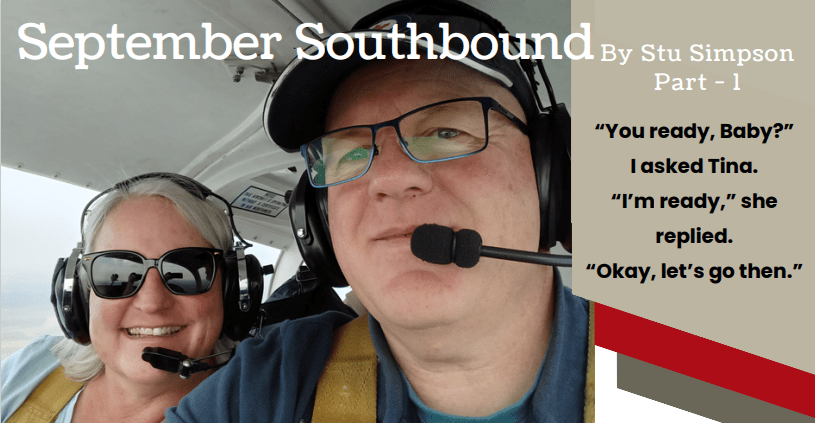
I pushed the Cavalier’s throttle in, released the brakes, and we were off. Not very quickly, mind you, but we were rolling. With my wife beside me, and our luggage in the cargo bay, the Cav’s usual sprightly acceleration was instead somewhat sluggish along Kirkby’s grass runway. It took a lot longer to get the tail up, too.
But, as I knew it would – and as it always has – the Cav got us airborne off runway 16 with plenty of room to spare. Gary Abel waved to us as we went by. I kept the nose lower than usual to build airspeed, and once through 90 mph I banked into a gentle climbing turn to the southeast and pulled up the flaps. We were on our way.
Southbound
Tina and I had talked for quite a while about a big trip together in the Cav, but a variety of factors prevented us from pulling the trigger on it. Now, though, a few days after the Labour Day weekend, we were making it happen.
I’ve long wanted to visit Memphis, TN. I didn’t know too much about the city before we departed, but there were some things I definitely wanted to see. Elvis Presley’s Graceland was one, and the Civil Rights Museum was the other. Tina wanted to visit Beale Street due to its musical history. We had no idea where we’d go from Memphis, but that’s a nice freedom to have.
We delayed our departure from Kirkby’s by a day due to heavy smoke in the Calgary area, but the forecast claimed the smoke wouldn’t be quite as bad this day. As we climbed up to 4500’ I was glad we waited. Visibility was about eight or ten miles. Not the usual unlimited vis we’re normally used to, but much better than the couple of miles the previous day.
We had no clouds and only a light wind from the southwest which allowed us 125 knots over the ground. Our first stop would be Swift Current for a top up with gas, then on to Williston, ND, to clear customs.
Shortly after we passed Lake Newell south of Brooks, visibility started to deteriorate substantially. It dropped to about four miles, as measured by the section lines of the farmland below. I wondered how long it would last.
Turns out it didn’t last much longer at all. It soon reduced to only three miles. The bad visibility persisted along the southern edge of the Suffield Range and all the way to Swift Current. We had a long way to go this day, ideally all the way to Bismarck, ND. How long would the smoke haunt us, and how bad would it get?
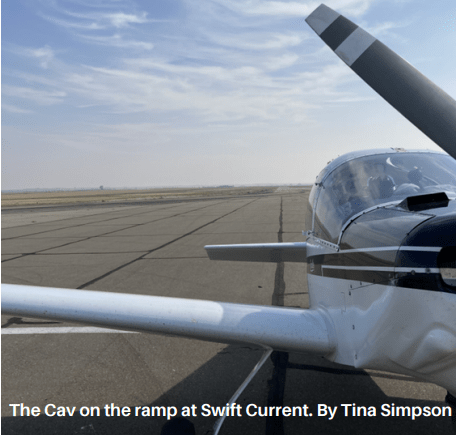
We fueled at Swift Current and I called to file a transborder flight plan. I asked for a trans-border squawk code even though the preferred practice is to get one in the air just before crossing. Doing that has been troublesome in the past. And on this day, due to the smoke, there was a really good chance I wouldn’t be able to get high enough to radio for one along the route.
Fortunately, I was able to negotiate with the flight service specialist to get a code for the whole leg from Swift Current to Williston. He understood my plight and quickly got me some numbers. A big relief, that.
As we put Swift Current to our rudder the visibility improved to five or six miles and I climbed to 4,500’. Within minutes I was starting to lose sight of the ground. I told Tina we had to descend to 3,500’. It was disappointing that I couldn’t show her the landscape. She was concerned about the poor visibility and the subsequent possibility of a mid-air collision. I assured her there were unlikely to be any other planes up on a day like this and how the Cav’s ADS-B can give us a huge safety advantage.
It was getting bumpy, too. I was using my autopilot, which is only single axis, but it will track a GPS course. Quite bluntly, if I didn’t have it, I would have turned us around. It was one of those situations where I questioned whether we should continue. I looked at it from a risk management perspective. What was the risk? If the autopilot or EFIS failed, could I still fly safely? The answer was yes. I could still see the ground, the terrain along our route is flat and familiar, we had 3 miles visibility, no clouds, and no impending weather or darkness.
I also had a total of three GPS’s on board, two of which were then in use. Everything was working well, and if there was a sudden electrical power loss, I could still get us easily and safely to an airport where we could land using the back-up battery power in the EFIS and the GPS’s. We also had lots of gas.
I decided to continue, albeit with regular risk assessments as we proceeded. That basically consisted of judging the visibility in the smoke versus the Cav’s operational performance.
We crossed the border and Tina peered down to see if she could spot anything more telling than the simple fence line that exists there. She couldn’t. We were now into the northeast corner of Montana.
About half an hour from Williston, it hit me that I was flying primarily – and quite comfortably – mostly using the Cav’s instruments. I looked out the window occasionally, but mostly I concentrated on what the Dynon EFIS, the nav display, and the autopilot were telling me.
Tina made an interesting comment then. “I can see why you use the autopilot,” she said. “Flying in this without it would be absolutely exhausting!” She was right.
We landed at Williston, cleared customs and swapped sim cards in our phones. Since our cell provider charges outrageous US roaming rates, we purchased US sim cards for $30.00 each. That gave us US telephone numbers, unlimited calling and texting all over North America, and a bucketful of data usage. It wound up saving us about $200.00 over the course of the trip and we can use them again in the future.
Then we hit a frustrating and unexpected delay. The US flight service contractor, Leidos, has made it nearly impossible to talk by phone with a briefer anymore. This was a vast dfifference from the trip Bob Kirkby, Carl Forman and I made to the US earlier in the summer.
Basically, you now have to set up an account based on your cell number and do all your filing and closing online. It’s absolutely infuriating and I wonder how many lives it’s going to cost as people avoid filing flight plans and getting briefings by voice over the phone.
After many minutes on hold, I finally got to speak to a briefer to file for the last two legs of the day. That evening, though, I grudgingly built an account, which mostly worked well for the remainder of the trip.
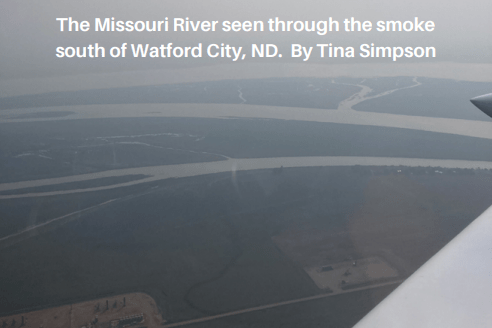
I had no intention of paying Williston’s fuel prices, so we headed out for Watford City, 25 miles southeast and with lots cheaper gas.
After that, there was only 135 miles to go. We were making good time, but we were knackered.
We’d lost an hour, too, due to that part of the US being on Central Standard Time, not Central Daylight Time. At least Bismarck was only a little more than an hour’s flying time from Williston, and less from Watford City.
I was very glad to set down on Bismarck’s runway and taxi to the ramp. I creaked and groaned my way stiffly out of the cockpit to tie the Cav down for the night.
Executive Air’s staff treated us like royalty, like nearly every other US FBO does. I was well used to it, but Tina was simply blown away by the experience. They even loaned us a crew car for the night.
On the way to our hotel we passed a sign advertising a joint-pain relief clinic. Tina said I should ask if they have a drive-through. Funny girl, that wife of mine.
Day 2
We left Bismarck behind a TBM 750 turboprop with hope the sky would be clearer. It was for about five miles, then frustratingly socked back in to about three or four miles visibility.
It was, however, a nice smooth morning with no bumps and a light tailwind. Things sure could have been worse. We slipped unseen past Aberdeen, SD, and I thought of the times that Bob and Carl and I have stayed there while flying to destinations further east.
While filling up at Madison, SD, we were approached by a fellow in beat up coveralls who was totally smitten with the Cav. He was very excited to see it and asked all sorts of questions. As many Cavalier admirers do, he compared the vertical fin to that of a Maule, and was totally surprised to learn the Cav is made of wood. He was a wonderful fellow to chat with and a former professional pilot. He said he’d flown a Piper Aerostar around the world many moons ago. I could see him wistfully recalling his past flying adventures as Tina and I were living out ours. When we taxied out past his hangar he saluted us and gave us a little prayer bow. We waved back, smiling happily.
We finally outran the smoke about half an hour north of Des Moines, IA, our destination for the day. It’s amazing it extended so far south and east. We could finally see more of the farms beneath us, their various crops, and other land uses. Combines and other equipment worked busily beneath us and we pondered what crops they might be harvesting.
I studied the airport info and com procedures for Des Moines from the Cav’s nav display and got myself comfortable with the upcoming approach.
DSM’s approach controller couldn’t see me on radar when I made my initial call. I recycled the transponder once, with no joy, then squawked ident and he found me. I began the descent about fifteen miles out. Closer in, we switched to tower who soon cleared us to the left base for runway 05 as a business jet landed there ahead of us. The controller cleared us to land, asked me to keep it fast and tight due to a Cherokee inbound from the south.
I kept my speed up with only one notch of flaps, carved around to short final maybe a third of a mile back, forward slipped a bit, and bled the last 20 mph of speed coming over the threshold. Runway 05 at Des Moines has a nice little upslope to it, which helped a bit, too.
“Experimental Bravo Quebec Romeo, exit right on Papa 4, give way to the taxiing Airbus. Then turn left on Papa 4 and a right turn to the Signature ramp.”
I read back the instructions, waited as the A319 rolled by, waited a few more seconds to avoid the jet exhaust, then taxied to the ramp. Once more we had unbelievable FBO service, this time from Signature Aviation.
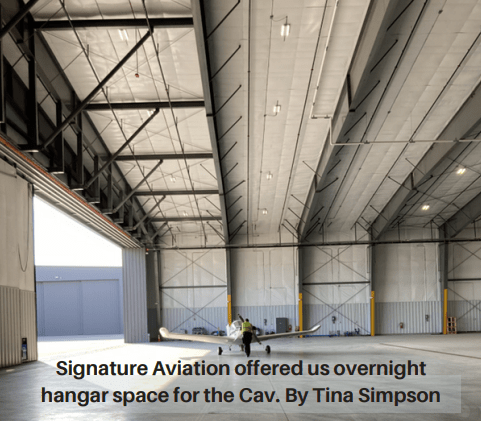
They even offered to house the Cav in their cavernous hangar – free of charge – because they didn’t have any available tie-downs.
Then they drove us to the airport terminal so we could rent a car, and returned it to the agency for us the next morning. I love flying in the US!
Part-2 coming next month. Stay tuned.
 Calgary Recreational Flying Club YYC