
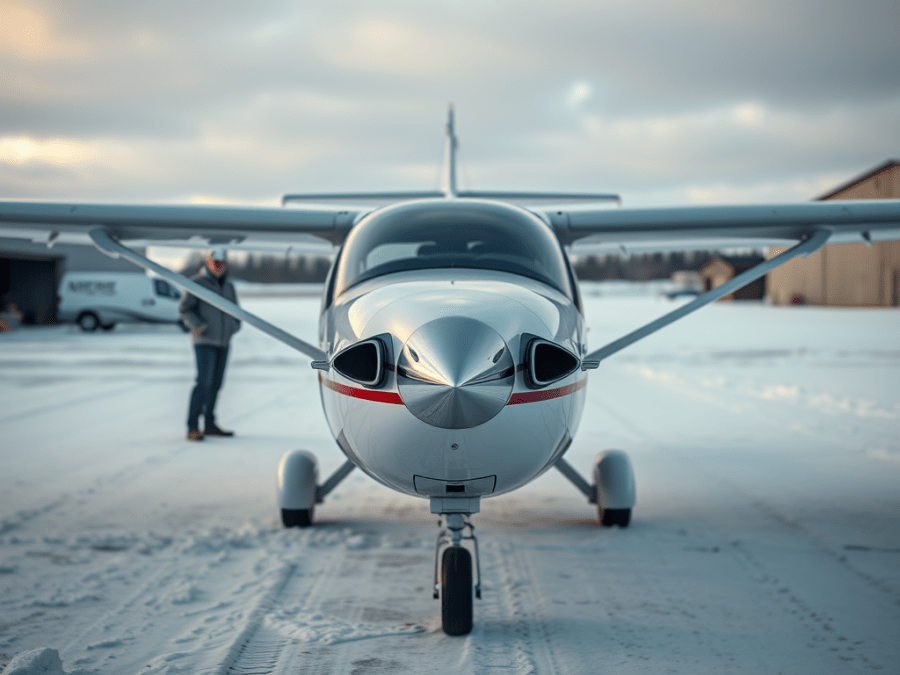
This is the story of flying C-IKIM, a Zenair CH-750 advanced ultralight airplane, from Cobden, Ontario to Calgary. This is the plane that I bought from its builder, Bob McDonald, just the week before, with the help of my friend Stu Simpson. Claude Roy from Ottawa, ON, agreed to help me ferry the plane to Calgary.
The flight was an opportunity to fly the plane and learn from Claude Roy on how to overcome the challenges that we do encounter during such an adventure. The major challenge was the weather: wind, rain, snow and cold, as it was nearly Canadian winter. Another challenge was the type of aircraft; an advanced ultralight which limits the flying to only the daytime and in VFR conditions. The third challenge was the time window that we, Claude and I, had to fly the plane. We both made the period from November 20 to 29 open on our schedules to move the plane from Cobden, ON, to Indus, AB. If we missed that time window, other options would be to find another ferry pilot to help move the plane or to wait until April of 2014 before ferrying the plane. Bob was very gracious in offering me his hangar in Cobden for some long-term storage during the winter if needed.
Day Zero (Nov. 19):
I flew from Calgary via WestJet to Ottawa, leaving Calgary at 10:30. Snow was already starting in Calgary and WestJet 737 went through the de-icing process. I arrived at the Ottawa International Airport at 16:05. Claude was waiting in Ottawa, and he drove me from the airport to the Comfort Inn in Kanata, at the west end of the city.
We then went to have dinner with Claude’s wife Joan. She is a pilot, and she flew a Champion taildragger on floats for many years. She has great experience, and she is a very sweet and lovely woman.
After dinner at the Montana Restaurant in Kanata, Claude drove me to his house, a lovely acreage house just outside Kanata. Claude has a share in a Flight Design CT that he keeps at the Carp Airport, a few miles from his home. He also has a Quad City Challenger that he flies from an airstrip in Carleton Place, ON, not far from where he lives.
We sent our wife’s e-mail addresses to Bob McDonald to be added to Bob’s SPOT mailing list. We called Bob and agreed to meet him at the Bruce McPhail Memorial Airport, in Cobden, ON, the next morning at 8:00 AM with Joan and Claude picking me up at the hotel at 7:00 AM.
Our plan for the next day was to fly two legs and head towards Sault Ste. Marie. If the weather was good and we arrive in Sault Ste. Marie early, then we would head to Wawa and stay there overnight.
Day one (Nov. 20):
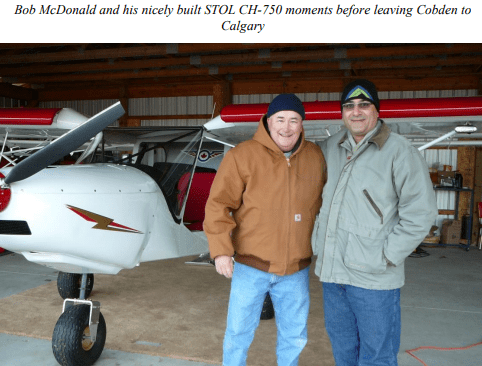
Joan drove Claude and me to Cobden Airport. Bob was there and he had made the plane ready to fly. It was fueled up, oil and filter changed, extra oil in the back of the seats, the SPOT device ready and transmitting.
We loaded up and shook hands with Bob. He provided the last operational instructions, and we started the engine warming process. We pushed a few buttons to check the Dynon D180 Electronic Flight Information System (EFIS), the Garmin Mode C Transponder and the ICom radio. We were not entirely happy with the radio’s volume level, though we had Claude’s hand-held ICom radio as a backup.
Bob watched his nicely built machine taxiing to Runway 30, heading west. Once we lined up on the grass runway, Claude added power and the plane accelerated, jumped from the runway and there we were, flying with the nose up, much higher than what I am used to in the Cessna-172 and Merlin GT, aiming for Sudbury.
The day was sunny, the wind calm and the temperature was around -7 °C. What a beautiful day to start the venture! We had 3,000 kms to cross over the provinces of Ontario, Manitoba, Saskatchewan and Alberta. The plane is capable of cruising at 93 mph.
We flew west-northwest, parallel to Ottawa River, and the cities rolled out one after the other. We stayed about 2,000’ AGL, with Claude in the left seat and I performing the required navigation in the right seat, while taking pictures and uploading them on Facebook! What a great feeling it is when you are in your own plane flying over the gorgeous Canadian nature.
The first city’s airport we called was Pembroke and Claude transmitted about 5 miles east of the Airport, transiting through and heading towards Sudbury. A local operator asked, “Tell me more about this plane?” Claude said it is an advanced ultralight and we were ferrying the plane to Calgary. The operator knew about the plane and said that he knew that the plane was for sale and that it would sell quickly. He wished us a safe flight and we continued.
We noticed that the radio was not operating well and it was difficult to hear the others. This radio malfunction, or so we thought, would possibly bite us at the larger airports.
We flew over the cities of Petawawa, Chalk River, Deep River, the Rolph Airport and by Mattawa and its airport. Both the Ottawa and the Mattawa Rivers connect in downtown Mattawa. We flew around the Chalk River nuclear plant’s restricted area and continued heading towards North Bay, on our way to Sudbury.
Nearing North Bay, we were not able to get the ATIS nor hear the operator due to some radio malfunction. We went around the south of North Bay and then headed west on the outskirt of the controlled zone. A Cessna 172 was flying southwest and above us heading southeast and preparing to land in North Bay airport. We passed over Lake Nipissing and then turned northwest, heading towards Sturgeon Falls and Sudbury. Claude tried his handheld radio with no success. He was hearing the tower but the tower, after few calls, did not respond to him. He switched back to the airplane radio. At that time, we were already southwest and passing the airport when we started hearing the tower.
After almost three hours from take-off, we made it to Sudbury. We joined the left downwind pattern after listening to Sudbury ATIS, contacting the tower and getting the landing clearance. This time the radio worked properly. Upon landing and while we were taxing to the fueling station, the tower operator asked, “What about this nice machine?” Claude replied, “It is a Zenair machine that we are ferrying to Calgary”! After a short pause, the tower operator replied “not today”
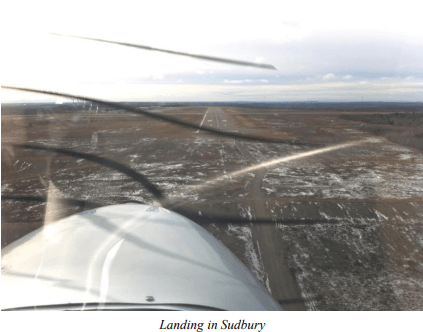
We landed in Sudbury and fueled up in a quick turnaround. After refueling at Shell service station, we took off from Sudbury around 12:30, aiming towards Sault Ste. Marie. I had switched to the left seat, so I taxied to Runway 22 and found that C-IKIM is much easier than a Cessna 172. When Claude returned the control to me immediately after take-off, I continued flying the plane from that point on under his supervision. We crossed over the City of Espanola and Spanish, flying north and parallel to the Spanish River. We flew over Blind River, Iron Bridge and approached Sault Ste. Marie from the east. Upon arriving to Sault Ste. Marie from the northeast, again we were unable to hear their ATIS or the tower. We checked the fuel, and found we had plenty of it, thanks for Bob’s 30-gallon tank installation. Based on our physical condition, radio issues and fuel availability, we decided to continue and fly north to Wawa.
From Sault Ste. Marie, we crossed over mountains ranging up to 2,100’. The wind picked up, varying from a very strong crosswind to a tail wind. I encountered my first strong crosswind flying experience while I was flying over the series of bays: Batchawana, Pancake, Hubbard, Mica, Alona and Agawa. The plane was strong, and it properly handled the wind. We regularly indicated cruising airspeed at 93 mph, but we were showing 101 knots groundspeed. The GPS ground speed even went to 130 knots for a short time.
Half-hour from Wawa, I was flying almost diagonally due to crabbing into the wind to avoid drifting. We always kept Highway 17 to our left and followed the road. We passed Lake Superior Provincial Park and 20 minutes from Wawa, I was flying at 2,400ft ASL and the peaks around us were 2,200 feet. The wind was pushing me towards the peaks as I was trying to turn right and pass the mountain from the east as the road was turning east in the mountains. I ceased the trial and turned west over the water and passed the mountain from the left.
Claude made a comment after 5 minutes flying over the water, “If the engine quits, we are dead”. Very true comment and a big lesson, I rushed turning the plane towards the shore and telling myself “Well, I sure will be dead because I don’t know how to swim”. When I made that comment to Claude, he replied we would both be dead in about 30 seconds, due to the water’s freezing temperature. The idea then was that we never attempt to fly over the water more than from a gliding distance to the shore. In this case, the shore was a mountain ridge and the road was going on the other side of the mountain.
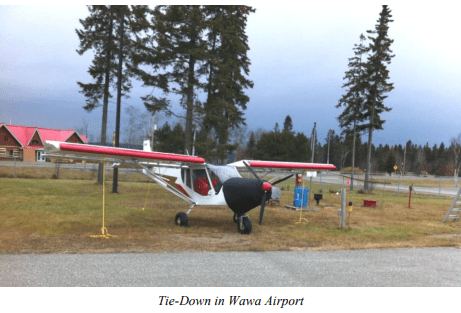
Nevertheless, we returned back to flying over the land and we landed in Wawa against a strong head wind. We fueled, covered and tied-down the airplane before we called a taxi to take us to the Wawa Motor Inn; a nice and cozy place to have a warm shower and stay there overnight, after 6.7 hours of engine time.
Day two Nov. 21:
Weather was not cooperative; we had low ceilings over Wawa and Thunder Bay had a zero degree spread between temperature and the dew point. We walked to the airport, talked to other pilots, walked the town and spent time reading and relaxing. There was no rush as we had plenty of time and the goal was to land the plane safely in Indus, Calgary.
Our plan for the next day was to fly to Thunder Bay via Marathon. I was thinking aloud “if the weather is good and we arrive in Thunder Bay early, then we will head to Kenora”. I was always thinking two steps ahead but Claude was telling me focus on our next step, not to over plan.
Day three Nov. 22:
We were watching the weather in Wawa, Marathon and Thunder Bay. The weather in Wawa was showing a short opening from a low ceiling and snow after 10:00, the Thunder Bay forecast was showing acceptable ceiling but windy between 13:00 and 15:00, while Marathon weather was predicted to be IFR in the afternoon. We recognized an opening in the Marathon weather forecast until around noontime with 30% potential precipitation. The decision was to go.
We arrived at the airport before 10 AM, prepared the plane, loaded our stuff, started the engine and I did my first take off in the plane from Runway 4. We headed north and followed Highway 17.
The sky was gorgeous, but we were feeling the cold. Ice on the outside the cockpit window didn’t completely dissipate until after 45 minutes of flying. We passed over the city of White River and then north of the Hemlo Mine blasting area at 3,600’ ASL.
Within 1:30 from takeoff, we reached the City of Marathon and passed east and north of the Marathon Airport.
We were still having radio problems in Marathon. Arriving at Peninsula Bay, the clouds became overcast, so I descended under the clouds to maintain VFR. Before reaching Coldwell, the weather deteriorated rapidly, and I descended to 700’ AGL above the road and kept flying “IFR” (I Follow Roads). The occasional snow and low flying between the hills, watching for antennas and getting bounced around in turbulence gave me another unforgettable experience. I was thinking, “When will Claude decide to turn and go back?”, he never did. Later when I told Claude about my thinking he replied, “He never thought about turning back to Wawa”.
We were passing gorgeous bays one after another: Ashburton, Jackfish, Terrace, Collingwood, Pays Plat, Gravel, Mountain, Cypress and Kama Bay. A few times, I passed the bays south of the shore and re-connected with the road on the other side of the high hills because of the high mountains and low ceilings.
We passed Nipigon and turned south heading towards Thunder Bay with a head wind around 20 knots. Once we passed Black Bay and within a half-hour flying time from Thunder Bay, we saw the Eldorado Airstrip and made a note to use it in case the radio issues would not allow us to land in Thunder Bay. Claude pulled his handheld ICom radio and tried to get the Thunder Bay ATIS. The plane radio was dead silent and Claude connected with Thunder Bay tower via his handheld device. He took control and performed a great landing after a sharp-angled, right base approach to Runway 25. Upon landing, I took care of the braking (the brakes are only on the left side of the airplane) and Claude requested exiting onto taxiway Charlie. Tower responded “negative” and asked us to backtrack onto Runway 25! We turned 180 degrees, on Runway 25, and we saw a Cessna on short final and didn’t know its intention, landing or not! Claude informed the tower that we would taxi on the grass. “We have big tires” he said, and we simply taxied on the grass. The Cessna did not make a landing. The tower informed us that they didn’t allow us taxing onto Charlie because a military C130 Hercules was performing a full engine run up on the ramp. If we were proceeding on taxiway Charlie, then we were exposing ourselves and our light plane to the thrust of the C-130’s four massive engines.
After switching to ground frequency, the controller asked whether we were confused when we taxied onto the grass. Claude explained that no, we were not confused, but unsure about the Cessna pilot’s intentions and we just freed up the runway by using the grass to taxi back to the ramp.
The wind was strong, we fueled up, checked the oil, tied down the plane and we headed for a hotel. The servicing crews at the Shell terminal were very kind to book us in a nearby hotel and called the hotel shuttle for us.
Our plan for the next day was to fly to Kenora via Dryden and if the daylight and the weather permitted, we will fly to Winnipeg. Again, I was over planning, while Claude was thinking in the next step and how we would make it to Kenora.
Day four Nov. 23:
The morning didn’t start as planned! Thunder Bay had a really cold night and the temperature was -23° C at 7:30 AM. We brushed the snow from the wings, checked the fuel and packed our stuff for departure. The engine would not start!
It was too cold for the small battery to start the engine. The solution was either boosting the battery or getting a temporary heated hangar. The Shell terminal staff helped us to find a temporary hangar with Bearskin Airlines. We walked the plane for 200 yards and placed it in the heated hanger. We returned back to the pilot room at the Shell terminal and waited for about two hours.
At 11:00, we pulled the plane out of the hangar and it started immediately. Both Shell terminal and Bearskin Airlines staff were very friendly and helpful in getting us flying from Thunder Bay. The warm-up time was about 30 minutes though.
We took off on Runway 30, on a straight out 308-degree heading with the wind at 15 gusting 25 knots. It was a very windy day and I was challenging my limits with lots of wind flying experience. The radio worked very well that day. It seems the radio loves the cold weather!
After a half-hour flying from Thunder Bay, low ceilings started again with patches of snow. The snow continued pretty much until after Dryden. We passed Ignace and paid special attention to the antennas scattered left and right of Highway 17. In order not to enter the Dryden control zone, we passed south of the controlled zone over Wabigoon Lake and we rejoined the road on the west side of Dryden.
The outside air temperature was -21° C. The cockpit temperature was below zero for all the day’s flying time. I thought at one point: “If I touch my nose, it will break!” The cockpit heater was not designed to sustain such a low temperature. The engine oil temperature was also cold during the flight, most of the time it was around 175° F and the front cylinder head temperature was between 198° and 200° F (in the yellow zone of the indicator).
During that time, I did lots of dodging beneath the clouds and tried different techniques with the plane. It is the ideal time to discover my new machine.
We arrived at Kenora about 3:30 PM and landed on Runway 26. I had a high approach, still thinking I was flying in a C172, which you put the nose down and sustain 65 mph. This plane is different, and the nose should be kept up to reduce and sustain 65 mph and you control the altitude by power. Claude took control on final and did a successful and smooth landing. We looked for a heated hangar, but we had no success. We fueled the plane with 85 litters of 100LL Avgas. We parked the plane in front of the Shell terminal, tied down the wings and tail and headed to a downtown hotel.
The Kenora weather forecast for the next day was calling for snow showers during the morning, windy in Winnipeg for the afternoon and good weather in Brandon, MB, about 220 nm from Kenora. We decided to look at the weather in the morning, the review our plan and call it at that time.
Day five Nov. 24:
We were stranded in Kenora! We walked downtown in the morning, with blowing snow, very windy and cold weather. Then we spent the rest of the day in the hotel, feeling cozy and warm. Our plan for the next day was to fly to Brandon via Winnipeg.
Day six Nov. 25:
We arrived at the airport about 7:45 AM with a low ceiling of 800 feet, snow and wind from the northwest at 15 gusting 25 knots… not VFR conditions. We waited in the Shell terminal until noon when the ceiling improved, but the wind and blowing snow remained high until our takeoff.
We decided to go because the Steinbach and Southport (Portage La Prairie, MB) weather forecast was better than Kenora and because Kenora was expecting more snow for tomorrow.
The flight was bumpy, but Claude did a great job in taking off diagonally from Runway 26 into the wind, and then I took control. We were airborne at 12:50 hrs. The weather over Highway 17 was not much better than the Kenora weather, with occasional patches of snow and low visibility. The wind was another factor with our ground speed dropping at times to 38 mph. The radio was working very well today. When approaching Winnipeg, I noticed that the IAS had dropped to 45-55 mph, which indicated that the pilot tube must be plugged with ice. We visually confirmed that after landing in Southport.
The wind was from 300-320 degrees and I was very happy when the road turned south, because I was gaining ground speed the nose pointed away from the NW winds.
Before reaching Winnipeg and entering the Winnipeg Terminal Control Area (TCA), we headed southwest to the Steinbach Airfield, southeast of Winnipeg. The ground became flat, and I utilized the range roads for my navigation benefit. After passing the Winnipeg TCA to the south, we headed northwest towards Southport. There was not enough daylight left to proceed to Brandon, therefore we decided to land at the Southport Airport. Before reaching Southport, we encountered another patch of drifting snow, close to a whiteout condition. Claude took control of the airplane and descended quickly to stay visual with the horizon again.
We landed in Southport at about 15:30, fueled the plane and paid for one night in a heated hangar so we could get up early in the morning, fly early and make some progress.
The folks at Allied Wings in Southport were very helpful and a guy by the name Ray drove us to our hotel. The total flying time was about 3:40 hours and the ground progress we made that day was 160 NM. But the major progress was to leave the bad weather behind and carry on towards Calgary in much better weather from that point on.
Our plan for the following day was to fly via to Moose Jaw or Swift Current.
Day 7, Nov. 26:
It was one of the best flying days we encountered; windy but not bumpy with the ground speed between 58 and 93 mph, most of the time above 70 mph. We departed Southport, following a squadron of Grob military trainers taking off the airport for their daily training routines. Before leaving the hangar, the military instructors and some trainees assembled around my airplane, wondering how this mosquito shape machine could fly. Once they looked inside the cockpit with the Dynon D180 digital screen, the dash-mounted Bendix King GPS, the Garmin Mode C transponder and ICom radio, they knew the machine was well equipped.
We took off Southport and turned right to the north, according to the tower instructions. We leveled at 2,500’ ASL, cleared the control zone to the north and then turned west, heading towards Brandon, MB.
From Southport, we reached Brandon, flew towards Andrew Field in Virden, MB, where we estimated our fuel. To be on the safe side, we decided to land at the next airport, Marshall McLeod Field in Moosomin, SK, for refueling. The field includes a long gravel runway and there is a flying club shack on the field, a few hangars, a house and few private fuel tanks.
We checked the flying club shack, and a woman arrived, asking what kind of airplane we were flying! Claude explained to her what we were doing, and she advised us how to refuel. It was simple: fill your tanks and pay $2.0 per liter of 100 LL Avgas by putting the money in that small box on the table. We fueled the plane; paid the dues, signed the guest book and we took off from the field.
This day was the day of navigation; we actually navigated our way toward Swift Current via north of Regina area, north of Moose Jaw military training field and then landed around 16:00 in Swift Current municipal airport. The wind was gusting to 25 kts and we had a very crosswind landing.
We taxied to the self-service fueling station and filled the plane. We walked toward one of the hangars and met Duke Barker, a colorful man in his late 70’s. He helped us out to plug in our aircraft block heater. Duke also drove us to the city and we enjoyed our time with him. He owns two Mooneys and he was thinking about buying an ultralight.
Day 8, Nov. 27:
We arrived at the Swift Current Airport early in the morning and the service door was locked. We didn’t have the lock combination to enter the airport. Luckily, there was a twin-engine Piper Navajo unloading some oilfield workers, and they had one of the doors open for that purpose. We told them that we had our plane in there and we needed to enter to get to our plane. We entered the airport before sunrise, and we walked the taxiway to our airplane with three pieces of luggage each. It was windy, 300 at 20 knots. We arrived at the plane, and we saw, as expected, the wings covered with ice. We waited for our friends from Craft Aviation to arrive, which they did at 8 AM. It was still dark, and we helped them pulling a few planes in and out of their hangar, first an agriculture spray plane and then a beautiful Citabria and then we put in a turboprop version of the Piper Malibu called the Piper Meridian.
We borrowed big brushes and started the snow removal work. A fellow named Larry, the owner of the Piper Meridian, gave us a snow removal liquid spray apparatus which helped removing the snow from behind the leading edge slats. The snow cleaning took us about 40 minutes. We thanked Edward from Craft Aviation for his kindness, unplugged our block heater, untied the plane, pulled it onto the taxiway and started the engine warm-up at about 9:25 AM.
At 9:50 AM, we were airborne on our final leg to Calgary. We navigated our route by heading 280 degrees M toward the northeast corner of the Suffield military ranges. After one hour and fifteen minutes of flying, we cleared the Suffield restricted airspace and turned west, heading 262° M, to the Winters Aire Park in Indus, AB.
On the way from Swift Current to Indus, Claude took the opportunity to demonstrate the plane capabilities in slow flying, stall and steep turns. By all means, Bob McDonald built a very well performing machine. The power off stall is around 40 mph, the plane buffeted but the controls were live and the plane sustained very high nose-up attitude. Turning at 45 degrees of banking was another maneuver the plane performed very well.
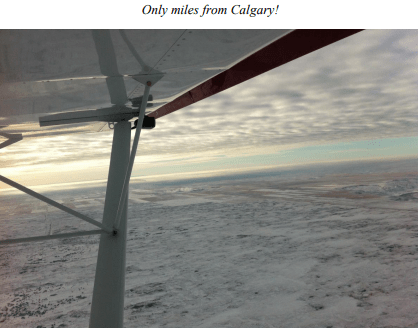
We arrived in Indus around 12:25, circled the circuit, normal left hand, and landed in Indus at 12:30. Upon arrival, Bob McDonald called, congratulating us on the safe trip. I took the opportunity to thank him for the beautiful machine he built and promised him to take good care of my new bird.
We parked the plane in a temporary shelter, and we met a few interesting pilots, two of them by the names of Buck and Ron, who showed us their treasures: several homebuilt warbird replicas sleeping in adjacent hangars.
Ron and Buck gave us a ride into Calgary. With that, we concluded a very amazing winter cross-country journey in an ultralight airplane. I had the privilege to be seating side-by-side, shoulder-to-shoulder, with Claude Roy who is an amazing person on all fronts. Frankly speaking, in my best dream, I was thinking about flying between Calgary and Edmonton. Now here we are, having just crossed most of Canada, 3000 kms, in winter conditions. We encountered pretty challenging winds, snow falls and low visibility; we flew nearly 31 hours over a time span of eight days, six days of flying and two days stranded on the ground in both Wawa and Kenora.
 Calgary Recreational Flying Club YYC