
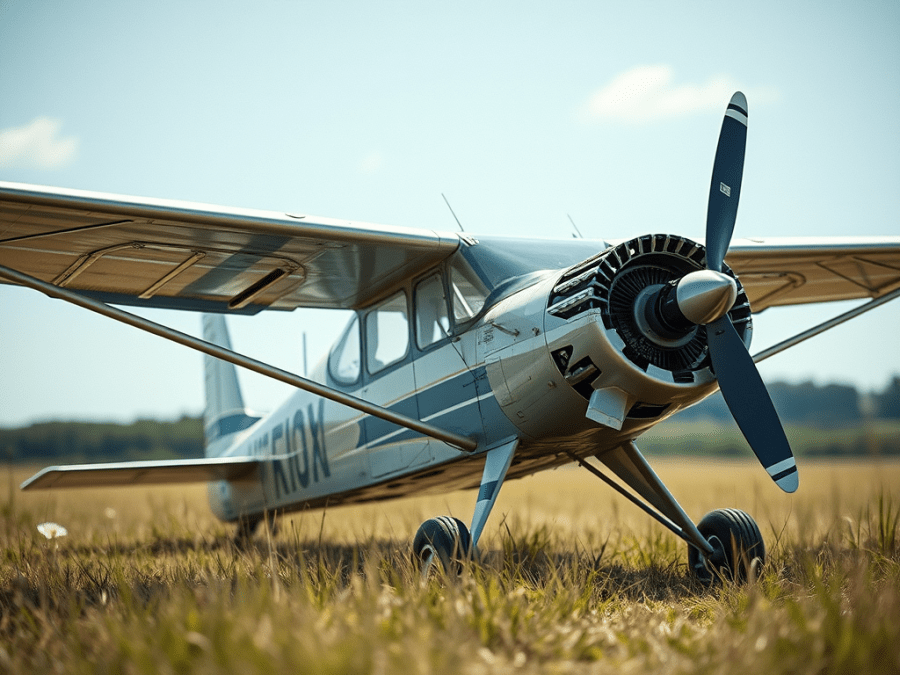
In November of 2000 I had the opportunity to purchase a partially completed project from a builder in British Columbia. The project was a Kitfox Classic IV with an EA81 Subaru installed. A belt reduction drive by Reductions Inc. was also fitted to the engine. Very little else was done and what was done was not done to my preferences so most of the work to the panel, wiring, and engine was redone to my liking.
After six years of working on the project I had finished the plane and jumped through all the regulatory hoops including fighting with Transport to get my medical back even though I was in great health.
In August of 2006 I took the first flight in C-FBYV which consisted of a couple of circuits in the aircraft. Some airport friends were on hand to congratulate me when I shut down. I added some more fuel and shortly went for another flight. Much to my surprise on about the fourth circuit my engine stopped dead at 500 ft AGL.
I quickly found out that a restart in midair is somewhat difficult. I had one hand on the throttle, the other on the key switch and my knees gripping the stick to maintain flight control. I had no joy on the restart and had to very quickly find a field that was not waterlogged by the recent rains. I chose a field and headed for it only to find myself high and fast on short final for the turf. With very little time on the plane, I didn’t think of doing a sideslip but instead opted to pull on full flaps and lose altitude and airspeed that way.
The Kitfox uses flaperons for roll control and with full flaps the ailerons have little movement. I was mercifully slowing down when my left wing started to drop. Even after applying full right aileron, I couldn’t pick up the left wing. The left-wing tip impacted the ground first and bounced the wing back into the air while spinning the plane 90 degrees in it’s yaw axis. For a few seconds I was doing 40 or 50 miles an hour sideways until the right wing tip impacted the turf and dug in hard. The result was that the right wing was bent in two with the outboard end stuck deeply into the turf. The Grove main gear hit at about the same time and was collapsed and bent up under the fuselage with a fair bit of damage to the structural tubing under the cabin.
The doors popped open, I snapped off the seatbelt and exited the aircraft. After clearing my head and looking at the carnage I walked over to the farmhouse to make some phone calls. Good airport friends responded quickly, and the plane was back in the hanger later that day. After a few days of feeling sorry for myself I went back out to the airport to try and determine why this happened. After a few cranks on the the engine and big backfire the engine fired up and ran smoothly. No water in the fuel.
What I eventually determined the problem to be was fuel starvation. The Kitfox has folding wings with a flexible fuel line from the wings down to the header tank. To enable the wings to fold an extra six inches of fuel line is bunched up near the wing root. It is imperative that this portion of the line maintain a constant downward path from the tank to the header. I had a small high spot in mine that allowed the fuel to flow nicely when on the ground (tail low attitude) and those many hours of ground running, but when flying straight and level the fuel would not flow properly over the rise. Every circuit that I did I was running off the fuel in the header tank when in straight and level flight, and then for a short time on the ground and climb out, fuel was running to the header tank. Finally on the fourth circuit I used up the last of the fuel in the header tank.
The right wing was removed and taken to the dump. The left wing was repaired and used in the next iteration of the plane. The landing gear was sent back to Grove in California and returned back to me in like-new condition. The fuselage was another story. It took many long hours to cut out the bent and broken tubes, replace them, and get everything straight and in back into alignment.
During the time that I was repairing the aircraft the Canadian dollar went from $0.65 U.S. to about $1.08 U.S. The Subaru engine in the Kitfox had some shortcomings and I was not completely satisfied with it. The belt drive didn’t like to track properly, and the water pump and alternator were belt driven by a single V belt. The single ignition system was totally dependant on the alternator or the battery. The engine weighed 230 lbs which made the Kitfox nose heavy and reduced my useable weight.
I saw the opportunity to get rid of the Subaru and exchange it for an engine better suited for my aircraft and my preferences.
Steve Bennett at Great Plains had a package set up for a VW engine conversion for the Kitfox IV, complete with an engine mount and exhaust system. I took advantage of the great exchange rate and bought the engine package. I decided on dual ignition, one magneto and one electronic ignition on a direct drive 2276 cc engine. Because I was feeling flush I also chose the aluminum cylinders for an extra thousand bucks. These cool better and save 10 pounds of weight for the plane.
The kit comes in a large wooden box in many, many pieces but includes a good assembly manual and a DVD that shows how to do everything. I was very careful to follow instructions very closely and took my time building the engine. I had some difficulty with the supplied intake tubes but managed to get them fabricated so they didn’t interfere with any thing else under the cowl.
Steve originally suggested that I run a single Bing CV 40 carburetor slung under the engine. The intakes on the heads are on the top of the engine so the intake tubes are about 18 inches long. The engine ran fine on the Bing, but the carburetor wanted to escape from it’s rubber socket mount when the engine vibrated. I didn’t like that scenario, but I did fly it with the Bing for two hours.
After taking off one afternoon in August of 2009, I was just about to circuit height when I thought I heard the engine running a little roughly. I ignored it for a few seconds but the turned back towards the airport. Sure enough, it started running really roughly.
I made it back to the airport, but I was high and fast again. I elected to overshoot the runway and to try to use a runway more aligned with the wind. On the way back to the approach to the runway I found I couldn’t keep the plane flying anymore. A forced landing left me and the plane in chest high canola, which I managed to swath a bit of before the plane flipped upside down.
Again, with help from good friends from the airport, I managed to get the plane back to the hanger. When I got to check the engine, I found that the exhaust pushrod on the number two cylinder had lost capture in the rocker arm and that the exhaust valve on that cylinder was not operating. I thought that I must not have tightened the jam nut correctly on the rocker arm when adjusting the valve lash. This was not the case as I found out later.
After another 18 months of repairing and changing out carburetors to find one that I felt happy with I settled on my fourth choice, the Rotec throttle body injector. I had tried a Zenith carb and the Aerocarb. I almost didn’t settle on the Rotec because the first one sent from Australia had a fuel leak internally and no amount of adjusting would stop it from running rich.
All the time I was testing carburetors I continued to have problems with the pushrods. They would often get bent or the tips would break off. I couldn’t get the cylinder head temperatures down. I switched from steel to chromoly pushrods so I could set the lash tighter, but the pushrod tips were still breaking.
After running the engine for a couple of hours one day, I took the valve covers off only to find the heads of the valve stems mushroomed because of loose tolerances in the valve train and the ball feet rotating on the rocker arms. This required replacing the valves by cutting the ends off to get them through the valve guides. When I installed the new valves, I thought I’d try new rocker arms, so I switched to 1.25:1 ratio rockers from Scat. The arms slide across the valve stems. This solved the overheating cylinder heads allowing the engine to exhaust the hot gases more efficiently now. My cylinder heads rarely got over 250 degrees F, but I was still having pushrod issues.
After researching the VW racer sites on the web, and all the talk about coefficient of expansion, it finally hit me. The aluminum cylinders were expanding at twice the rate as the steel pushrods were! It was even worse when I used chromoly pushrods as they have an even lower coefficient of expansion than regular steel. As soon as the engine warmed up, the valve lash became enormous and there was slop all through the valve train.
The answer would be to use aluminum pushrods.
I went to town and bought a set off the shelf from a VW supply shop in Calgary. They were cheap junk, but I didn’t know it at the time. I put them in and thought my problems were solved. I flew the plane for about 10 hours with these pushrods in with no problems.
Then, at the end of a two-hour flight I was getting close to the airport when the engine started running roughly again. I tried to make it back to the airport but ended up landing in a field about five miles from the airport. The crops were off so there was no damage to the airframe!! When I got the plane back to the hanger, I found the aluminum pushrods had their chromoly tips mushroomed back into the pushrods by as much as 1/4 inch. No wonder the engine was running rough, the exhaust valves were hardly opening.
I sourced out a site for reliable aluminum pushrods from AirCooled.net. and installed them. Finally, the pushrod issue was put to rest. I have over 50 hours on these pushrods and have no issues with them at all.
While I was working on the pushrod issue I got an email from Great Plains that the wrist pin keepers supplied with my engine may not be the correct ones and they would send me replacement ones. Despite being only a couple of bucks worth of parts, it meant removing the heads and jugs and replacing the wrist pin keepers after removing exhaust, intake and baffling. It was a full day’s job.
One day I had added a muffler to the exhaust and wanted to hear how it sounded from outside the airplane. I got my son to sit in the plane and rev it up and down. When he throttled back I noticed a ticking noise. After shutting the engine down and turning the prop over by hand I found the ticking and clunking to be coming from the crankshaft. It had some end play movement of about 1/8”.
After removing the engine and the Deihl accessory case from the engine, I found the head of the gland nut that holds the flywheel to the crankshaft broken off. The dowel holes in the flywheel had been made oval from the crank shaft movement. This necessitated replacement of the flywheel and gland nut. The cheap 36 mm cast gland nut that broke in half was replaced by a larger 44 mm chromoly forged gland nut and the engine was put back together and reinstalled.
The gland nut requires 219-foot pounds of torque, and I put the chromoly nut on with about 230-foot pounds. Six months later, after the winter had passed, I went flying again. After a short flight I turned the prop over by hand. I immediately heard the telltale tick and realized it was the gland nut again.
I removed the engine again, and because I’m getting good at this, it came off in two hours. The gland nut was not broken this time, just backed off. There was no damage to the flywheel. This time I torqued it up to about 300 foot*pounds and used Loctite. I’ve had no problems with it since.
While all this was going on I was having problems with the valve covers leaking oil at wide open throttle. I did a compression test and found all the cylinders to be between 110 to 120 psi, meaning the rings were not worn and allowing too much blow-by into the crankcase and subsequently the valve covers.
My thoughts were that this crankcase was originally designed for a 1300 cc engine and now I’ve got it bored and stroked to 2276 cc. That leaves very little extra room in the crankcase for pressure to build up. I wondered if the natural blow-by from the increased displacement was over pressuring the crankcase. My first attempt to solve this was to install a PCV valve from a similarly sized Nissan engine into the crankcase and run vacuum lines to the intake manifold. This worked but not at full throttle. I then installed vents in the valve covers to pull air into the crankcase, but oil would simply blow out these vents. The PCV valve couldn’t handle the amount of blow-by in the crankcase, so I scrapped the PCV valve.
Newer engines, I’m told, run a thing called a metered orifice instead of a PCV valve. The idea is to use just the right amount of vacuum from the intake and by pulling the vacuum through an orifice of the right size you will pull the correct amount of vacuum on the crankcase for all engine speeds. I took a brass nipple and filled it with solder and drilled it out to 5/64” and installed it in the hole where I had the PCV valve. I kept drilling the solder out by 1/64” at a time and running the engine up to full throttle till I got to 11/64” when all of the oil leaks stopped. I now have enough vacuum on the crankcase that all the blow-by is evacuated from it. Any leaks are leaks of air into the crankcase not oil out.
After solving that problem my oil consumption went up slightly, which was anticipated. The 30-weight oil I was using was misting too much in the crankcase and was being sucked out by my metered orifice system. I switched to 50 weight oil and the problem was solved. Most VW air cooled engines under severe service conditions use 50-weight oil. I was ready to put some time on the airplane.
I stopped test flying this year once the canola crops got high and started again after harvest. I did my climb test, as required by Transport Canada’s amateur-built aircraft rules, on October 18th and got all of my flight restrictions removed from my Special Certificate of Airworthiness on October 19th. I dealt with Dave Sward at Transport. He is a good guy and a pleasure for homebuilders to work with.
I managed to get my first cross country flight in this fall before it became too cold: a short trip from Indus to Vulcan and back. I was listening and imagining bad things happening both ways on the trip but nothing out of the ordinary occurred with the VW. I think I finally have an airplane.
Climb with the VW is about 600 FPM at gross with a cruise of about 85 MPH. Cruise rpm is from about 2800 to 3200 RPM. Wide open throttle is about 3300 to 3400 RPM. I’m currently running a GSC 60X32 prop but am looking forward to trying some other options in the next year. My project for this winter is to build some wheel penetrating skis and beef up the heater so I won’t have too much down time next winter.
It has been a long and often disheartening struggle to get to where I’m at now and I hope nobody else has to go through these troubles. If you are building a VW for aircraft use, I would suggest you buy the best parts available. If you are building a kit engine, check the quality of the parts that are supplied. There are tons of Asian manufacturers that produce cheap and faulty parts for VW engines and the kit suppliers often like to use them due to the lower cost. Aircooled.net in Salt Lake City is a good supplier of quality parts. Concept 1 in Calgary can supply good parts, but they also have cheap Asian junk on the shelves, so choose carefully. Use OEM parts when you can.
I hope that for anyone else who is planning on using a VW engine that my experience and solutions will help them with their build. Keep in mind these are my opinions and I’m not an expert by any stretch of the imagination. Good luck.
 Calgary Recreational Flying Club YYC