
GETTING AN AVID BACK IN THE AIR OR “STILL LEARNING THE HARD WAY”.
On March 12, 2012, fellow club member, Bert Lougheed and I drove to Fox Creek and picked up an Avid Speed-Wing that was in need of some repair. The previous owner had “left the runway” (his term for ground-loop) and was not interested in the efforts to repair her. I was able to pry it from his hands for a reasonable price. The plan was to repair the Avid first, and then start rebuilding the Buzzard, allowing me to have a plane to fly while working on the projects.
First lesson I learned was damage is not always visible unless you pull the fabric from a rag and tube aircraft. I was shown the damage to the fuselage and told that should be all that was in need of repair. Of course when I arrived and inspected the aircraft I noted the wing had some looseness in the fabric. I also noticed the wing tip had an unusual amount of flex.
I decided to take a chance and go ahead with the purchase, so Bert and I put the plane on a trailer and back south we drove. Note: When you pull an Avid or KitFox make sure you pull it tail first. I did and arrived back in Airdrie with no further damage. A guy in Red Deer pulled his KitFox from Yellowknife facing forward, bent the top of his fuse near the tail and broke some of the welds near the tail. Even a folded KitFox or Avid wants to fly.
In any case once I got the plane home, I cut the fabric open and found the wing was indeed damaged more than the previous owner thought. There is a one-inch tube that is attached to the back spar that holds the wing tip in place. Not only was this bent but it was cracked ¾ of the way through. There was also a drag tube that was bent and rather than patching by trying to straighten the tube a replacement was in order. I was able to accomplish this by cutting holes the size of inspection rings and then patched the fabric with inspection rings and doilies. Of course the covering had to be removed from the top of the last bay and then replaced after the repairs were made.
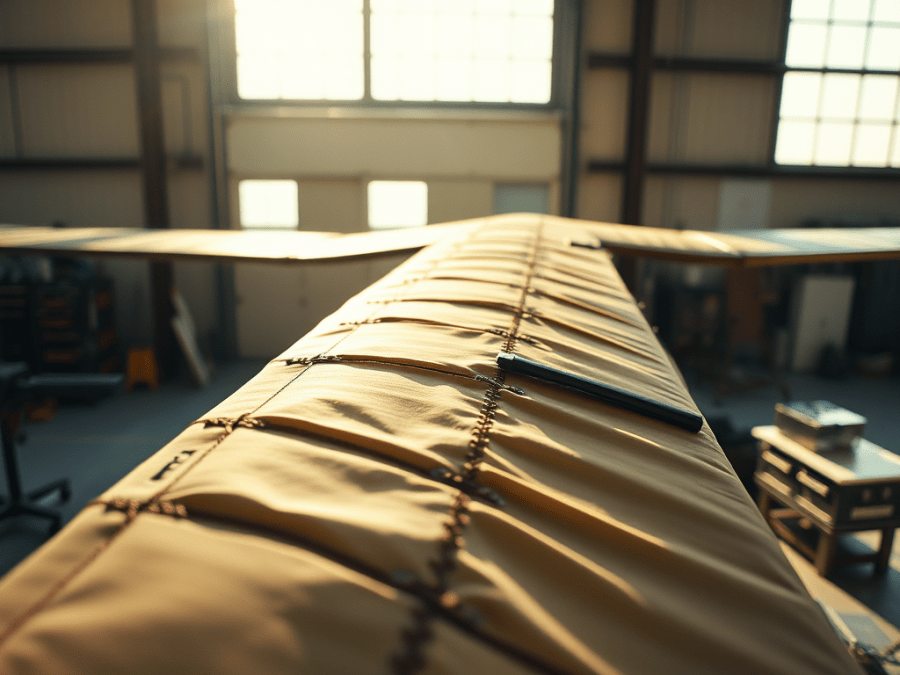
I also noted that the Speed-Wing was not rib laced and my thought was a plane that is supposed to travel at 100 mph should have more than just glue holding the fabric in place. I pulled the reinforcing tapes and took out the needle and lace out and started lacing the fabric to the ribs. Then I laid the reinforcing tape back into place on both wings. The windshield was replaced as it was cracked but the skylight was left in place and the windshield became a two-piece installation. Repairs were also made to the fuse as necessary.
With the repairs all complete to the airframe it was time to go to work on power for the Avid. The motor was a Rotax 532 and had some issues with the water pump and rotary valve shaft gears so a search for a new motor was in order. I found a good Rotax 582 Greyhead and did a decarbonation, crankcase seal replacement and mounted this refreshed motor in the plane.
Now here is chance to learn lessons from reading instead of the hard way as I did. The motor seemed to have some heating and cooling issues. Now, I have run 582’s in the Buzzard and have learned to keep an eye on my EGT and CHT temperatures. I have also noted that sometimes the motor needs to be burped. So, since the temperatures were running high, I attempted to keep filling it and try to get the motor cooling under control. It seemed like it should be working right so I considered the possibility that the gauge was faulty. I kept tapping the gauge and feeling the water hoses but could not figure this one out. The water hoses were cool, but the gauge was reading much too high. Tap on the gauge some more and then nothing. The gauge went to ZERO. Feel the water hoses again and they are cool. OK WHAT’S GOING ON?
I was at the far end of 16/34 and decided to taxi back to my hanger. I got back to the hanger just in time for the motor to stop. Great the motor that I had so carefully inspected, decarboned and resealed was just turned unusable.
It was time to go back to the books. What was going on? I poured through the Rotax manuals and spotted a possible answer. I had seen this before but did not put it together. When a 582 is run in the upright position there is a vent line on the top of the engine to burp out the air, but when the 582 is run in the inverted position then the vent line must be placed on the top of the water pump housing.
Inspection of the motor revealed one scored piston and jug. The motor had gotten so hot that the temp gauge sender had melted the wires off. I replaced the piston and jug as well as the temp sender and I was back in business. I moved the vent line to the top of the water pump housing and tested my efforts. I was rewarded with a smooth running motor that was now keeping the temperatures where they were supposed to be.
It was now time to test this little plane. For my test flight I wanted everything to be perfect. I was hoping for little to no wind, but my preference would be to have the wind from the north if at all possible. The morning arrived where it seemed like all the planets had aligned and it was time to try a circuit or two. The date was Friday the 13th. Do I dare? I had the propeller set to give me the required RPM for takeoff and I pointed the nose to the north. Smooth, full power was applied and after about 1200 ft, the plane was traveling at 55 to 60 mph and started to get light. As it left the ground, I noted an airspeed of 65 to 70mph and a climb rate of about 600 fpm. I was at 1000’ AGL in the downwind and saw 85 to 90 mph. I lined up on final and approached at 75 to 80 mph. As I approached the threshold I continued to slow and landed in a three point at about 55 to 60 mph. The plane was done flying, but I kept my feet busy until I was stopped. This plane has a history of treating pilots unkindly if you don’t stay active on the rudders. Thank goodness I’m still alive and the circuit was done. It was time to put the plane away and digest the information
A couple of days later I did a few more circuits and then further inspections. I checked all my cooling lines, rechecked bolts, connections, pins that hold the folding wings, added a cigarette lighter style power panel, and a power filter. It was time to take to Avid for a little flight. I only planned to go the North 40 ranch, but the day was good, and Innisfail was closer in a plane that travels at 90 mph than it is in my Buzzard at 65 mph. I landed in the grass again in a three-point attitude. A quick visit with a friend at Innisfail and I decided Red Deer for coffee. The take-off from Innisfail caught me by surprise as a crosswind blew me quickly off course. I recovered and made the quick flight to Red Deer, again landing in the grass next to 29. After coffee, the takeoff from the asphalt of 29 was quick and easy and the flight to Carstairs smooth with just a few ripples in the midday sun.
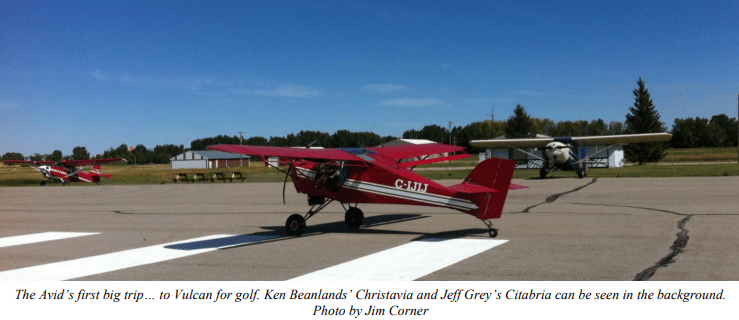
I have since been to Vulcan for golf with Ken Beanlands, Jim Corner, and Jeff Gray and the plane handled the trip much better than I. The Avid is back in the air where she belongs and I am still learning the little things about her that make her unique. The small wing makes her much faster than anything I have flown before and she requires my full attention. I continue to learn and advance my flying skills.
I owe a number of big THANK YOU’s. There were many members that helped with information and support while I was rebuilding and testing and the concern, I have with mentioning names is I will probably forget as many as I mention. However, I will start by extending a thanks to Bert Lougheed for helping with the pickup adventure; Jim Corner for helping with the weight and balance, the initial testing and taking me in his KitFox II so I knew what to expect; Ed D’Antoni helping with some of the motor work and Avid questions; Wayne Winters helping with some Rotax parts; and Gerry Theroux for some hinges for my trim system (still not installed).
Next, a great big thank you goes to Glenn Bishell for the support and guidance while I was putting the Avid together. When the tail wheel ground loop issues reared its ugly head, Glenn quickly jumped in to help make a rudder guard to keep your feet centered on the pedals. Glenn even had his AME look at the tail wheel on the Avid and it was agreed that the tail wheel was breaking out of its lock too easily. Because of the ground loop history of this plane I have removed the cam from the tail wheel and it now stays locked.
There was also the night that after an aborted takeoff when Glenn took me for a ride in his BishCaddy. I was then able to return to the field and take to the air in the Avid. Thanks very much Glenn. Without that ride the Avid may have become a hanger queen. The list goes on so thank you to all who helped in returning this plane to the air, where she belongs.
Lastly, a great big hug and kiss to my wife Judy for parking outside while that “little red plane” took up her space in the garage where her husband disappeared to for countless hours. By the way, Judy and I live in a plus-50 community and the little Red Plane had quite a few visitors while the nose stuck out of the open garage doors. What a great way to meet the new Neighbours.
Till next time…Smooth Skies and Good Lies

 Calgary Recreational Flying Club YYC