

Well, another year is over, and it went out with a roar! By the time Christmas rolled around, I assumed that we weren’t going to see any flying weather in December at all. In fact, it was scary just driving around.
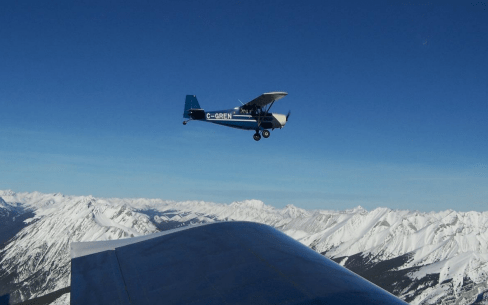
My parents showed up on the 23rd for a two-week visit. Surprisingly, Boxing Day dawned absolutely beautifully to clear skies and light winds. Glenn Bishell had e-mailed us to say the runway was clear. Stu Simpson also e-mailed to say that he was planning to fly and a call from Troy Branch helped me make up my mind to go flying. Of course, Dad was game for a flight as well.
Mike Sweere was waiting for us when we arrived. We pre-flighted the plane and fired up in the -15°C. Fortunately, by the time we reached 5500’, the temperature had risen to +6°C. We flew south to Chestermere where we heard Stu firing up with a flight of three aircraft. We decided to head south to High River and meet at Troy’s hanger for a visit.
By the time we reached High River, we heard Troy doing his run-up for a flight with his in-laws. After a quick chat, Mike and I decided to head west with Troy into the Kananaskis valley. Mike and I were west of Longview when Troy took off. By the time we got through the pass, Troy was already over the Kananaskis Lakes.
A little background is in order here. My mountain experience to this point had been one flight through Banff and out over Lake Minnewanka and another with Troy to Nelson, BC in his RV-9. For me, this was a very big deal.
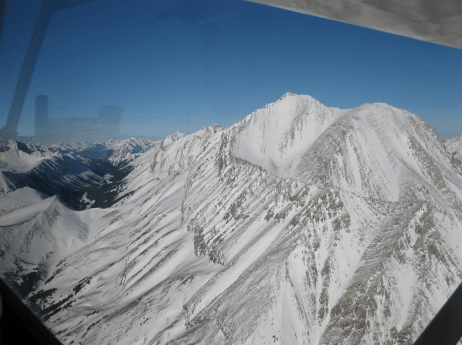
The trip up through the valley was incredible as we passed by the Kananaskis Lakes, Fortress Mountain and up to Nakiska. Dad was snapping pictures like crazy and even got a few of Mike and Troy. Once past Nakiska, we turned right and followed the valley to Canmore and on to Banff. That’s where we finally met up with Troy. Dad got one picture of Troy before the batteries gave out.
From there, Troy sped away from us heading out through the Lake Minnewanka pass. We followed well behind him and finally broke out of the rocks. It was another 20 minutes back to the field. For me, it was a 2:45 flight; the longest I’ve logged in Chrissy. I don’t think I saw the groundspeed waver from 90 kts the entire flight, nor did the airplane bump once with turbulence. It was absolutely still air. What a perfect day of flying!
One of the things I’ve been experimenting with over the past couple of months is my new oil cooler air intake control. One of the issues I’ve had with the Christavia is trying to regulate my oil temperature. First, I had it set up so that it was fine in the winter, but running hot in the summer. I changed several things including the oil cooler, the oil cooler ducting (went from 2” to 3”) before finally doubling the cowl outlet size. At last, I was able to maintain an oil temperature of less than 210° F on the hottest day, in the climb and with a full load.
Unfortunately, this meant that I couldn’t get much above 130° F on cold days in the winter. That solution would seem simple, put plates on the oil cooler air hose to restrict the flow. Unfortunately, temperature variances here in Alberta can exceed 45° C while climbing through a mere 1000’. With the plates on, the engine was again running hot when I got it above the inversion layer. The only solution was to control the airflow to the oil cooler in flight.
I first saw the device on Troy’s RV-10 while it was under construction. It’s a neat little controllable valve that sits inline in a 4” duct. It allows the pilot to manually control the amount of air being fed to the oil cooler. Unfortunately, at 4”, the unit was a bit too big for my 3” ducting, and adapters would be challenging to make. This summer, Troy mentioned that the device was now available in a 3” size.
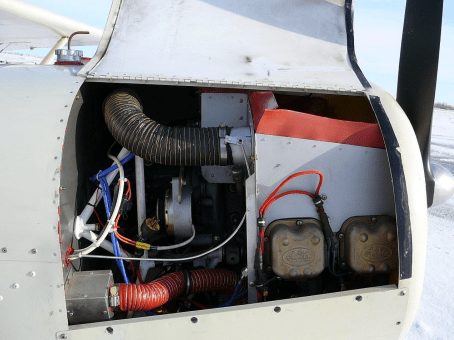
Installation was a snap. On my engine, the air ducting to the oil cooler comes off the back of the baffles. All I had to do was pull back the ducting and slide the unit on. One thing I did add was a screw to act as a control stop in the full open position. It comes with a stop for full closed. I used a standard vernier control available from Aircraft Spruce (generously donated by Troy, as he had a spare) and it was easy to install in the panel using a Unibit and was fed through an existing hole in the firewall. The entire process took about 1.5 hours.
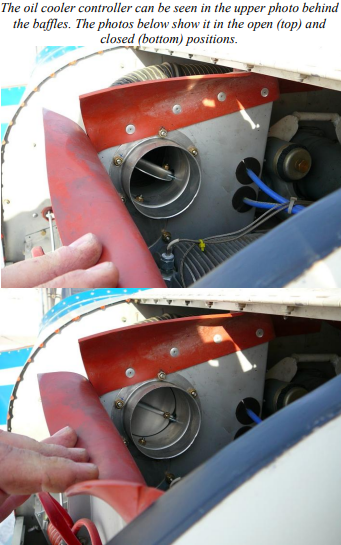
This has resulted in a few extra procedures while flying. For start-up and warm up, I leave the valve closed. If I don’t have much temperature before take-off, I’ll leave it closed until It starts to get around 180° F. From there, I can open it about halfway and maintain 180-190° F. For descent, approach, landing and taxi it goes back to full closed to keep the heat in the engine. Obviously, that is for cold weather operations. Once it gets warm again, the control will stay full open.
Avery Tools (www.averytools.com) sells the 3” unit as part number 1507 for $60.00 and the 4” unit as a 1503 for $60.00.
 Calgary Recreational Flying Club YYC