

Like Pat, December has been one of the few months in the last five years that I have not logged a flight! What a pathetic month for weather. I hear that a few club members did get some flight time; however, it appears that most of the time on the runways has been spent clearing snow.
Fortunately, I spent most of the month studying for exams and working at the cabin. The distraction of flying would have been detrimental to those activities. Hopefully, January will be a better month for flying. The long-range forecast is indicating a warmer trend for the next two weeks.
The terrible flying weather has also given me some time to get back into the Buttercup construction starting with cleaning up the basement and unearthing the workbench from under a year of junk. I hope to be pulling the first rib off of the jig this week.
Now that I’m thinking of wing ribs and the wing in general, I’ve been toying with the idea of removing nose tank and replacing it with a pair of 20-gallon wing tanks. This will help in four areas. First, the space ahead of the instrument panel will only allow for about 32 gallons. This is a bit light for an O-320. Wing tanks will allow for a more suitable 40-gallon capacity.
Second, the forward mounted tank will leave a mere 7” between the instrument panel and the tank. Although most instruments will fit in this space, the avionics I wanted to install are around 12” long. There is a small space at the top of the panel that would allow these radios to slide in over the top of the tank, but it would make for an awkward panel layout.
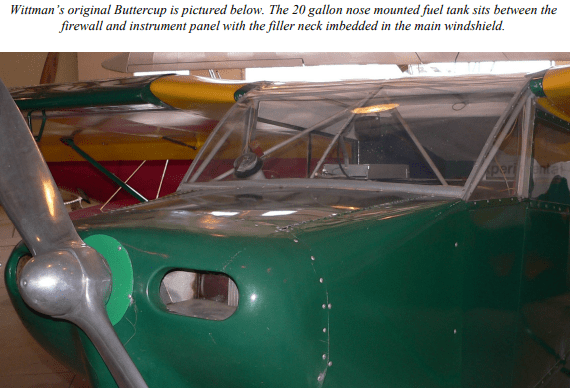
Third, the original position of the tank forces the filler neck to be installed in the front windshield. This can be seen in the picture below. Unfortunately, there are some obvious issues with this. Any drippage or overflowing will soak the windscreen with fuel, which can lead to crazing and cracking.
Finally, with the addition of 60 lbs. ahead of the firewall (after swapping the original O-200 mill with an O-320), moving the fuel tanks aft will help with the inevitable forward CG problems. This will mean that I’ll have most of the payload sitting along a small region of the length of the aircraft, making it more practical to handle the various loading conditions, i.e. one-person, full fuel, two people, full fuel and full cargo, etc.
Over the past couple of years, I’ve had a number of folks ask about how to generate a weight and balance report for their airplane. I’ve put together a great little spreadsheet for the Christavia that allows for easy updating when equipment is added or removed and quick pre-flight weight and balance calculations. If you’re interested, I’d be happy to e-mail a copy to any member, just drop me a line.
You can easily add lines to the “Amended Weight and Balance” section to revise the report. However, the forward and rear CG limits must be reworked a little for each amendment. By simply printing the first sheet, you get a weight and balance report to satisfy the requirements for your airplane.
The other worksheet is a pre-flight worksheet that allows you to plug in the particulars of your flight and check that the weight and balance is within limits.
Well, I hope to see you all at the meeting on Thursday night.
 Calgary Recreational Flying Club YYC