

Happy New Year everyone!
My first term at SAIT was quite successful AND I was fortunate enough to have three weeks off over the Christmas break. This gave me time to finish some needed maintenance on the Christavia, including the replacement of the front crankshaft seal on the engine, which had been causing a rather annoying mist of oil over everything. The new seal fixed this nicely. I also added a small “skull cap” style spinner.
There were a couple of impromptu club events over the last month. December 8th saw a number of local members fly into Red Deer for a festive brunch at Tipitinas. The girls that operate the restaurant opened up especially for the event. Unfortunately, I was unable to make it.
However, I was able to make the potluck lunch on the 22nd. A few of us decided to fly out somewhere for lunch. Since most places were closed for the holidays, we decided that a potluck barbecue would be the best bet. After tossing out a few destinations, we decided to go to High River. We had eight aircraft show up. It should have been nine, but Stu had some mag issues that forced him to take ground transportation to High River.
On the way home, I decided to skirt around the east edge of YYC’s class C airspace, following Barry Wood in his Musketeer. As we passed Airdrie, I flipped over to terminal to listen for traffic in time to hear the controller inform one of the Calgary-based 172s that he had passed close to a north-bound aircraft east of Airdrie. I never saw him at all despite looking for traffic.
This prompted me to dig out a little device I purchased at Oshkosh in 2006. It’s a Monroy ATD-300 traffic monitor. Despite having it for over a year, I had been waiting for some downtime on the plane to do a nice clean installation, despite the fact that it’s quite easy to install using Velcro on the glare shield and is equipped with its own antenna.
It took all of 30 minutes to make a passable installation and involved applying a power cord to an available outlet and wiring into the headphone jack.
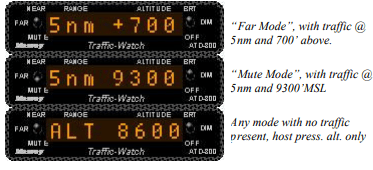
The Monroy unit uses both the transponder signal from the host aircraft as well as those from other aircraft in the area to warn the pilot of potential collisions. It has a simple display showing the horizontal and vertical range of other nearby aircraft. In addition to the display on the front of the unit, there is also an audible warning, which can be muted.
The unit displays different things depending on what’s happening. There are three modes. If you have the unit muted, it will show any aircraft in a 5 nm radius with their range and pressure altitude (altitude at 29.92” hg).
The other two modes are “far” and “near.” Normal operation would be in the “far” mode. In this mode, the audible warning will let you know whenever it picks up traffic within 5 nm and +/- 1000’. The near mode is used when inside a busy terminal area and will report traffic it detects within 1 nm and +/- 500’. If the traffic does not have Mode C, then only the range is displayed. When there is no traffic in the area, the unit displays the host aircraft’s pressure altitude as reported by the transponder.
Of course, there are some limitations to this type of technology. It only works if both aircraft are transponder-equipped and if the aircraft are being interrogated by ATC. This means that there is a significant number of aircraft that it won’t see, but in and around the YYC control space, there is a large percentage of aircraft that are transponder equipped, buzzing in and out of the YYC. In addition, many of the production aircraft operating out of other fields (Okotoks, High River, Three Hills, Olds/Didsbury, etc.) are transponder equipped and will activate their transponders whenever they are flying. I guess what I’m trying to say is that you’ll have a better picture of the traffic around you with the Monroy than without.
As for actual operation, it seems to work quite well. I’ve only flown a couple of times since installing it and, sure enough, it did its job quite well. It picked up an aircraft at my altitude as I departed Olds/Didsbury. I dropped 400’ to 4500’ and watched as the other traffic got to within 2 miles. I finally saw it as it passed by me to the east, but without the Monroy, I would never have seen it at all.
The unit itself sells for around $600. For me, that’s cheap insurance. There are other, more sophisticated units available, but this seems to be a good compromise.
Hope to see everyone at SAIT next week.
 Calgary Recreational Flying Club YYC