

Merry Christmas everyone and a Happy New Year! I hope everyone had a great holiday season and that Santa was kind! Did anyone get a new set of plans… or even a new kit for Christmas?
Santa Renée brought me a new digital camera, a Panasonic Lumix TZ1. I love my old camera (Lumix FZ 20) but it’s a bit too bulky for using in the plane. Most of the small point-and-shoot cameras are the perfect size to shoot and fly with, but they have a very limited zoom capability (3-5x optical). The TZ1 is slightly larger than the average compact camera, but it has a 10X optical zoom with an image stabilizer, a 2.5” screen, and an aerial photography mode! It also has a very nice video mode that even allows widescreen filming and zooming while filming. The only thing left is a bean bag mount so I can set up the camera on the dash and film hands-free fore or aft. This thing is perfect!
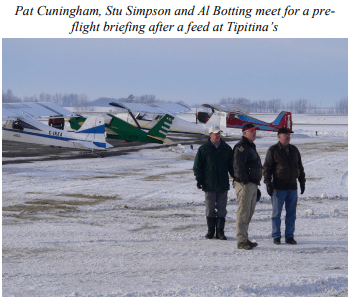
December has been a great month for flying with very mild weather through the Christmas season. We had a wonderful Saturday morning fly-out on December 9th to Tipitinas. Glenn Bishell had arranged with the Tipitina management to be open on Saturday and cater an event for us. We had a great turnout with about 13 aircraft and about 25 folks showing up. Tipitinas prepared a great homemade breakfast for us and everyone left full and contented. Almost everyone met back at Bishell’s place for a bit of hangar flying and to watch Ralph perform a spectacular “missed approach” in the RV-7A.
Work is slowly progressing on the Buttercup. Things got a little delayed with some surprise home renovations. It’s a long story that involves my little white GMC truck getting destroyed, which led me to meeting a dry-waller… Anyway, I’ve almost completed the wing rib jig and have started cutting bits for their construction.
Things on the Cessna 150 front are also progressing well. I believe I’ve found a buyer, but one of the conditions is that I deliver the plane… to Ottawa! This is not something I look forward to in the middle of a Canadian winter! Although the aircraft has been extremely reliable, I’m worried about finding facilities to de-ice the flight surfaces and pre-heat the engine.

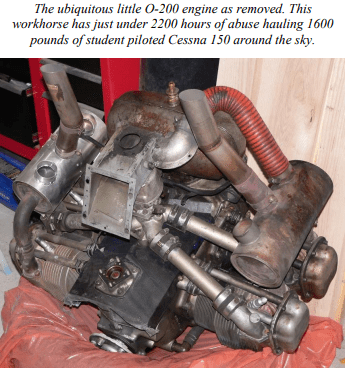
Speaking of engines, I’ve had a chance to do a little more research on the engine for the Buttercup. I’ve been planning on rebuilding and installing the O-200 we removed from the Cessna 150 last year. So far, I’ve been really impressed with the little engine, and I couldn’t help but think how well an O-200 would work on an ultralight.
Let’s face it, most folks choose to use a 2-stroke to avoid the high purchase costs of the available 4-stroke engines. For those interested in 4-strokes, there are only a few options. First, there are the certified 4-strokes. These include the Lycomings, Continentals, and Franklins. These engines are old technology but very reliable engines with a fairly low operational cost. They do tend to be heavier than most of the other options, but not excessively so.
Next would be the non-certified sport aircraft engines. These would include the Rotax 900 series engines (granted, some are certified), the Jabiru, the Rotech radials, and various others. These are generally lighter engines with a reasonable reliability rating. Unfortunately, some of these engines are released before they are ready. This leads to expensive field modifications to continue operating safely. From a cost perspective, they are less expensive than new certified engines but have a similar operating cost.
Finally, there are the automotive conversions. Generally, these hold the promise of inexpensive power for the budget project. Unfortunately, this category tends to be the least reliable of the 4-stroke engines and typically ends up costing much more than first budgeted.
Fortunately, there is a reasonable option out there; the little four-cylinder Continentals, and the O-200 specifically, make a great option. They are relatively light at around 200-225 lbs range (depending on electric options chosen). Also, they are extremely reliable with millions of flight hours behind them and an 1800-hour TBO (easily extended with regular use). Although they cost nearly $20,000 new, there are less expensive options. The O-200 is one of the cheapest engines to overhaul. Often, you can find overhauled O-200s on Barnstormers or Trade-a-Plane for around $10,000. Cores generally go for $2500-$4000 and you can do your own overhaul for around $5000-$6000. Compared to a Lycoming O-235, the parts costs are quite good. New Titan cylinders cost about $650 USD, versus $1300 USD for the O-235. Crankshafts are about 1/3 the cost of the Lycomings ($1500 vs. $5000).
From an operational standpoint, they are very inexpensive to live with. Fuel burn depends on throttle setting, but even at full throttle, the C-150 usually burns about 5.0-5.5 GPH at our elevation. Although I normally burn 100 LL, the O-200 is quite happy burning Mogas. Many homebuilt projects, even kits, have issues with cooling, both cylinder heads and oil. The low compression ratio of the O-200 not only allows you to burn cheap fuel, but also generates very little heat, making them easy to cowl and cool. With a $250 oil filter kit from Wag Aero, oil changes need only be done every 50 hours. Plugs are expensive (about $160 per set), but with proper maintenance and cleaning, two sets can last the life of the engine.
Although the overhaul interval is 1800 hours, they will generally go well beyond this with proper maintenance and regular use. The engine we pulled off the C-150 had just under 2200 hours. We had assumed that the engine was starting to run rough, but it turned out to be worn rubber bushings between the engine and the mount. They were completely eroded away after 2200 hours and 15 years of use. The only sign of wear on the engine was the thrust bearing. The endplay of the crankshaft (the distance the crankshaft moves fore and aft) was at limits.
This leads to another advantage of the O-200. Since it powered one of the most prolific aircraft of all time, the Cessna 150, there are lots of parts and spares available. Need an exhaust system? No problem. How about an air box and filter kit? Easily available.
Numerous Cessna 150 props are available on the used market at reasonable prices. Unfortunately, 150s utilize a 69” prop to maintain proper ground clearance. A 71-72” diameter prop will work much better on the typical ultralight with taller gear legs.
There are a lot of sources for this engine. If you have the cash, you can buy one new from Continental (yup, they are still in production) in either the certified version (what you’d find on a Cessna 150) or a new LSA version (with lightweight starter, alternator, oil filter kit, electronic ignition, etc.). I also heard this summer that there is a new IO-200 fuel injected version using similar technology to the IO-240.
If, like most of us, the price of a new engine is out of reach, then you can buy an overhauled engine from one of the various overhaul shops. These will range from $10,000 for an A&P overhaul (overhauled cylinders and accessories) up to $15,000 for one from a certified shop with new cylinders and accessories.
Finally, there is the builder overhaul. This will run about $8000-$12,000 depending on the condition of your core and the accessories you choose. The advantage of this approach is that you can use all new parts and still come in around the $10,000 mark. The engine itself is relatively simple and easy to overhaul.
As a result of all this, I’ve decided to do my own overhaul on the core left over from the Cessna 150. Of course, the choice was made easy since I already have the engine, and it’s the recommended model for the Buttercup.
Oh well, enough babbling. I hope you and yours have a wonderful new year!
 Calgary Recreational Flying Club YYC