
In 2024 we were asked by some friends in Atlanta if we were interested in making a trip to Alaska. A group flight is always fun so why not. We would be the rest stop for them until we left for the last part of the journey north.
We did not have a lot of time as our house sitter had conflicting plans, but we were going anyway. When you have horses, dogs, chickens and such, we can’t just leave, it takes planning. The other 2 RV10’s arrived on Wednesday, and we took Thursday to do our last prep for the trip. We had booked hotels in January, and it looked like the weather might just allow us to use them.
Friday Morning was a calm and clear day, a perfect start. We took off from our place and went down to High River to fill up. Next stop from there would be Dawson Creek. We flew in loose formation through Calgary and made our way north. The forecast showed strong winds that would decrease near Ft Nelson and then turn into showers heading towards Watson Lake.
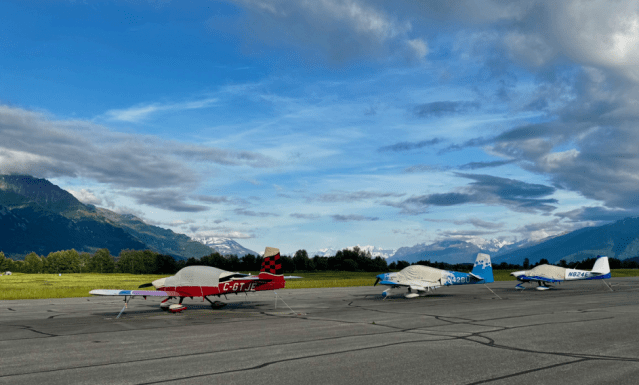
We were soon descending into Dawson Creek, and the wind was over 30kts on the ground. We hit the top of the belts a few times from turbulence on the approach and landed without much trouble. We all filled the tanks and had a snack. The plan was Ft Nelson and possibly push on to Watson Lake if the weather looked reasonable.
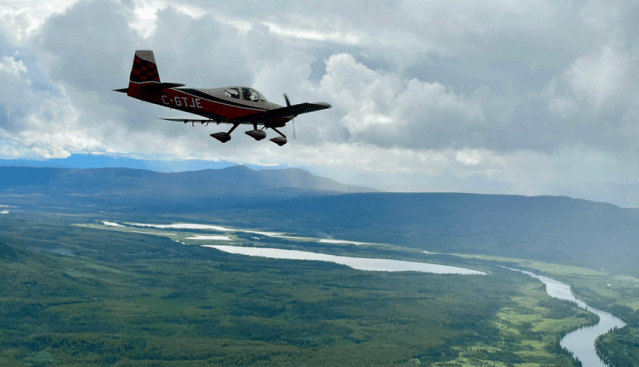
Once at altitude the air was smooth again and we were on our way to Ft Nelson. Wind started to die down, and we passed through a few showers. The decision was to continue to Watson Lake. There was a TFR near Toad River, so we stayed north and did not follow the VFR route. The clouds started to fill in, and showers started. As we neared Watson Lake there were many cells creating heavy rain, so we had to work our way around them. Another aircraft was just coming up through the trench and said that Watson lake was fine so we knew we would get in. After passing the last shower we set up for landing.
This is when the decision for a go no go gets interesting. There is no XM weather, no radar, just one metar from Watson Lake to Whitehorse and you have the GFA. You can’t file IFR as the route is too high and is in icing conditions. The only real choice is to go for a look and stay low. If we could continue to go around the cells and see through the smaller ones it would likely be fine. There was one shower just west of Watson Lake and the decision was that if we could get around it and see what was ahead, we would make a final decision.
Off we went and we soon passed the rain shower. Got into the VFR route and just plugged along in loose formation down the valleys. Visibility was great, Ceilings were just below the peaks and the shower never got to heavy. Not long we saw two Canadair coming down the valley below us. I chatted with them on conditions, and we then knew we could get to Whitehorse.
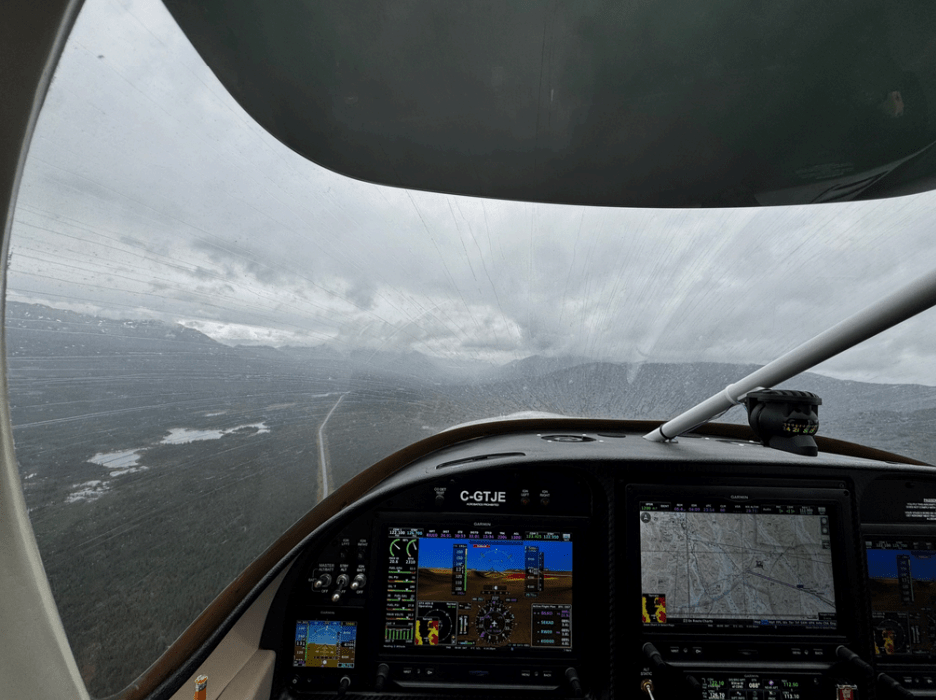
Not long after we reached the first gravel runway which was Pine Lake, it gave us our first easy out. During each turn I made sure everyone was comfortable to keep going. The nest runway was Teslin. The weather was a bit worse in that area. We flew over the airport then continued up the lake. At the north end of the lake, the clouds looked like they got quite low but we went for a look.
Sure enough, they were blocking the valley north but we needed to make a left turn through a pass and that was clear. Not long after we reached the last corner and set up to land in Whitehorse. They gave us the runway, and we all landed and back tracked together.
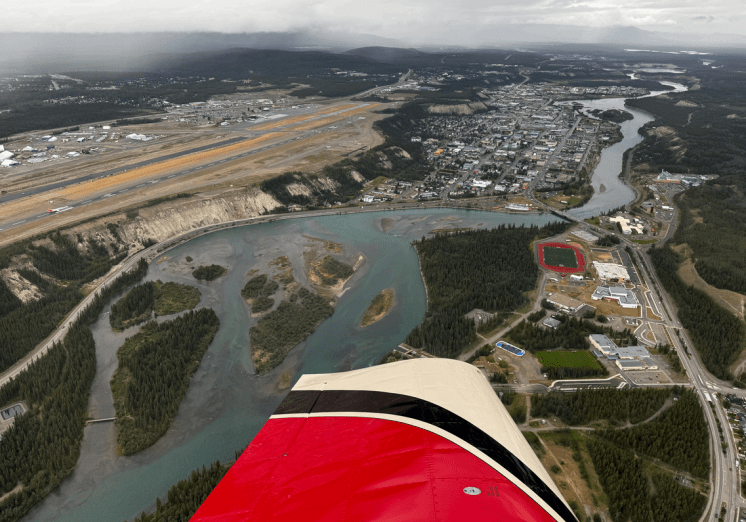
Not often you fly 2 hours in rain in the mountains with reasonable visibility and ceilings, the planes got a good wash. Summer weather was over as we stepped into a cold wind and rain. Planes got tied down and we got a shuttle to the hotel. The next day had much the same weather, so we planned to stay a second night. We ended up renting bikes and toured all over. Seeing the dam, fish ladder and a ride up to Long Lake.
Sunday, we woke up to mostly sunny skies. We had trouble the day before reaching customs in Northway by phone. They had issues with their phones. Most would get approval to land in Tok for fuel and clear customs in Anchorage. What we learned was that was for American Pilots only. So, to our benefit, customs would come to Northway to clear us all as we had one Canadian plane.
The next trouble for the morning was trying to get the pumps working. After about 4 tries I got the pump to work and I filled everyone up, as we were going to be late for customs if everyone had the same trouble. We all got a transponder code from Whitehorse ground, and we were on our way to Alaska!
We weaved our way over the Alaska highway northwest bound. We stayed below the mountain tops just for the scenery. Some scattered clouds above and some scattered clouds below us on the route but the air was nice and smooth.
As we crossed into Alaska you could clearly see the border from the cut line in the trees. Many Alaska airports operate much like our Mandatory frequency airports. It’s normal for Canadian pilots but totally new for American pilots that have never flown in Canada or Alaska. We were soon talking to Northway and set up to land for customs.
Gavin and I were just down in the states touring Montana, Idaho, Oregon and Washington so customs had a picture of us from our last crossing. The clearing was quick, and the officer was very friendly. Next stop was to be Gulkana for fuel.
The area was quite smoky as we climbed up to just below a scattered cloud base. Not long after we saw Mt Sanford towering above the clouds as it is over 16000 ft tall. At first, we thought it was just a higher cloud layer until we realized it was a very tall mountain! Gulkana was busy with lots of bush plane traffic. We pulled up to the pumps to fill up and started touring. Next stop was to be Anchorage with some glacier tours on the way.
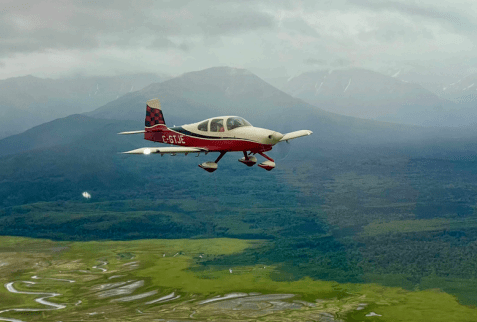
The Tazlina glacier looked like a good start. We flew over the west shore of the lake and made our way up the glacier. These glaciers are very wide with lots of room to turn and no place to land. The crevasses were huge, and many filled with bright blue glacier melt.
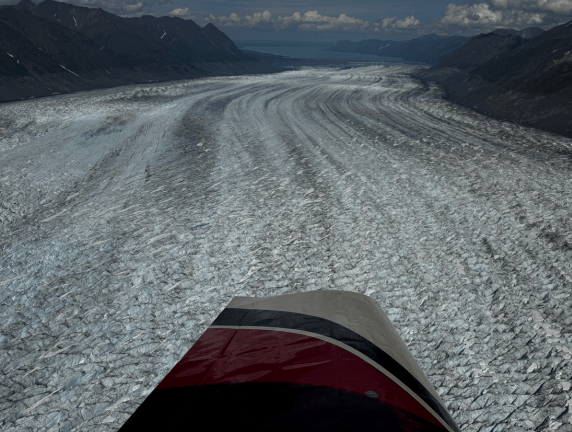
The air was smooth and the scenery was spectacular. Before reaching the top of the glacier we turned around and headed back on the other side. After exiting we turned west and passed many more glaciers on the way to Anchorage.
The plan was to land at the international and taxi over to Lake Hood to tour the lake and go for lunch. It is only a class D airspace but there are many VFR procedures that you must study before flying the area. We got cleared to land on Runway 7 R with a massive taxi instruction. Getting a taxi instruction for an unfamiliar airport while still on roll out is not the most fun thing to do. Soon we were clicking our mike to open gates and having cars stop for us as we crossed the roads. That part was very fun to do. We found a place to park, and it was time to relax and explore the area.
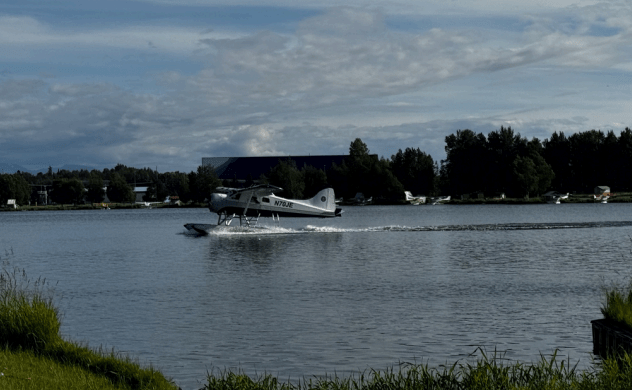
There was lots of activity both on the water and on the gravel runway. It was a perfect afternoon of plane watching. We had lunch at Lake Front Anchorage and made sure we did not eat too much, making us tired as we had more flying to do. It was back to the plane to load up and depart a different runway than we landed on. This was the Lake Hood 2200 ft Gravel Runway. Last stop of the day was Palmer for the night.
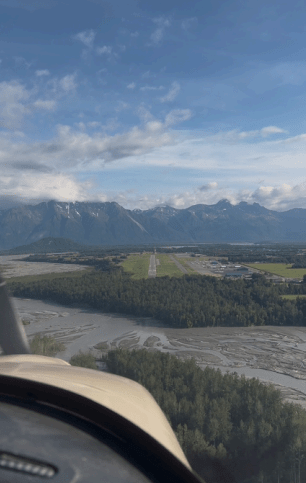
We took off north bound over the Knik arm at low level making our way east over Wasilla and into Palmer. It was late evening now, but we had lots of daylight. There were many planes flying everywhere enjoying the great weather. We found a slot in the traffic pattern and landed in Palmer.
We took our time unpacking and making sure the planes were ready for tomorrow.
Once tied down, we walked into town to find our hotel. When we arrived, there was no one to be found but a sign on the desk to call this number. We did that and each of us got a room code. We never saw anyone. Weird…..
Next morning we woke up to cloudy weather with rain in the forecast for the flight to Soldotna. We filled up the planes and loaded up for departure. The plan was to fly the Knik Glacier before heading to Soldotna. The weather was still good, and we made our way well up the glacier. Lots of blue pools and amazing views. The amazing part is that all the glaciers are so low in elevation we never flew very high.
After the tour we headed back towards Palmer and turned east for Anchorage. Ceilings started to get lower and the rain started. We stayed out of all the airspace and just kept our eyes out the window looking for all the traffic. ADSB was a huge help as it clearly showed the other planes on our EFIS and we could take action to avoid them.
As we flew over the Turnagain arm the rain got a bit heavier. Vis was still reasonable. You could see all the white caps below, but the air was smooth. Once across we turn direct to Soldotna. We cruised down the Kenai Peninsula and enjoyed the mountain views on our left.
Weather started to improve as we landed in Soldotna. The plan was a couple of days of fishing Salmon on the Kenai River. It was now Monday, and we would spend two nights in Soldotna as we had a room booked in Whitehorse for Wednesday.
Gavin fished all afternoon into the evening learning the Alaska way to catch salmon. By Tuesday he had figured it out and caught several that we put on ice. The plan was to have them filleted and shipped home.
Wed morning, we woke up to an overcast sky with improving weather to the east. We loaded up the plane for a solo trip back home. The air was smooth, and we soon passed Anchorage and made our way to Gulkana for fuel. We filled up and made our border crossing call to get our number from Canpass.
Typically, we get our transponder code from center but for some reason that was not the case. We needed to get the code from flight services and the other strange thing was our Forflight flight plan did not get into the system. We filed in the air and got a transponder code. We did not need to talk to anyone after that.
It wasn’t long and we were back in Canadian airspace following the Alaska Highway. Jody and Gavin were both sleeping so I guess the scenery was nothing special anymore.
We landed in Whitehorse and made our way to the hotel. There was still lots of the day left so Gavin spent hours fishing the Yukon River and catching many Greyling. As the day came to an end, I knew we would be in for a challenging flying day tomorrow. The plan was for an early start.
We woke up to clear skies and planned to make a stop in Watson Lake to fill up so we had more options with full tanks. With good weather we made more of a direct route to Watson Lake. As we neared the destination, we could see a cloud cover well below us and it was near the airport. I talked to unicorn and it was scattered 7500 over the field. Sure enough, as we arrived there was a big hole over the airport. East and south of the airport had large cells and rain showers. The turnaround needed to be quick to try and get around the storms before they got too big.
I filed a VFR flight plan on an IFR route as I really was not sure how this was going to play out. I figured if I did that it would be less work to change it to an IFR flight plan in the air. I was talking to flight services before we got airborne and explained my plan. He could see lightning strikes on each side of our route, but it looked like we could get through.
Once airborne we climbed to the east. The clouds were all at different levels and there was no real clouds base. It was not long before I figured this was not going to work VFR so I got the flight plan changed over with FSS to IFR. You don’t have long to make the change as you will go out of radio range with FSS and you are too low to get center.
Minutes later I got the clearance. I was able to get 8000 east bound as 9000 was a bit too tight for the freezing levels and the lowest on the airway was 7100. I then requested a deviation left and right of course to avoid the larger cells. I got cleared for 5 miles on each side of course.
I have the diversity transponder so they could see us the entire time even if there was no radio contact. I was told to contact center just outside of Fort Nelson. We were in rain and in and out of cloud for about ½ hour then it turned to smoke so thick we could not see the ground. It was close to an hour before we could get in touch with Center. IFR and no one to talk to, it was an interesting leg.
After we turned the corner at FT Nelson on the airway the smoke got better as we went south to Dawson Creek. We flew the approach and landed in good weather in Dawson Creek. We filled up and went inside for lunch. The radar from Edmonton to Calgary looked terrible and the Taf’s were not any better. Based on timing it looked like Red Deer had decent weather for our arrival time, so we flight planned IFR to there as a start.
We climbed out of Dawson Creek through a scattered layer to smooth air. The first leg was direct to the Whitecourt VOR. As we flew along, the scattered clouds started towering and filled in to more of a broken layer. We were in and out of clouds most of the way to White court. I was watching the radar, and our course would take us between some very large storms but the track to Red Deer did not look good at all. Centre soon gave us a reroute for after Whitecourt as they knew the current one would not work.
The new route was to the Rocky Mountain House VOR which would keep us in between the weather. With the vertical development increasing, I requested lower which got us out of the clouds.
We got through the vertical development part of the weather and then had to climb back up into the clouds because of the Minimum altitude for our route. By this time, it looked like we could change our destination as there was a nice slot right down to Springbank. The line of storms was south of Calgary to North of Edmonton with no gaps.
We changed the destination with Center and made our way past Rocky Mountain House. The air had gotten much smoother, and it was not so jarring in the clouds. We got cleared for the Kipev Four arrival into Springbank. Just before we got cleared for the approach, we broke out going down to the next assigned altitude. We knew from there we could get home. I canceled IFR and made out way direct for home.
As we looked down everything was flooded with standing water everywhere. The next question was how soft our runway was going to be. I have great drainage so there is never any standing water but was it going to be soft. I set up to land with a planned go around. Let the mains touch and instantly knew it was fine. Rolled out and taxied up to the hangar ramp. What a flight from Whitehorse. It was good to be home, but the trip was much too short. Went into work on Friday and then blasted off for Oshkosh solo Saturday for more IFR flying fun.
 Calgary Recreational Flying Club YYC