

There I was, at 5000 feet, tracking Highway 21 south from Three Hills approaching the Rockyford area. I thought I’d turn in a few more miles to head for Strathmore and flyover Gary Abel’s house to wave at him. The Lycoming in my Cavalier thought differently.
Suddenly, the engine started running really roughly, sputtering and missing, and generally complaining about everything. I immediately pulled on the carb heat, but to no avail. The roughness continued to the point where I started planning for a forced landing.
I’d just nosed over to begin an emergency descent when the gurgling and spitting began easing off. I turned directly toward the Early Bird Air ag strip, which sits on the west side of Highway 21, planning to use it if the engine did quit. And if I made it that far. Suddenly, the motor returned to almost normal, but with still noticeable roughness, and I was able to effect a safe landing back home at Kirkby Field several minutes later.
That bad behavior would need to be addressed immediately before any further flights.
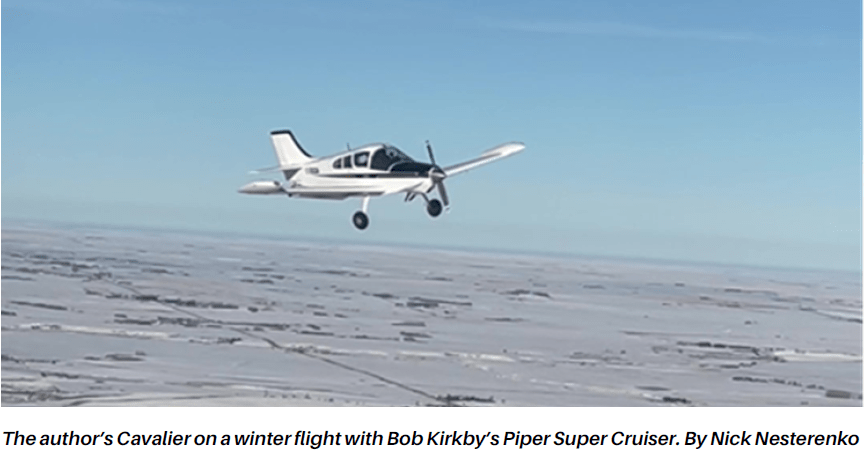
Due to a prolonged winter cold spell, I had no chance to get to my hangar and dig into the problem until late February. I talked about the event at the February Flying Club meeting, and one of the learned AMEs in the group suggested it could have been carb ice, or a sticking valve.
I doubted it was carb ice because it was nowhere near a carb ice day. Plus, my carb temperature gage showed well above zero both before and after the near failure. And once the worst of the roughness cleared up, I removed the carb heat and the lesser but still noticeable roughness persisted. Of course, I experimented with carb heat on and off for the remaining minutes of the flight, but there was no substantial change because of it.
I did worry about a sticking valve. And while I didn’t rule it out, I also doubted that. My engine has always run really clean, largely because I’ve used a mixture of about 50% mogas. Plus, I ALWAYS run lean, to the point where I’ve never run it at full rich since I’ve owned the plane, not even idling on the ground. I’ve never experienced what’s called Lycoming morning sickness, either. That’s where the engine runs roughly when it’s cold just after start up. It’s a symptom of lead fouling in the valves and valve guides.
Finally, in the last week of February, I got to the hangar and started the investigation. My first check was the fuel. I sumped both tanks and the gascolator, but the fuel looked clean enough to use for surgery. No joy there.
Next, I rolled the Cav outside and ran it up for several minutes doing mag checks at various RPMs. There was less roughness then, but it was still there. Then I leaned it way out and things improved dramatically. When I shut it down, the RPM rise just before it quit was exactly as it was supposed to be, only about 50 revs, or so. That cast doubt on problems with the carburetor.
I ran out of time to do more that day, so I headed home, still rolling the problem around in my head.
The next day I pulled the lower spark plugs and learned I was the victim of a motor most foul.
All the lower spark plugs were terribly clogged with lead! The ones on the front two cylinders were the worst, by far.
I stuck an inspection camera into the jugs and saw that the front two piston crowns were much more heavily coated with lead chunks and deposits than they’ve ever been. Even the spark plug holes had chunks of lead around them.

I couldn’t for the life of me figure out what would cause such a fouling issue, especially since this had never occurred before. Could it be the ignition, a case of poor or inconsistent combustion because of a bad magneto? Unlikely, I thought, because there’s only 200 hours on the mag since it was rebuilt. I checked that it was solid in its mounting hole and hadn’t slipped at all. All the plugs showed proper resistance on my ohm meter, too.
The top plugs all looked fine. They’re automotive plugs on a Light Speed Plasma II electronic ignition system. Their gap is a relatively broad .032”, while the aviation plugs’ gap should be about .017”. The Light Speed has been rock solid, a very unlikely source of the trouble. It’d be foolish to discount the ignition completely, but it wasn’t the prime suspect.
Maybe it was a carburetor issue. I felt that was equally unlikely because I had the carb re-built with updated floats only a year and 75 hours prior.
So what was the culprit? I admit that I was stumped.

I awoke in bed that night and as I tried to return to sleep, the answer finally found me.
Several factors colluded to bring the Cav’s engine to that problematic juncture, I theorized. The first, as I mentioned, was how alcohol-free mogas is no longer available. Of course, alcohol in aviation fuel is unwelcome because it can cause vapor locks and stop the flow of fuel to the engine. So, instead of running 50% cargas, I’ve been forced to run 100% 100 low-lead, which isn’t really low lead at all.The bottom line is that my engine now had a lot more lead going through it.
The next factor was the weather, being much colder in the fall and winter, which naturally cools the cylinders more, especially the more exposed front two. Thus,the heat necessary to properly burn off excess lead and put it out the exhaust is substantially less at that time of year. That was evident in the heavier lead fouling on the front two cylinders. And my engine runs cool to begin with.
But what about just running the engine faster and thus hotter? And that is where the real crux of the issue lies. My flying habits in the previous few months had changed substantially.
I usually fly with guys whose aircraft speeds are close to mine. I normally fly at 2500 – 2550 rpm, which gives the Cav 125 – 130 knots (145 – 150 mph) true. But things have changed lately.


Bob Kirkby, with whom I fly most frequently, swapped airplanes with his son, Keith. Keith now has use of Bob’s Piper Cherokee 235, while Bob is flying his Piper PA-12 Super Cruiser. The Cherokee and the Cav are very similar in cruise speed, where the PA-12 cruises at about 105 mph.
I also fly with Wade Miller and his Zenair CH601, which cruises around 100 mph.
What I didn’t realize is how the more frequent slow speed, low-RPM, and low temperature flying was affecting the Cav’s engine.
So, there in the middle of the night I reckoned that the lower revs, slower speeds, cooler temperatures, and higher leaded fuel content, were fouling my spark plugs to the point of drastically affecting the engine’s operation.
So, what’s the remedy? I replaced the front two lower spark plugs with new ones.Then I thoroughly cleaned and re-gapped the other two. The rest was simple. I needed to fly the snot out of the Cav for the next several hours, well-leaned, to get things hot enough to rid the cylinder innards of all that excess lead.
A couple of days later, I climbed into the Cav with fingers crossed that the diagnosis was right and the cure was correct. The O-320 fired up easily and smoothly. I did an extensive warm-up, a careful run-up, and headed for the runway. Prior to the takeoff roll, just in case, I re-visited my plan for a forced landing immediately after departure.
I put the throttle to the stop and away we went. Acceleration was normal and smooth, and in seconds the tail was up. Then the Cav lifted gently off the runway and headed back home to the sky. I kept the power a bit higher than normal for the flight, around 2600 RPM, and warily enjoyed flying on a pristine and exceptionally pleasant late winter day. I did several touch-and-go’s and after a bit more than an hour brought the Cav back in for a full stop. The Lycoming ran like a sewing machine.
One last pleasant surprise was discovering that my fuel consumption had dropped a bit. Once I figured out that the plugs were fouling, my research revealed that excessive fuel consumption is a symptom of that issue. It was one last confirmation of having found and fixed the problem.
So I guess now I’ll have to be more careful flying with guys whose planes are a bit slower than mine. But that’s ok. I don’t mind flying a bit differently to keep my engine healthy.
The bottom line is that I’ll still get to be flying, and that’ll keep both me and the Cav from feeling foulb

Wade Miller’s Zenair Ch601. It cruises near 100 mph.
 Calgary Recreational Flying Club YYC
Great report, thanks for posting this. Ethanol or not, my Rotax 912ULS never gets 100 LL. I just wish ethanol- and lead-free gas was available at my home airport. Or anywhere, for that matter. It seems odd that they’re forcing ethanol on us to help the environment when it just causes pilots to use the highly leaded 100 “low” lead which is a lot worse.
LikeLike