
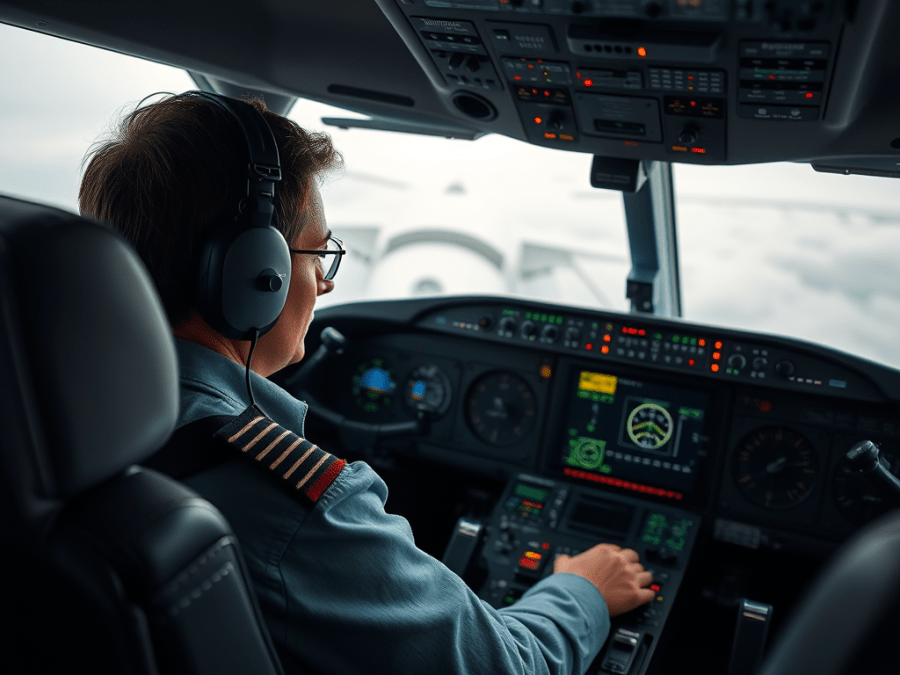
I’m really enjoying the fact that I have a multi-engine instrument rating. However, there are certain minimum requirements to keep the IFR rating current.
One of these is that I have to do six approaches and six hours of IFR flying every six months in a multi engine aircraft. If I haven’t met this requirement there’s an option called an instrument proficiency check (IPC) in a certified multi-engine simulator, or actual aircraft once a year.
Unlike logging regular hours, IFR hours only count when flying actual IFR. On an IFR flight on a clear day you can only count the IFR departure and approach time, not the blue-sky time. Or you can bring a qualified pilot along and fly with a hood. Admittedly, the rules can get a bit complicated around this stuff.
A multi-engine aircraft rental costs between $400-$500 an hour, so to meet the 6/6/6 requirements I’d have to spend $6000-$10,000 per year staying current. That didn’t make much sense to me if I didn’t have a job where my employer was paying for my flying time.
Thus, I chose to do the annual IPC in a simulator. In my case this was similar to my IFR flight test which was about an hour of oral examination and then two hours of instrument flying including emergency procedures. Naturally, this includes losing an engine on approach. My IPC sim ride ended up costing about $1000 and it’s time I can use in my logbook. I think it was a good investment.
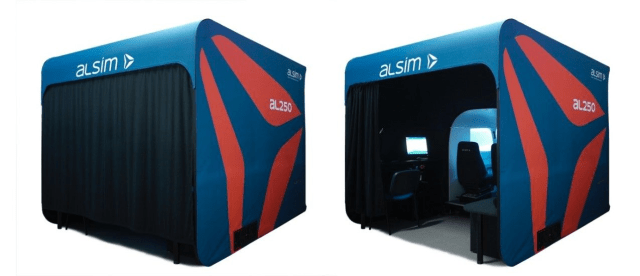
Flying the simulator is a challenge because it’s not like the real plane. From a panel perspective it’s equipped with similar instruments and radios, but there’s no motion. Since this is an instrument flight test there’s no ground or horizon outside the windows. Shortly after takeoff the windows turn cloudy and stay that way until you reach minimums on approach. Fortunately, I was able to use autopilot for part of the IPC which gave me time to get more familiar with the simulator and get a better feel for handling the plane and coordinating that with the instruments.
Even though I was in a sim I was expected to make the same radio calls, do the checklists and otherwise fly the flight plan as I would in a real plane. In the sim the examiner acts as ATC and provides ATIS information when requested.
My examiner let me pick my own route and I “filed” Springbank to Olds/Didsbury and back. The examiner gave me my clearance, taxi instructions, and at the appropriate time, the takeoff clearances. It was strange trying to taxi a flight simulator, complete the checklists, and do things exactly as I would in the plane. It felt kind of like a video game.
The simulator doesn’t have turbochargers in its configuration so takeoff was a bit pathetic. If I were to stall and crash on takeoff I knew not to expect a do-over. Oddly enough, it’s the same in real life.
At 400 feet I confirmed gear up and started retracting flaps. I started to set power climb power when I realized that the view out the windows was gone. Once I leveled off I did the cruise checklist and then soon started into the descent checklist. At this point the examiner, seeing that I’d done all the required items, moved me ahead closer to the actual approach into Olds-Didsbury, and gave me my approach clearance.
Next, I switched frequencies, made the required radio calls, and got the ATIS. I started the approach and did the landing checklist. This approach was what’s called an RNAV LPV with the autopilot. It uses pre-loaded waypoints and steering cues that the autopilot follows including a calculated glideslope. The examiner was watching closely to see that I handled the automation correctly.
It’s important to note that modern instrument flying requires a very strong understanding of how to properly use the automated aircraft systems that are onboard even relatively basic singles and twins. The advent of automation, and the substantial safety boost that it can provide, means that pilots MUST know how to best use it in a wide variety of scenarios. It’s also critical to understand how to recognize and safely react when the automation screws up, or if the pilot has programmed it incorrectly.
Back to the sim. At minimums the runway didn’t appear so I went to full power, squeezed the TOGA (Takeoff/Go Around) button and leveled off above the minimum descent altitude (MDA) until reaching the runway threshold.
Then I started the missed approach procedure. The TOGA button activates the flight director (guides on the attitude indicator) and sets the autopilot to fly the plane through the proscribed procedure for the missed approach. That procedure is designed to position the plane to where the pilot can either try another approach, or divert to a different airport. If there are terrain, obstacle, or airspace restrictions nearby, the missed approach procedure can be pretty complicated or have higher than normal climb rate required for obstacle clearance.
My divert airport for the sim ride was Springbank. I “called” Edmonton Centre, which is the air traffic control facility that looks after IFR flights across the Prairies and Arctic, and asked for a new clearance back to CYBW.
I got the sim back into cruise configuration with all the checklists completed. I got the latest ATIS for Springbank after which the examiner instructed me to fly an oval pattern called a hold. This is where the plane heads to an established waypoint of lat/long coordinates, and then flies an oval race track pattern based on that waypoint.
IFR flying takes more time since aircraft have to be separated farther apart than in VFR flying. Thus, before a plane can approach an airport, it may have to wait in line. A holding pattern on a fixed waypoint allows planes to essentially wait their turn before being cleared to fly an approach.
My examiner sent me to a waypoint called ADVOX, near Cremona. Once in the hold I powered back to save fuel, and concentrated on flying consistent one minute legs and knowing my position for when I got cleared to turn toward Springbank. Once my examiner was satisfied with my performance in the hold, he vectored me southward.
I completed the descent checklist and configured the plane for that phase of flight. Here’s where I got my “unexpected” emergency. One of the oil pressure readings went to zero. The first thing to ask is whether or not it’s actually a pressure loss, or simply a gauge failure. I was able to determine that it was simply a gauge malfunction.
The point, of course, is to see if the student can think his or her way through proper trouble shooting to determine the cause of the problem and then initiate the best course of action.
Sometimes you have a few minutes to work the problem, other times, like with an engine failure or fire, the reaction has to be immediate. Now it was time for some unusual attitude recoveries. I had to close my eyes while t he examiner reached over the copilot seat to maneuver the plane. When I opened them I quickly determined from the flight display what the problem was and then recovered to a normal and safe attitude. We did a couple of these exercises, which don’t take long, and then all that remained of the ride was the last approach into CYBW.
I was assigned an ILS approach to runway 35. An ILS is a precision approach that uses ground-based radio signals as opposed to just GPS waypoints and courses like an RNAV approach at places like Olds-Didsbury, High River, Three Hills, and many more. I was instructed to fly this approach by hand, no using the autopilot. My examiner gave me vectors to intercept the localizer. He was watching closely to ensure I was flying my turns correctly with the appropriate speed and bank angles. Then there were more checklists, and a passenger briefing. I made the appropriate radio calls, set up my instruments to show my position on the localizer and glide slope on final. I received my heading to intercept the localizer, then I set the flaps. And my instructor failed one of the engines.
As I said above, my reaction had to be immediate. First, I had to fly the plane, and ensure it was under control. No time to troubleshoot the problem, I had to figure out which engine abandoned me, secure it, and then maintain the proper position on the instrument landing approach.
In this situation the plane is fairly hard to fly accurately. Added to that, the examiner might have actually set the clouds to below minimums, meaning I wouldn’t be able to land. That would entail a single-engine overshoot, climb,and then setting up again for another approach.
Imagine if this was in real-life, at night, in worse weather that might include heavy winds and turbulence, heavy precipitation, in-flight ice, and other mechanical or instrument problems where the diversion airport is a long way away. You can easily see how single-pilot multi-engine (and single-engine) IFR operations can quickly turn deadly.
Today though the runway appears straight ahead as I break out of the clouds at about 100 feet above minimums. The landing was pretty straight forward, even on one engine. I shut down on the runway and set the parking brake.
It was far from a perfect flight, and my ILS approach was more like a roller coaster ride than a normal approach. But my examiner determined I stayed within limits and that I’d met the requirements to call myself a multi-engine instrument pilot for another year.
 Calgary Recreational Flying Club YYC