

ICAO Designators: What’s Your Type?
So, interestingly, there’s a good chance that your aircraft has a type designator listed with ICAO, even if it’s an ultralight or a homebuilt. Allow me to explain what I’m talking about.
First, what’s ICAO? It’s the International Civil Aviation Organization. It’s a United Nations agency, headquartered in Montreal tasked with, among many other things, ensuring standardization and cooperation between countries for air operations around the world.
That’s really important because aviation so easily transcends national borders. Imagine if you took off from one country and flew to another where they used different runway designators, different radio bandwidths, phraseology and more. Global air travel would be an absolute disaster. ICAO makes sure everyone’s speaking the same aviation language everywhere.
One of the standards that ICAO offers is in flight plan formats. When you file a simple VFR flight plan, the type that our club members most commonly use, that plan adheres to ICAO parameters. There may be some very minor tweaks from one country to the next, but the vast majority of the flight plan will be usable world-wide. One of the boxes on the flight plan form is that of the aircraft type.
You might try to fill in that box as a ‘Cessna 150’. But the form ain’t havin’ any of that. It requires a specific two, three or four character type designator from a list that ICAO maintains. If you’re flying a Super Goober 2000, and the manufacturer has gone to the trouble to register the type with ICAO, the agency will have assigned it a discrete code. If it’s not on the list, there are options for you or the briefer to still fill out that box. For an ultralight, I think the designation is ULTR in Canada.
I got curious about some of the planes in our club and what their designators are, so I decided to take a look. Here’s what I found:
- Zenair CH-250 = CH25
- Zenair CH-601 = CH60
- Zenair CH-701 = CH70
- Bush Caddy R120 = CAD2
- Evektor Sportstar = EVSS
- Ercoupe = ERCO
- Cavalier SA102.5 = SA02
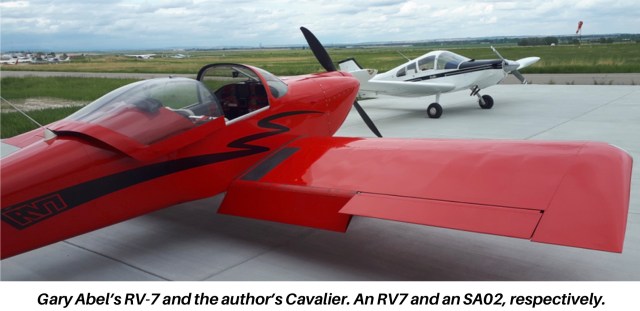
The Vans RV series are all simply known as RV4, RV6, and so on.
There are over 40 different Piper Cherokee models designated, all with variations on P28, such as P28A, P28R, etc.
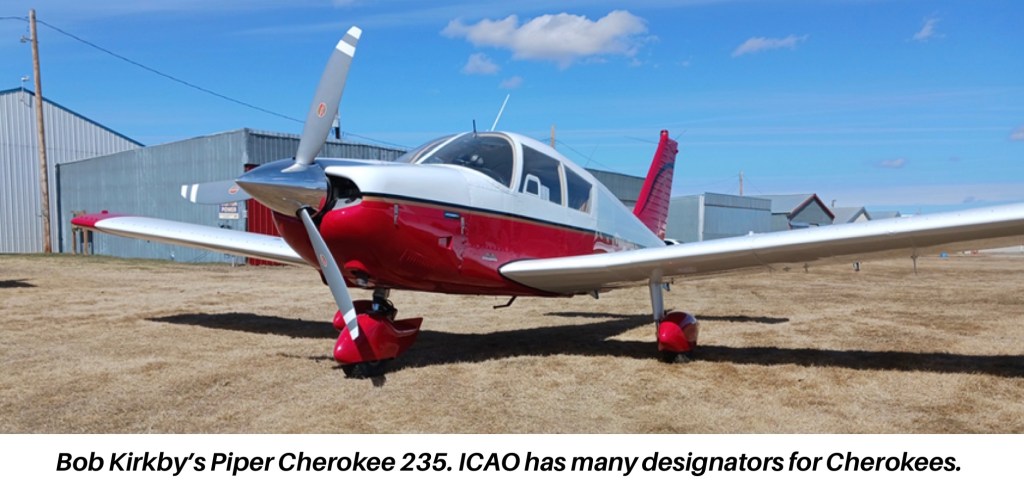
By contrast, the Cessna 182, has only 4 variations; C182, and C82R, S and T. The Cessna 195 is noted as a C195, or an LC-126 for any that have been converted from military use. All models of the Cessna 150 are noted, not surprisingly, as C150.

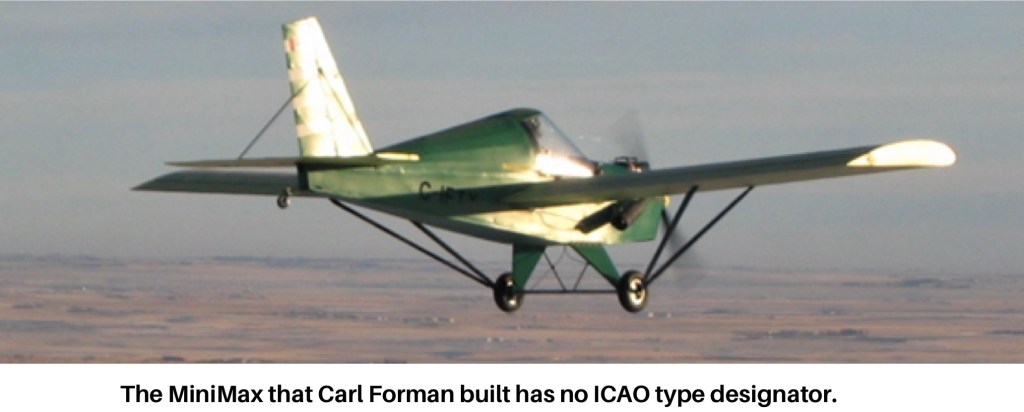
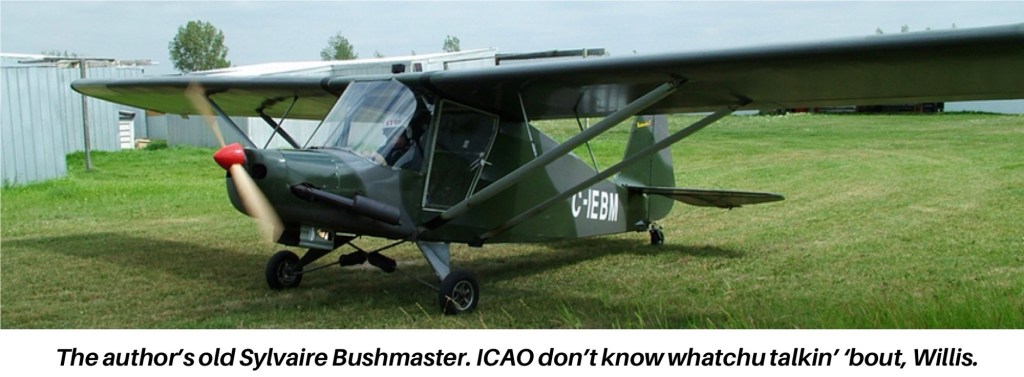
John Kerr’s RAF 2000 Gyro is an RAF2. I was honestly surprised at some of the entries for ultralights, both for what is there, and what isn’t. For instance, I couldn’t find anything for TEAM Minimaxes, or Himaxes. Same for the Sylvaire Bushmaster and the Challenger.

But I did find entries for the Spectrum (later ASAP) Beaver as BEVR. The Aces High Cubby 2 is the CUB2, and the Chinook is CHIN. There are 11 different designators for Rans aircraft.
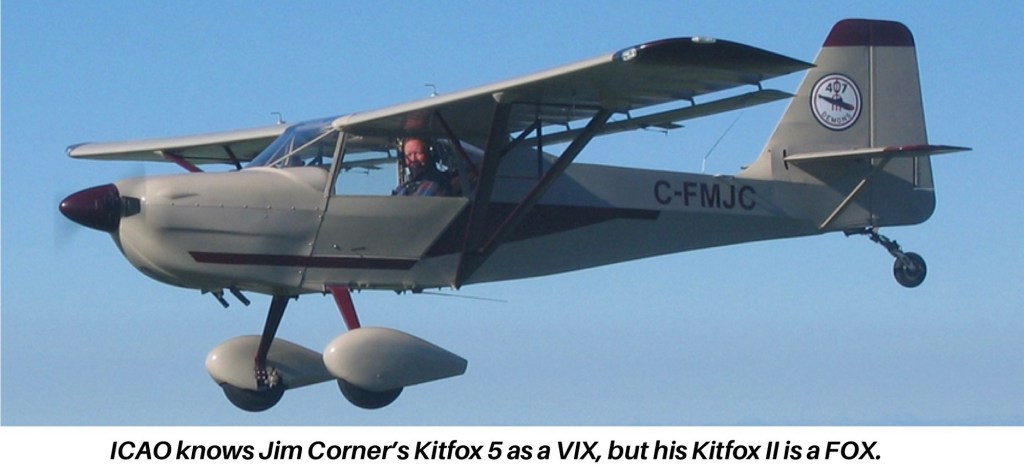
All models of the Kitfox except for the 5, 6, and 7, are noted as FOX. The others are typed as VIX.
So, the next time you’re filing a flight plan and the briefer or online service asks,
“What’s your type?”, they really want to know your plane’s ICAO designator.
If I haven’t covered your aircraft, here’s the link to search it on the ICAO website.
https://www2023.icao.int/publications/DOC8643/Pages/Search.aspx
 Calgary Recreational Flying Club YYC