

I’ve had an ADS-B system in my Cavalier for the last four years, so I thought I’d take a look at how it’s performed and how it’s affected my flying in that time.
Mine is the EchoUAT made by Uavionix of Kalispell, MT. It’s an in and out solution, transmitting and receiving traffic and other data on 978 MHz, and also receiving traffic data on 1090 MHz. Being a UAT device it picks up signals from compatible ground stations, which only exist in the US. There is one privately operated station at an airport in southern Ontario that’s been operating successfully for a while, but that’s the only one I know of in Canada.
The 1090 MHz systems, use Mode S ES (extended squitter) transponders and shoot out the same information (ident, position, speed, altitude, etc.) as 978 MHz transmitters. But 1090 users still need a separate receiver unit to pick up any ADS-B signals from other aircraft or ground stations. Those receivers are dual band and receive on both frequencies.
The EchoUAT is optimized for use in the US, but having a dual band receiver makes it very well usable in Canada, too. The system is only for use on homebuilts and ultralights, not certified planes. From what I can tell, Uavionix is still supporting, but no longer selling the unit. Too bad, because by a long shot it was the most cost effective ADS-B in/out solution out there.
I’ve made several flights in the US since installing the EchoUAT and it’s clear that a much larger percentage of US small aircraft are ADS-B equipped compared to Canada. That’s largely because the FAA, the aviation alphabet groups, and avionics manufacturers in the US essentially fostered the completely false fear that a plane wouldn’t even be able to leave the ground if it didn’t have ADS-B installed.
The truth is that if you’re outside of Class B or C airspace down there, and below 10,000 feet, or 2,500 AGL in high mountainous areas, you don’t need ADS-B. Period. Have a look at the Google Earth screen capture below. It shows the only places you need ADS-B if you’re below 10K. There are laughably few spots compared to all the fear mongering that occurred. Some states have no low-level (below 10K) ADS-B airspace at all.

From our VFR, low-and slow, perspective you might think that if it’s required in so little airspace in the US, and not yet required at all in any low-level airspace in Canada, ADS-B is a waste of time and money. That will be a personal choice, of course, but my ADS-B investment has absolutely paid off.
ADS-B is a quantum leap in safety and situational awareness for us VFR pilots. It’s truly like having 360 degree radar in the cockpit. I’ve lost count of the number of times the EchoUAT has been essential in conflict avoidance in four years. On some occasions, I’ve even contacted converging aircraft on 126.7 and been able to resolve potential conflicts that way.
A good example showing how ADS-B boosts flight safety. Flying back to Kirkby Field from Vulcan put the Cav in conflict with C-FTLM. The other plane displays as red due to being within 5 miles of me. I was able to climb to 5300 feet, where I took this shot, and avoid any conflict with the other plane. (See below)

Another great feature for me is how it’s so useful when flying with another aircraft. Bob Kirkby and I fly together regularly. He has Garmin ADS-B rigs in his aircraft. If we get separated, which happens sometimes, I can still see exactly where he is, which allows for a much safer re-join. And it gives peace of mind showing that we’re not about to collide while we’re unseen to one another.
It’s also useful for meeting another aircraft while airborne. On several occasions Brian Byl and I have hooked up in the air between Bishell’s and Kirkby’s strips. ADS-B leaves no room for doubt about the rendezvousing aircraft’s position.
The EchoUAT shows other aircraft’s positions, but it tells lots more information, too. It displays their ident, altitude, speed and direction. That information is really useful when you’re trying to judge whether or not a target presents a real or potential conflict.
Let’s say I’m headed to Vulcan, inbound from the north, twelve miles back. My screen shows another plane also headed there, but perhaps from the High River area, and a similar distance out. I can simply tap on the other plane’s target icon to bring up his or her information. If it shows them grounding 100 knots, while I’m doing 130, there’s likely little to worry about. I’ll be well out of their way before there’s any issue. And of course, we’ll be on Vulcan’s radio frequency as we get closer.
If I see another aircraft suddenly appear at Vulcan, I can also tell if it’s one that just started up and may pose a potential conflict upon my arrival. I don’t necessarily have to wait until I hear that plane holding short of the runway to know it’s a factor.
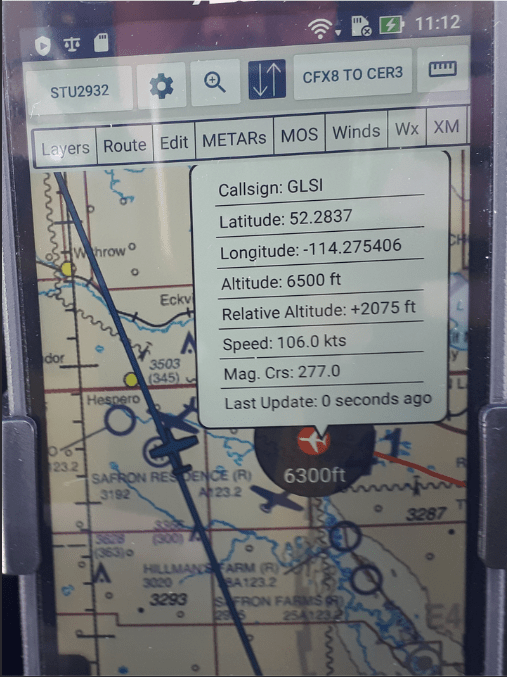
This shot below was taken northwest of Red Deer and shows the information available if I tap on a target icon. I was 20 kts faster and more than 2000’ lower than C-GLSI, and thus able to avoid any conflict. Undoubtedly great information to have.
Here’s how the Cav appears as an ADS-B target on Gary Abel’s GRT EFIS in his RV-7. I’m at Gary’s 11 o’clock level for about a mile and a half. The +00 means we’re at the same altitude, and the line extending from the Cav’s target icon shows my heading. Since Gary’s quite a bit faster than me, there’s a chance of conflict without this information being available to him. Photo below by Gary Abel.

Of course, all of this depends on whether or not other aircraft are broadcasting ADS-B signals at all.
On the several trips I’ve made to the US since installing the EchoUAT, it’s proven itself enormously helpful. I recall flying with Kirkby and Carl Forman, who were in Bob’s Cherokee, as we traversed a narrow air corridor between Wendover, UT, and Salt Lake City. The corridor is bounded north and south by some very heavily restricted military airspace. ADS-B showed another aircraft approaching us head on. We were able to safely track the other target and stay well clear, though we never did see him.
The US also provides a host of other in-flight information on the UAT system that’s not available over the satellite based 1090 MHz frequency. UAT receivers can get METARs, TAFs, radar, and more. That proved very useful for us in 2023 when we dealt with some severe thunderstorms over Idaho, and later some very low weather in Wyoming and Montana. And then later in the year the weather and traffic features were exceptionally helpful when my wife and I flew the Cav to Memphis and back. The traffic displayed was especially welcome in the busier areas like Memphis, St. Louis and Minneapolis.
A couple of things to note here. If you only have an ADS-B in receiver, you can see other ADS-B equipped traffic and access all the extra UAT-based information available in the US, but you’re not sending your position to other aircraft.
And regarding weather radar, Kirkby and Forman and I found that the UAT radar lagged a few minutes compared to radar info we got via cell-based internet on Windy.com. Of course, cellular internet may or may not be available depending on your location and altitude. Actually, the same can be said for UAT broadcasting towers, though they seem to have pretty good range and coverage in my experience.
ADS-B is coming to Canada, though I suspect it’ll only apply to mid and high-level airspace, as well as Class C control zones. Right now there are only 22 Class C control zones spread across Canada. Some have large terminal control areas and control area extensions attached, but you can fly underneath them since they don’t extend down to the ground.
So the question becomes how often you fly in those environments, and the overwhelming majority of the time the answer is seldom or never. ADS-B installation will future-proof your airplane, though, and certainly add value to it.
ADS-B has certainly gotten a LOT more expensive since I installed mine. I did so in 2021 for about $2000. Now, the cheapest Uavionix systems start well over $3000 CDN, and a full in/out set-up will likely set you back over $5K when it’s all said and done. There are some used ADS-B systems that I’ve seen for sale and I think those are well worth investigating. Also, receiver only systems are quite a bit cheaper and can at least provide you with more information even if others can’t see you. It’s lots better than having nothing.
Despite the cost, ADS-B use seems to be increasing steadily in Canada. If I hear another aircraft on the radio, I look at my screen to see where they are. More often than not now, I can find them there. My EchoUAT has made flying, especially in busier regions, a lot safer for me and for others. Installing it in the Cav has certainly been a worthwhile and well-returned investment for me.
 Calgary Recreational Flying Club YYC