
I prefer the way less travelled, a preference which when combined with happenstance, makes for good stories. Here is one about three fatal mishaps which occured during the WW II British Commonwealth Air Training Plan.

Each happened in our part of Alberta and each is commemorated by a physical monument. I did not seek them out, they were just waiting to be seen. They will do most of the story telling, and each has a bit of a twist of the tale for the attentive reader. The first is located on the south side of Highway 1A (for some of us, still “The Old Trans Canada”) just east of the Mini Thni reserve. Its bronze faceplate notes that on February 17th 1941 two members of the RCAF, one from Saskatchewan, one from Kansas , were “Stayed by the Hand of Death” nearby. Given these times of tariff tussles the words on the dedication plate ring now with hollow irony.
An internet search of the two airmen’s names , pilot Alfred Reginbal “and his American comrade” Quentin Burl Chace, reveals a good deal more about these men, the accident (they hit a cable near the Bow River) and how the monument came to be.

A small twist in this tale is that somewhere between ordering of the heavy bronze plates and their casting, the name of the Canadian was misspelled.. an “n” instead of an “m” in what should be Regimbal , a much more recognizable name in La Fleche, Saskatchewan.
Another monument lies on Range Road 25A just north of the Big Hill Springs Road (aka Highway 567) a couple of miles east of the Provincial Park of the same name. This lovely single stone memorial dates from November 12th 1995 but presents as almost new
It gives a detailed history of the crash and burn of a Tiger Moth on November 10th, 1941. Of note to me are the age of the instructor, the courage of his student and of course the heroism of a young woman, the local school teacher whose was awarded the George Medal for her actions . The words and pictures hint of the rigours of training and the risks necessarily taken to push through thousands of aircrew at what can truly be described as a breakneck pace. The pictures below are worth your study.
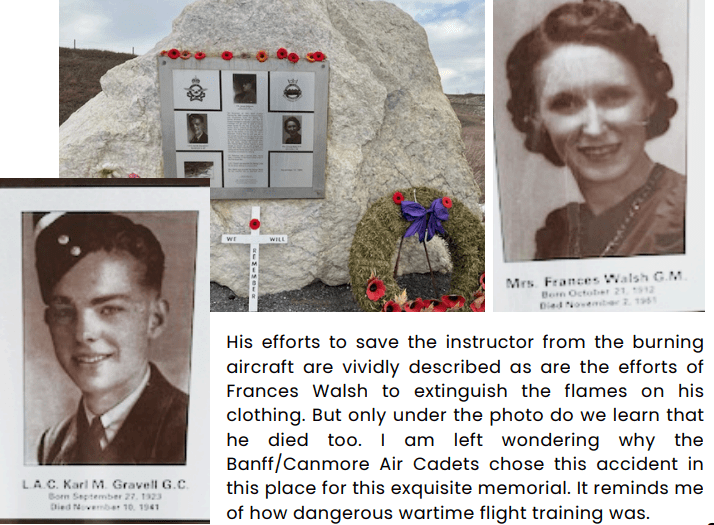
His efforts to save the instructor from the burning aircraft are vividly described as are the efforts of Frances Walsh to extinguish the flames on his clothing. But only under the photo do we learn that he died too. I am left wondering why the Banff/Canmore Air Cadets chose this accident in this place for this exquisite memorial. It reminds me of how dangerous wartime flight training was.
Once a client gave me the gift of a story about it. A superb pilot, he instructed for 2 years in Canada before going on to stellar active duty overseas in Europe, Africa , India and Asia flying VIP military people to and from every theatre of the war. He spoke of the tremendous push to get one class through, for another was right behind and the one ahead was desperately needed in Europe. Instructors knew full well that lessons were not always completely learned. Accidents in training were part of the calculations for victory.
He told too of being part of a group of instructors aloft in an Avro Anson studying a new piece of equipment. An Anson was a noisy classroom. Somebody seated well behind the pilot made a leaping reach over the pilot’s shoulder and turned the yoke. The others then saw an aircraft miss them by inches. His words to me: “They would have lost all of them and it would not have been the first time”.
His Anson anecdote brings me in suitable fashion to the last monument. It was dedicated on November 10th 1989 “In Memoriam, WWII Aircrew“ and sits surrounded by bushes at the end of a short path that leads to a stunning lookout about midway along the Powderface Trail. That’s the summer-only forestry road that winds through Kananaskis country from a point east of Elbow Falls southward to Sibbald Lake Recreational area. It’s a wonderful drive.
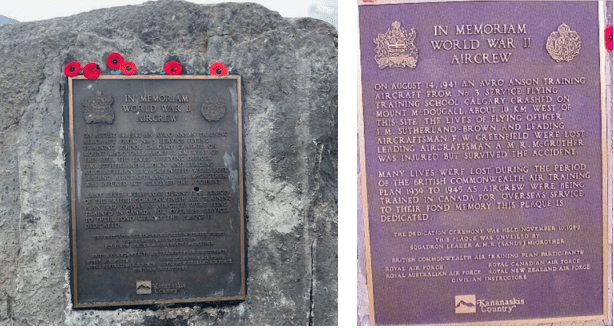
The photos and screen shots tell the story of a doomed Anson and its RCAF crew. The plaque nicely underlines the training risks involved and understates an incredible multi-day rescue and survival story. The screen shots or a Google search give welcome amplification to the details given. No STARS flew to Mount McDougall then!
I stood alone at this place on a perfect afternoon last October. There were no cars and I had no company except for the wind whispering to the yellowing leaves of sunlit aspens. The silence was broken by the whump whump of a helicopter. It swooped and hovered for a few seconds then swerved away like a dragonfly towards the mountains to the West.
I naively thought that perhaps they were checking to see if I needed rescue! Later I learned, to my surprise, that this spot is part of Springbank’s L R Helicopter’s scenic flight route for tourists.
The Twist here? The plaque mentions by name the leading aircraftsman who survived, but did you connect the dots to the squadron leader who unveiled this cairn?
In the quiet that followed, aided by the tattered poppies and wreaths still glowing after eleven long months of wind and snow, I reflected. First of course on the loss of vibrant young men and on their bravery. I marvelled at their utter commitment to a cause . Could my generation have done it? Could the generations following mine do it? I really do wonder.

 Calgary Recreational Flying Club YYC