


Day 1
Even though I promised myself that the last time was the last time, Bob Kirkby talked me into going to Oshkosh again. He actually had some pretty compelling arguments.
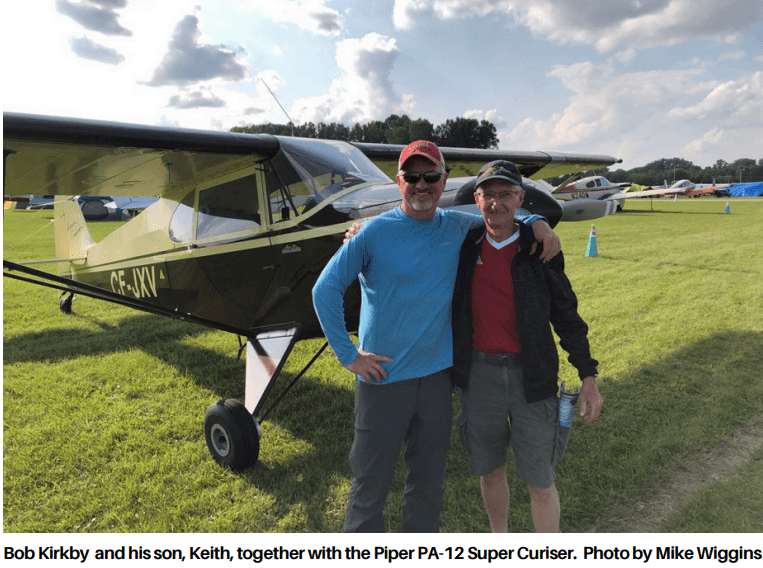
He said it might be his last time, and he was going to meet his son Keith there. Keith was planning to fly in to the show with his best friend, Mike, in the Piper PA-12 that he has on permanent loan from Bob.
How could I say no to that?
We lit out on Saturday, July 20th, headed for Cut Bank, MT. Bob and Carl Forman flew in Bob’s Piper Cherokee 235, and I piloted my beloved Cavalier.
Clearing customs was easy at Cut Bank and the customs officer wished us a good trip. We headed out eastbound and climbed to 5500’. Any higher and we’d likely lose sight of the ground in the thickening smoke. We had a headwind that increased with altitude, as well.
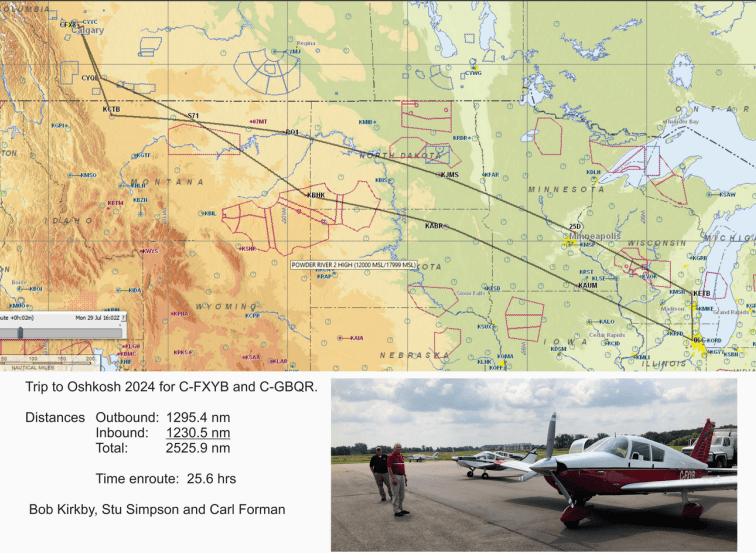
We landed a couple of hours later in Poplar, where a wonderful old fella sold us gas at a good price. His dog, Hank, a big brown mutt, was very friendly and not just a little demanding. He wanted his lovin’, so he just came up from behind me, pushed himself between my legs and flopped down on his back so I could give him the belly rubs to which he was so obviously entitled.
How could I say no to that?
Afternoon heat and humidity plagued us as we flew east, both of which steadily increased through the afternoon. Contrarily, the visibility dropped as afternoon haze mixed with smoke.
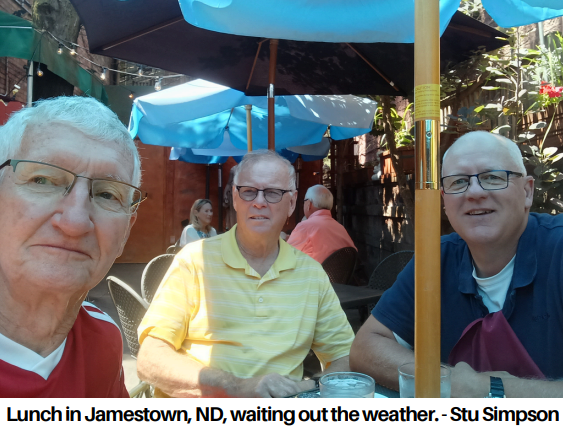
We ended the day in Jamestown, ND, a nice little city with a wonderful FBO owned by a guy named Sid. Sid couldn’t do enough for us and offered us the FBO’s crew car for the night, which we gladly accepted.
Day 2
Our plan today was to reach West Bend, WI, where we’d base and drive into Oshkosh each morning. But as we looked at the weather it seemed that our chances of making it that far were rather doubtful. In fact, it seemed doubtful that we’d even be leaving Jamestown.
All along our route numerous stations reported low ceilings with marginal VFR or just plain IFR conditions. We plotted an alternate strategy of shooting south around all the bad weather into eastern South Dakota and then more easterly through Minnesota on a line well south of Minneapolis. It looked like things were clearing sooner in that direction.
The delay did give us time to repair a minor wheel issue that had developed on the Cav’s right side. Once again, Sid provided tremendous help with the loan of a couple of hand tools and a jack.
By 11 a.m. things at Jamestown had cleared enough for us to be comfortable with departing. Other stations along our route were reporting improvements, too.
We left from runway 13 but within minutes of being airborne I was worried.
An unexpected low scattered cloud deck confronted us a few miles from the airport. We climbed easily over it and it seemed we’d have it to our rudders in about ten miles. But ten miles turned into fifteen, and then the scattered layer became a broken one. More cumulus clouds built quickly around us, too.
We concurred that we needed to get back below the clouds, so we each picked a hole and nosed over. We popped out much lower than we wanted to be, at only 800 feet AGL. We knew then that this wasn’t going to improve. We U-turned back to Jamestown having only gotten about 20 miles.
We landed, shut down, and went for lunch.
When we got back to the field the weather had improved substantially, but now a big squall line had formed 200 miles east between us and our destination. Our doubts proved correct, and we didn’t make it to West Bend that day
Day 3
The weather held us again that morning, but the forecasts were all pretty solid in their predictions of steady improvement. Sure enough, by 11 o’clock we were in the air and safely eastbound.
There were some tough spots in southern Minnesota, with scattered low clouds and patches of mist. It was incredibly humid, with the temperature/dewpoint spread of only a few degrees. Adding to the problem was the landscape itself which features very flat terrain and poor drainage. There’s a LOT of standing water in sloughs, marshes and shallow lakes.
We flew past St. Cloud’s airport, which is tower controlled, and the controller jokingly asked Bob if he was towing a glider. Our formation must have looked pretty tight on his radar. We all had a good laugh about it.
We quickly fueled in a place called Forest Lake, just northeast of Minneapolis, and were back on our way.
We soon encountered typical northern Wisconsin bush country with lots of marshland and bush. This lasted for about half an hour and I admit I was a bit uncomfortable traversing the area.
With the moose pasture behind us, we passed above typically beautiful farm country. Then the weather finally started to clear, too. We’d obviously flown from one air mass into another, and this one was much, much drier despite it being closer to Lake Michigan. Visibility improved to a thousand miles and any clouds, which had been skulking around just above our altitude all day, finally dissipated.
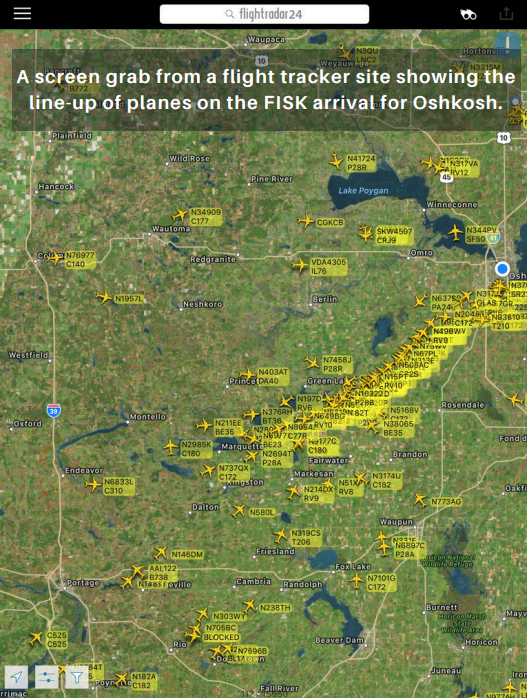
We listened to the Oshkosh check-in point at Ripon for the FISK arrival as the controller instructed inbound planes to rock their wings and follow his instructions. Within moments he picked out the last plane he was going to allow into the airport due to it closing for the pending airshow. He warned all other inbound planes that they’d have to land somewhere else. I was relieved because we were soon going to be crossing right over top of the area where the inbound conga line forms up.
It was suddenly a non-issue for us. ADS-B showed lots of other aircraft in the area that were now dispersing to other fields to maybe try again after the show finished.
We sailed on easily to West Bend airport where we landed, tied down, got our car and headed to check in at our hotel. Tomorrow we’d start our experience at Oshkosh proper
Day 4 & 5
We met up early with Keith and Mike and agreed to meet for lunch and then at the end of the day to all go for dinner. It was great catching up with both of them again and swapping flying stories. As for Oshkosh itself, I have to say that I was underwhelmed by this year’s version. Previous years have been much more interesting.
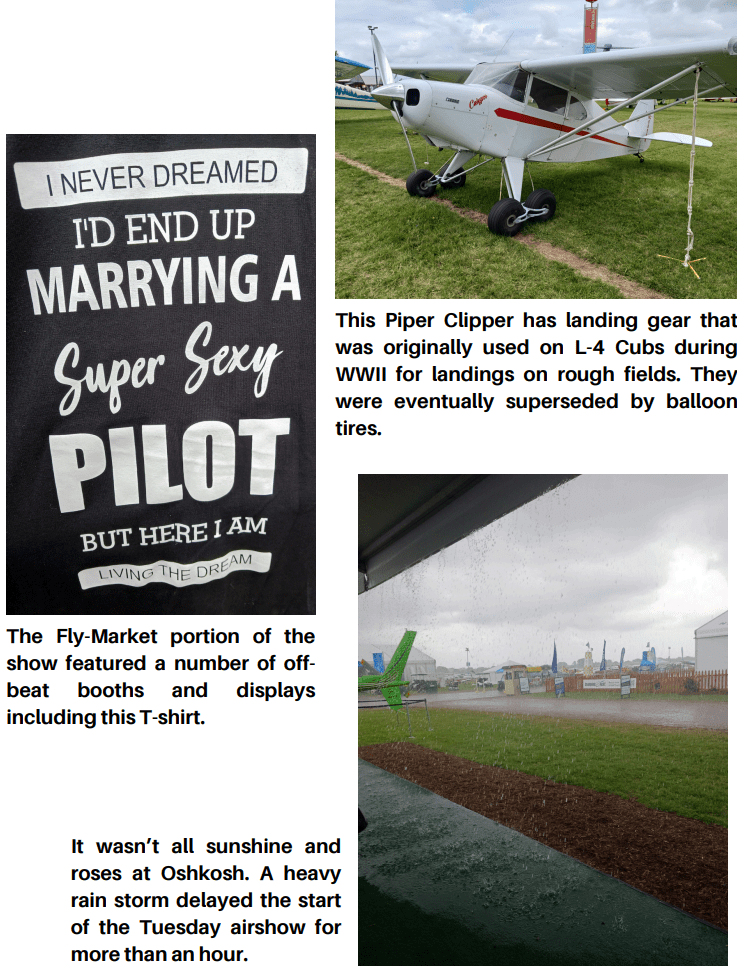
For instance, I love looking at all the different homebuilts that typically show up there. This year, there were only a few dozen in the homebuilt section, unless you count the hundreds and hundreds of RVs, that is.
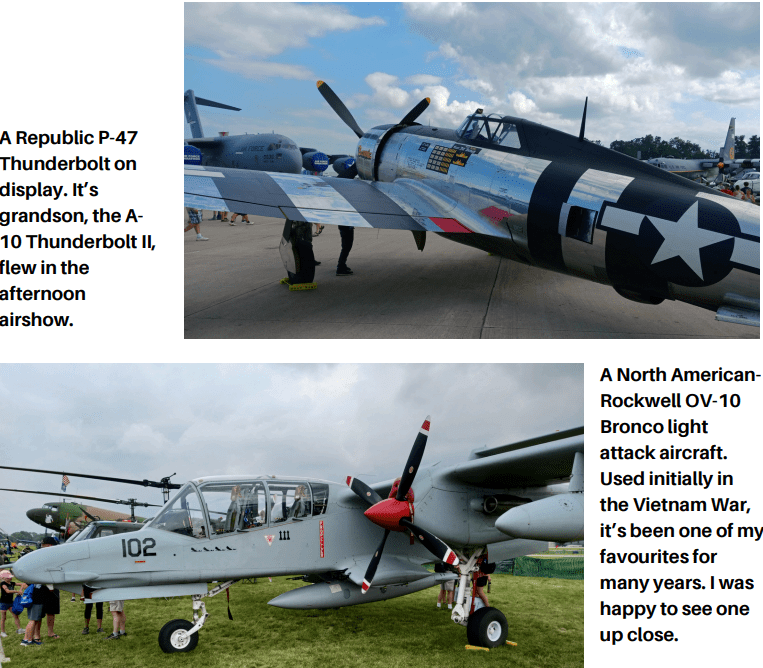
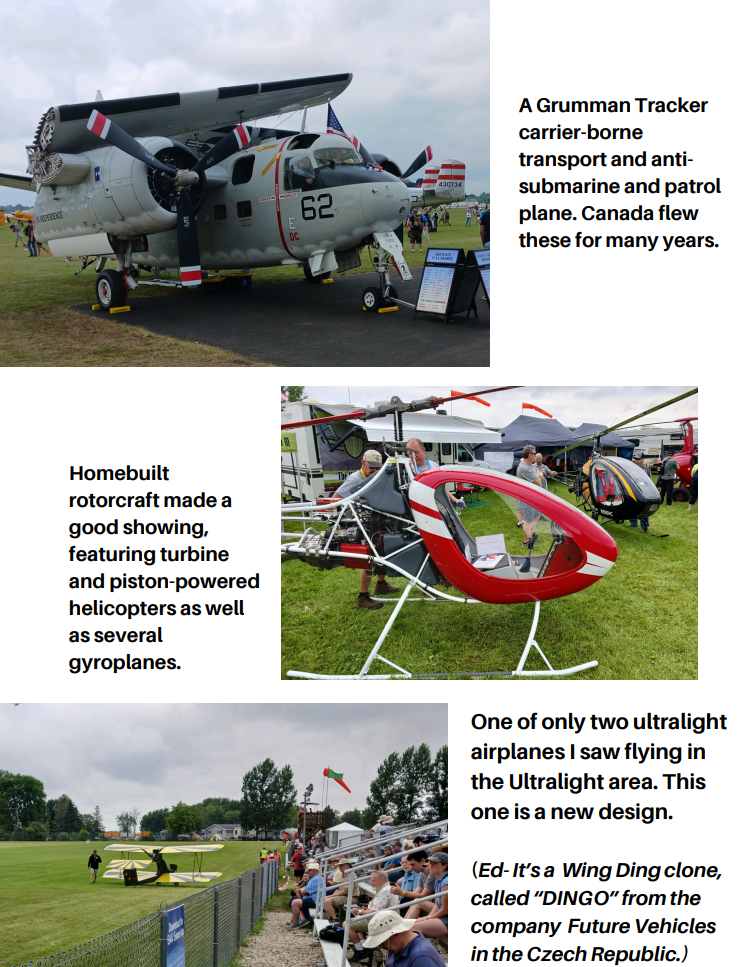
The warbird section had a couple of gems; an OV-10 Bronco, a Grumman Tracker, five F4U Corsairs and a P-47 Thunderbolt. I didn’t get to see the Spitfire, the Hurricane, or many of the jets up close. There were very many Mustangs, though, if you’re into those, including one really rare early prototype.
The display booths were generally interesting, as always. I found a number of purveyors of EFIS systems that caught my attention.
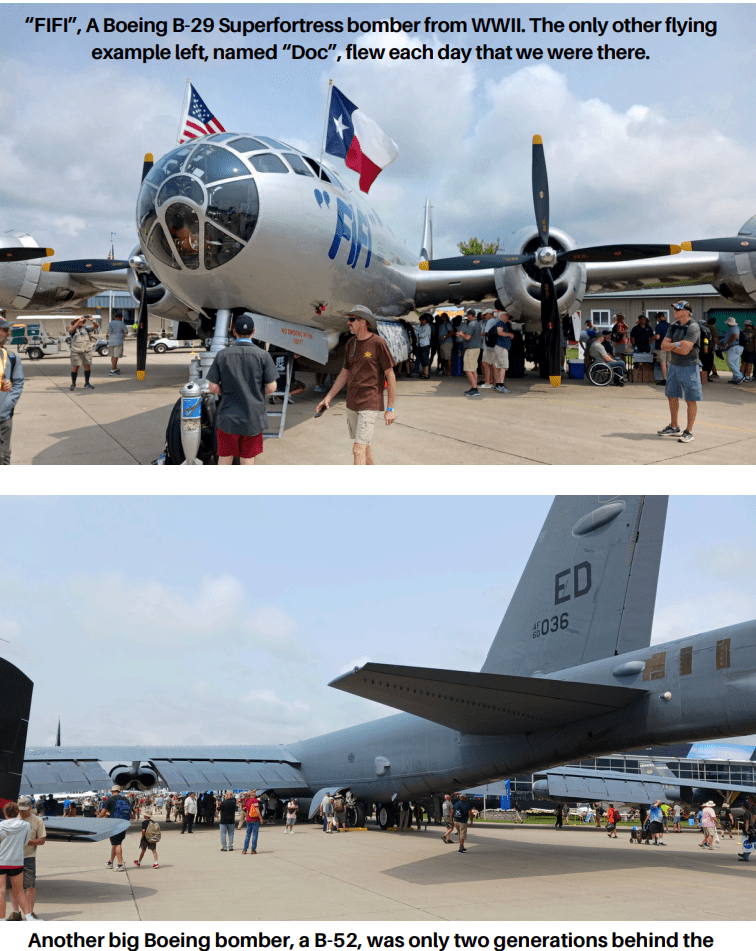
The biggest disappointment for me was the lack of ultralights. My roots are in ultralights and I love seeing them. Past years had lots of them represented at OSH, but not so this year
Despite the fact that the show was founded for homebuilt airplanes, it seems to have been overtaken by the big dollar commercial certified companies. Airbus, Boeing, Daher, Beechcraft, Continental, Lycoming, Rotax, and others had the biggest and most prominently featured tents and displays at the show. That’s fine, I guess, but for me it really highlighted the diminished presence of homebuilts and ultralights – the roots of this whole thing.
The best part of the show for me was seeing the US military flying displays at the end of each of the two days we were there. Seeing and hearing the F-35, F-22, F16 and A-10 flight displays was a visually and aurally memorable experience.
Day 6
We were headed this morning for Chicago. I’ve wanted to fly the Cav to Chicago for many years but something always seemed to get in the way. Now we had perfect conditions and no excuses.
Headed southbound from West Bend, we skirted Milwaukee’s airspace. The builtup areas became larger and more numerous as we continued on, and soon Chicago’s famed lakeshore skyline eked its way through the distant haze.
We set down at Schaumberg after less than an hour’s flying time. From the circuit I saw the enormous sprawl of Chicago’s O’Hare airport only seven or eight miles distant. Even from there I was gobsmacked by the size.
We spent the rest of the day poking around some of Chicago and checking the weather periodically in anticipation of our marathon run to home over the next two days.
Day 7
Getting out of Chicago was easy and fast with our speed and the terrific morning weather. The forecast for the route ahead wasn’t the best, but it was enough that we felt OK about getting as far west this day as we could.
Our goal was Bismarck, ND, a distance of 620 NM. We planned stops at Albert Lea, MN, and Aberdeen, SD.
About 200 miles into the first leg the weather was coming down and thickening up. This was as the prophecy had foretold, but we hoped it would have cleared more by the time we got there. Further on, about 15 miles east of Albert Lea, we were down to about 1500’ AGL. Things didn’t look good ahead. I suggested to Bob that we make a right turn to divert to Austin, only 10 miles off our right wings. It’s a sizable enough place that should we be held there overnight we could get decent accommodations.
Bob agreed and we soon set down on runway 35. We used the FBO’s crew car to get some lunch, then headed back to the airport to check weather again. Things were still less than ideal for about 50 miles west along our flight path, but both the METARs and TAFs were trending better through the afternoon. We decided to wait an hour and look again.
Ninety minutes later we were back in the air seeing the clouds lifting and visibility improving. The vis never really got good at all, though, due to the combination of smoke and haze.
The couple of hours delay at Austin took its toll on our day. Bob and I both remarked how tired we were feeling as we droned on to Aberdeen. Bismarck was seeming less and less likely.
On the ramp at Aberdeen, in the stifling heat and humidity, we called it a day. It was 5 p.m. and we were all knackered. We fueled, tied down and headed in to the FBO to arrange rooms for the night.
We got what seemed to be the last rooms in town at the cheapest place around. We’d landed in town on a Friday night at the start of a youth water skiing tournament. Though our hotel looked pretty rough from the outside it turned out to be just fine and a terrific bargain. We turned our eyes to making it home on Saturday.
Day 8
We had a long way to go today, 740 NM or 850 SM. We’ve done such distances before, and those days have been pretty grueling. Along with the distance we had to contend with the heat, the desolate terrain and the border crossing process.
Crossing’s not difficult, but it takes time and the timing of things in the process is important. One factor in our favour is how we were traveling westbound and gaining an hour by returning to the Mountain time zone.
Though I’ve flown over the area numerous times, I’m still amazed by the desolation of the Dakotas and Montana. There are numerous farms and ranches but woefully few population centres. The ones that do exist are small.
The morning air was clear and oh, so calm as we coursed northwestward. My ADSB unit was giving me grief and only transmitting intermittently. I tried various solutions but couldn’t quite nail it down. As the day progressed, though, it seemed to stabilize and work normally. I recalled reading about a scheduled GPS outage in that part of the continent, but I doubted that was the culprit.
We three chatted casually as we always do on these flights, and watched the occasional ag plane buzzing low over crops below us.
We refueled at a little spot called Baker, MT, then continued on toward our next stop at Chinook, just south of the Canadian border. The late morning air grew restless now, catching heat shed from the earth and slinging it upward, spoiling our airborne serenity. We slipped higher into the sky seeking cooler temperatures and more ready progress.
Two hours later I found myself a couple of hundred feet above 6th Street in Chinook on a gusty final approach to runway 26. The end of the runway sits a mere quarter mile from the houses at the west end of town. That was a weird and uncomfortable approach, especially with the turbulent ride over the town. We picked Chinook because the fuel was a full dollar cheaper than at Havre, 25 miles west.
We spent an hour or so fueling, filing our eAPIS forms, clearing with CANPASS and filing our trans-border flight plans. We’d need trans-border transponder codes once we got in the air and close to the actual border, but we planned to acquire those once airborne.
We took off on time and lit out for Lethbridge. Home was within our grasp.
Once we reached 6500’ Bob switched to Great Falls radio to have them open our flight plans and give us each our codes. But try as he might, he couldn’t get a response. I suggested we call Salt Lake Center. Bob thought I meant he could try a telephone call, so that’s what he did. In fact, I’d forgotten Bob can make calls from his headset, but I was just as happy to take credit for his inspiration. A few minutes later Bob had opened our flight plans and passed me my code. And a few minutes after that, we crossed back into Alberta.
We jousted with the afternoon turbulence and dodged a couple of restricted areas, then soon contacted Lethbridge radio to announce our landings. We sailed overhead the airport, one after the other, and into the left downwind for runway 06. It was odd to be landing to the east at Lethbridge, of all places, especially when the winds in northern Montana were stiffly from the west.
After landing we called the designated CBSA number and waited on hold for 45 minutes. The agents we spoke to told us that we didn’t even have to call since our CANPASS allowed us to simply call ahead as we did in Chinook, and wait fifteen minutes at our airport of entry to see if any CBSA agents showed up. If no one appeared, we were free to go. It’d have been nice to know that earlier, of course, but we certainly won’t forget now!
I tried to get some gas at Lethbridge but the fuel truck attendant said they didn’t have gas for anything but the school’s own planes. Apparently, we’d hit town in the middle of an avgas drought. Turns out there was a problem at a refinery near Edmonton and western Canada was in the process of running out of the stuff. Luckily, I didn’t need the fuel to get home safely, but I’m glad I didn’t have to go any further.
We departed runway 31 with a light crosswind as a local trainer was on short final for 06. Our last leg was an easy one. The turbulence had even calmed down due to us being over green and growing crops rather than parched, barren and alkaline prairie that bounced so much heat back at us.
Bob’s landing on runway 16 looked terrific from a mile behind him. Mine was ok, but I definitely went long in the calm wind. After nearly 7.5 hours of flying, Bob and Carl and I were done. We rolled our planes into our hangars, said our goodbyes and each went our separate ways to home. We entered another great flying adventure into our log books and our memories.
Summary
So, it’s stats time now. We flew a total of 2525 NM in about 25 hours of flying time, used 12 different airports, and landed in or overflew 8 different US states and one province. Our longest leg was from Cut Bank to Poplar, MT, at 290 NM or 333 SM. That leg took 2.5 hours in the air due to the headwind we had. Just for comparison, it would take more than 5 ½ hours by driving.
So will I go back to Oshkosh again? Well, maybe, if Bob wants to go. Perhaps he’ll want to see something really cool to add to his Cherokee. Or there may be a super cool airplane there that he’s always wanted to see. Maybe Keith will want to meet him there again some time.
How could I say no to that?
 Calgary Recreational Flying Club YYC