

In a previous article, I wrote about my flight to deliver a Zenair CH250 from Chestermere to a new buyer in Nelson, BC. In this article, I am going to write about what it took to plan and prepare for that flight.
The first person I wanted to talk to was Stu Simpson. He’s made many flights to Castlegar, just a few miles south of Nelson. Stu knows exactly where to take shortcuts, where to stay close to the highway, where to be high, and where I could drop down for a more comfortable flight.
The VNC has a lot of detail and even a suggested VFR route with the diamond indicators. That was a good starting point, but with Stu’s input now I could fine-tune that route.
In an RV9 or my own CH250, I could climb up to 12,500’, go direct and be there in an hour and a bit. I have a pulse oximeter and it’s pretty easy to rent portable oxygen if you think you’ll be up high for more than 30 minutes. In this case I would be flying a plane I had little experience with and which didn’t have a working transponder. Since going to 12,500’ meant part of such a flight would be in Class B transponder-required airspace, going direct that high was not an option. What we ended up with was a route that kept me near highways and civilization, and at breathable altitudes with only a few places where I needed to hop over mountain ranges to avoid big long loops around them.
Three really good flight planning tools are Skyvector.com, Fltplan.Go (Android or IOS), or ForeFlight (IOS only). Each of these supports drag and drop, nav log generation, and detailed airport info. Fltplan and Foreflight have Canadian VFR and IFR charts and supporting info.
Skyvector has the US version of the Canadian charts so it can be more difficult to plan with in great detail. Fltplan and Skyvector are both free, but Foreflight is a paid subscription starting at $150/year CDN.
At work in my flight dispatch job I use Foreflight and Jeppsen. But when I need to come up with a new route quickly, I use the free version of Skyvector to put it together, then use Jeppesen to work out the fine details.
With a bit of drag and drop magic Stu and I came up with a workable flight plan given the weather, terrain and season. I then manually entered the associated waypoints into my Garmin 496. I traded Carl Forman some avionics work for this amazing piece of technology and I can’t imagine how I got by without it. With the navigation worked out the next priority was to find weather that was going to be VFR from Chestermere all the way through to Nelson. I had a week off in November so we were hoping that at least one day would have a solid band of high pressure with no green crayon on the GFA to ruin the flight.
Stu is an expert resource when it comes to weather and since I rarely plan flights below FL200 his experience was more valuable than mine for this flight. We planned a flight for a cold Monday in November leaving me the rest of the week for contingency planning if I had to turn back and try again later. As it happened the first attempt didn’t work, but a few days later we had a perfect flying day. With the weather and routing worked out the last thing was to plan the survival gear required. To do this successfully it’s crucial to have a clear understanding of the situation and the potential survival environment.
Google has a million articles on survival, but for the most part those aren’t applicable to what I needed. I also had limited space for extra gear. To come up with the best use of space and available weight I defined three requirements.
The first was that I would be rescued no later than sunset on the third day. That seemed very reasonable given all the other factors involved, including the route and all the people looking out for me. For instance, Stu would be bird-dogging me along the route on the ground, and we were in touch by text. Gary Abel was also continually monitoring my progress from his home computer using my SPOT locator’s shared page. The ELT was recently re-certified, and I’d filed a flight plan in order to have NavCanada looking out for me, too. I felt I was pretty well covered.
I didn’t expect anyone to rescue me after dark, so I was planning to spend at least one night with the plane should the unthinkable happen. I brought four litres of water and I had gear to melt snow if I needed more.
For food I had two boxes of Larabars as well as an extra sandwich and some fruit. I would have to eat some of that food on the first day since it would likely freeze overnight. If you plan to eat then don’t forget to plan enough water to go with it. Also, food attracts animals so a foil sealed pack was slightly safer than roast beef in a paper wrapper. I figured I wasn’t going to starve to death in three days.
I didn’t plan to be cutting down trees or building a Robinson Crusoe themed camp, so the only calories I would need would be to keep warm. I had two first aid kits with me but only enough for some nasty cuts or a simple broken bone. I brought some extra power banks to keep my cellphone charged as well as a portable VHF radio with extra alkaline batteries. I had enough power to keep a single LED light on for several nights. It’s not that there’d be anything to see, but being able to turn a small light on from time to time does a lot to calm your mind when it is dark and you hear strange noises.
I always fly in running shoes and a sweater, but I also had an Arctic rated winter jacket, scarf, gloves, winter boots, and socks with me. Even if I didn’t get out of the plane, the boots and socks are really warm. The plane had a wrap-around engine cover and I strapped that to the shoulder harness so it would remain handy. It would have made a warm blanket if I needed it. A small survival space blanket was in my backpack.
Next, I hoped to be able to use the cockpit of the aircraft as a place I could remain and protect myself from the wind.
I had a large knife, a hatchet and a manual chainsaw so I could gather some firewood or build a small shelter.
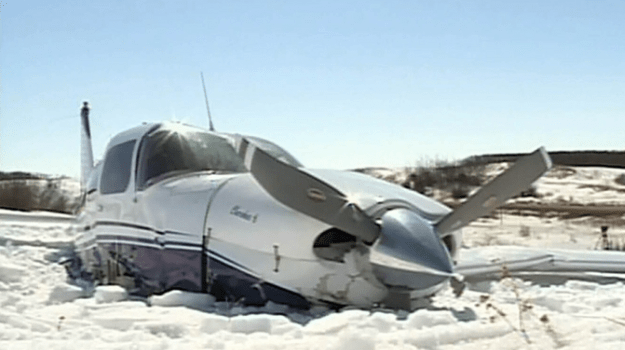
This might be necessary if the canopy was completely smashed out and I couldn’t patch it with the roll of packing tape I brought with me. Duct tape is useless in the cold or on a surface that has frost on it.
Building a camp would be near impossible if I had broken any bones in the crash, plus, building stuff expends a lot of energy. Knowing I’d have only a few hours to collect firewood and fresh branches before dark if something happened, it didn’t seem realistic to plan to build a camp on the first day, even in good conditions.
Even if I wanted to build a camp I might not be able to. The CH250 can be a difficult plane to get in and out of even with good agility. With a broken arm or leg that might not be possible.
That brings me to my third point. I made sure I could reach all my survival gear without leaving the plane, and that I wouldn’t have to venture beyond the wing of the plane while I was at the site.
I kept my priority items (water, some food and first aid, flares and radio) in my backpack on the front seat, belted in, where I could reach it even in a crash. The remainder of my gear was in the baggage compartment. In a bad upset it may end up spread all over or buried in snow so having a pack full of gear in the seat belt next to me was important.
While you can roughly pick a place to crash you don’t know exactly what the ground will be like. It could be in snow too deep to walk in, or on a difficult slope. I also wanted to plan for a possible injury that made mobility difficult.
I would not likely make a plan to walk out unless I was uninjured and could see a highway I could reach within a few hours. In reality if the highway was that close the rescuers would be able to get to me relatively easily, and with better equipment than I had with me. Proximity to the highways and other access roads was in fact one of the main reasons we chose the route in the first place.
In addition to what I mentioned above, I had a bunch of other stuff in a plastic tub that I brought with me, and which I keep in my plane. It contains a survival skills book, some knives and spare blades, electrical tape, duct tape and clear packing tape, survival blankets, pen flares, road flares and colored smoke. I had a can of Sterno, barbeque lighter, some barbeque starter cubes and lots of water proof matches in a few different containers in case I did decide to collect wood and start a fire. The can of sterno doesn’t last more than an hour, but it lights easily and is useful to get a bigger fire started.
Finally, I had a portable single burner camp stove with a pan to melt snow, not to cook anything, as that attracts animals. The small propane tanks don’t last long and carbon monoxide is deadly so this is just to melt snow, not to stay warm.
I knew I’d have to be diligent about any spilled fuel, too. Wet fuel on the ground will burn, but fuel vapors will explode. Either of these could make things more difficult.
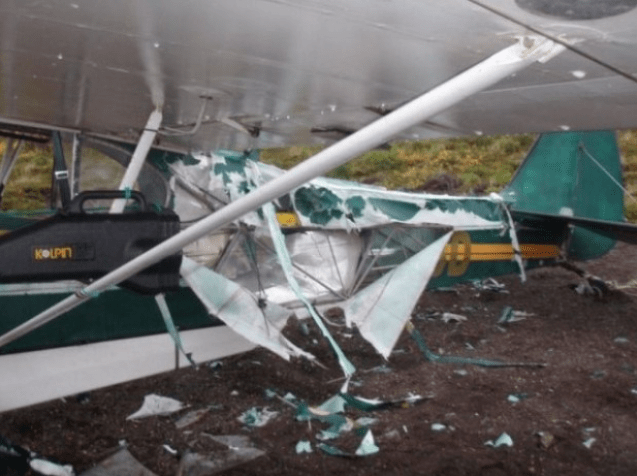
If I had more cargo space I would have brought a small tent, sleeping bag, and a whole list of other things. In the end, though the goal was to plan a safe trip in good weather and be prepared to hang out a few days in case something bad happened.
So, as you can see, this wasn’t a complicated survival plan, but it was a thorough one. It had just three requirements to keep me going until a rescue.
Of course, as it turned out, the flight occurred without any problems. I got some terrific and exciting flying experience to add to my log book, the new owner got his plane, and Stu got the indisputable pleasure of my company for the 7 ½ hour mountain road trip back to Calgary. All in all, a pretty good day of aviation.
 Calgary Recreational Flying Club YYC