

Day 3
I hoped this would be a pretty easy day. We only had two legs to get to Memphis. We’d scoot through Missouri and stop at an airport called Vichy Rolla. Bob and Carl and I stopped there on our return flight from Washington and Nashville in 2014.
We taxied out behind another Airbus A319 and did our run up as the jet thundered off ahead of us. As soon as we were airborne a few minutes later I called the tower.
“Des Moines tower, Bravo Quebec Romeo. Can we get a right turn to get offline of the jet?”
“Bravo Quebec Romeo turn right to 070, climb and maintain two thousand five hundred.”
There was likely no wake turbulence danger, but I didn’t want to take the chance, especially fully loaded and with precious cargo. We were soon cleared out of the zone and on course. I asked Tina what she thought of the whole experience at Des Moines, which was the largest and busiest airport we’d flown into together. She was impressed that we could mix with jets and other traffic so easily and she complimented me on how well I managed it all, too. I spent the rest of the morning glowing from her compliment. The smoke was back, cutting our visibility to about four miles. However, once we crossed into Missouri things cleared steadily, bumping the visibility up to 10 or 15 miles. This was more like it.
There was more cloud cover, too, which morphed into a complete overcast. The forecast showed little inclination for rain along our route, but there were some build-ups forecast for later in the day. ADS-B weather showed storms to the west of our route, but they were moving slowly and wouldn’t impact us. One thing that got my attention was the temperature dewpoint spread, being 17 and 13, respectively. Of course we were higher and cooler, and thus in a narrower spread range. I kept a close eye on the carb temperature gauge. At one point, I thought I felt the engine miss just ever so slightly. I didn’t hear it, I felt it. Well… I think I did. I pulled on the carb heat and left it on until we landed at Rolla.
Gassed up and going again, the landscape changed quickly from tree-bordered farmland to much more heavily wooded hills. I decided to climb another 2000 feet for some extra time and radio range should the unthinkable occur.
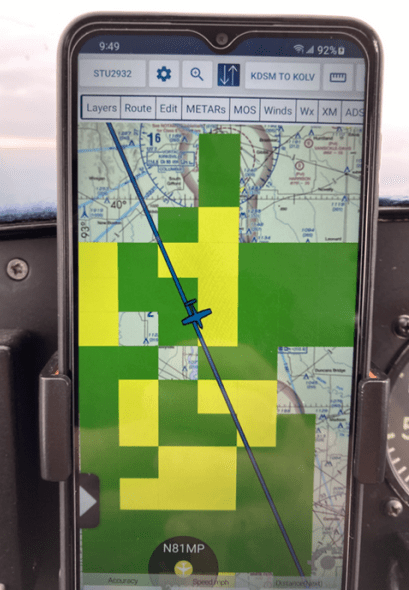
There were some spots where we could have set down if needed, but not a lot of them. Then for about 15 minutes or so, we were above the most heavily wooded area of what’s known as the Mark Twain National Forest. There were no roads or open fields there and Tina and I both remarked later that we were nervous being over that region. We put Missouri behind us and coasted across the very northeastern tip of Arkansas where the land spread into broad fertile river bed farmland.
The sky cleared, the sun shone, and the Mississippi River wandered lazily beneath us. Slow moving barges, shoved along by trundling tugboats, ambled up and down the river. Surprisingly large sand bars tempted me to land on them. Pure folly, I know, but I was still tempted.
How lucky I am, I thought, to be here in the middle of this adventure, especially when I get to share it with Tina.
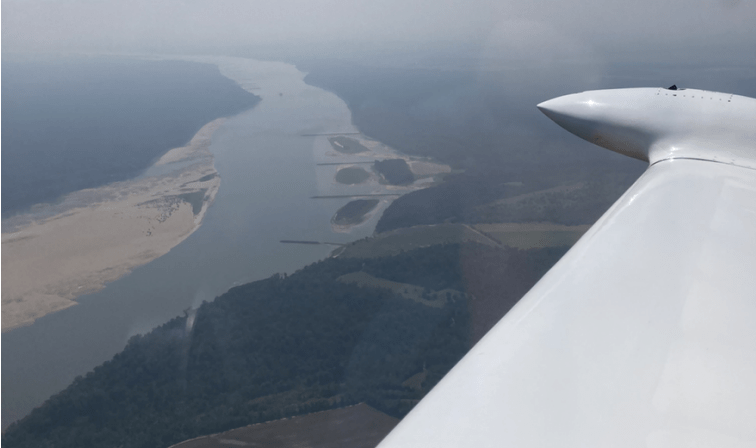
As we hit Memphis’ Mode C veil I called approach control and received regular instructions through the north and east side of their airspace. Approach handed us over to Olive Branch tower. Olive Branch is a small city just across the Tennessee state line in Mississippi. Tower vectored us onto a left downwind for OLV’s runway 36 with another request to keep it tight and fast. It was no problem for me and the Cav.
After landing, Olive Branch Aviation directed me to the general aviation parking ramp where we unloaded and tied the Cav down in the afternoon heat. I looked around to check if there was anyone nearby or anyone who could see us. There wasn’t, so hiding behind the Cav’s fuselage and tail, I quickly slipped out of my pants and into a pair of shorts. Tina laughed at me at first, but within a couple of minutes, she did the same thing. It was only then we realized that while no one at ground level could see us, the tower guys would’ve had a completely unfettered view of the whole thing. We laughed our asses off over that for the rest of the trip.
Days 4 & 5
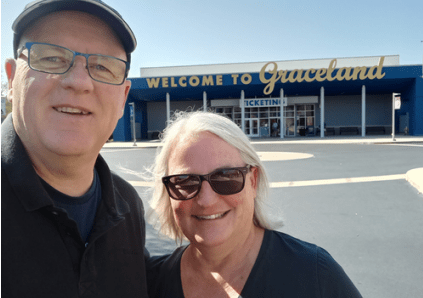
We spent the weekend in Memphis and saw what we came for. We went to Graceland, the Civil Rights Museum, ate terrific southern barbeque, and toured Beale Street. By Sunday evening, I was itching to get back in the air again.
Day 6
After returning the car, and getting a ride back to OLV, we loaded and fueled the Cav. We’d decided on St. Louis as our next destination, a 230 NM flight to the north. We would use Creve Coeur airport, a satellite field at the west end of the city, and only 7 NM from St. Louis International. Olive Branch was busy with training traffic on such a nice sunny morning, and runway 36 was active in the light northeasterly breeze. We taxied out and got cleared for the straight-out departure. At the edge of the OLV’s zone I switched frequencies.
“Memphis departure, Canadian experimental Golf Bravo Quebec Romeo, two thousand off Olive Branch, runway heading.”
“Experimental Golf Bravo Quebec Romeo, where are you headed today?”
“Northbound to St. Louis, sir.”
“Roger, maintain present heading and altitude.”
“Maintain present heading and altitude, Bravo Quebec Romeo.”
Happy to be back in the air, we watched the city go by and noted just how spread out it really is.
Approach bid us goodbye at the edge of the veil and I thanked him for their help. We were over the Mississippi again, and its adjacent riverbed farmland. We soon passed back into Missouri and the sky steadily filled with mid-level cloud. It was almost a carbon copy of our leg through the area a few days prior. We found a bit of rain this time, but hardly enough to even wet the windshield.
The landscape below wasn’t as comfortable to traverse as I’d like. It was largely wooded, but with enough open spots to use should we need one. I know my concern for forced landing spots is a byproduct of all my years flying two-stroke ultralights. My caution and subsequent anxiety aren’t bad things, but sometimes I wish I could shake them.

ADS-B radar told a colorful story of showers and growing thunderstorms north of St. Louis. Good thing we weren’t planning to challenge the sky in that direction. St. Louis approach guided us into the downwind for Creve Coeur and cleared me to change. frequencies. An RV-12 pilot announced himself doing circuits for the grass runway immediately beside the paved one. I made my calls and dropped into the right-hand downwind for runway 16, turning final north of the Missouri River. Final approach paralleled a pair of enormous girder bridges which were actually a little distracting.
Tina approved my landing and we rolled in to the fuel pumps. A fellow who identified himself as Jim greeted us. He was very friendly and thrilled to see the Cavalier. A FedEx pilot by profession, he once owned a Cavalier project. He eventually sold it, but stated he actually saw my airplane in Regina shortly before I bought it back in 2012.
Soon another guy showed up who was just as friendly as Jim, and who had an Emeraude project in his hangar. It was wonderful chatting with them about wooden homebuilts as I fueled and secured the Cav. Tina was busy arranging ground transport for us.
Once the Cav was tied down and covered up, we were on our way to the car rental place.
Day 7
We enjoyed the day in St. Louis, seeing the famous Gateway Arch and taking a paddle boat trip on the Mississippi River. One thing I can tell you about that city is that it makes Calgary’s roads seem like a billiard table.
Day 8
Today’s goal was to reach Minneapolis, MN, another big city on the Mississippi. I very much like Minneapolis, having flown there in the Cav on a couple of adventures alongside with Bob and Carl in Kirkby’s Cherokee. I was looking forward to showing the place to Tina.
We left Creve Coeur departing southbound and making a sharp right turn northbound as soon as we had enough height. I was careful to stay well below the Class Bravo floors around KSTL as we scooted north. We planned our first stop at Cedar Falls, IA.
We were over southern Illinois when I noticed the voltmeter on the Dynon EFIS acting strangely. The voltage occasionally jumped up and down from 13.8 to 14.5. Then it settled down to its normal 14.1 or 14.2. I kept a close eye on it but the variations seemed to be getting worse.
We were about 35 minutes into the flight, about five miles east of Quincy, IL, when I decided the errant voltage needed attention. I turned hard left, started the descent, and switched to Quincy’s frequency.
I assured Tina there was no danger, and we just needed to make a precautionary landing to figure out why the voltage was jumping around. I wasn’t worried about our safety, but I was concerned there might be a problem with the alternator. It’s a difficult one to find and replacing it could mean a lot of hassle and delay. And of all my airplane maintenance knowledge, electricity is my weakest area.
We set down easily on Quincy’s runway 31 and rolled out past a couple of well worn MiG-29 fighters on the ramp. The FBO’s ramp attendant actually brought a rolled up carpet over and set it out for Tina when she exited the plane.
Now that we were down safely, and Tina was standing comfortably on her ramp carpet, I could start worrying in earnest.
I knew we’d be peeling at least the lower cowling off the Cav so I checked with the ramp guys that doing so there would be okay. They said it would be fine. Then we headed into the FBO’s briefing room and I called Gary Abel and Gerry MacDonald. Both of them advised me to check the wiring connections and the tautness of the alternator belt. I hadn’t considered the belt as the problem, but it made a lot of sense the more I thought about it.
I pulled our luggage from the cargo bay, retrieved the tool bag, and we set about unfastening the lower cowl. I’m proud that Tina wasn’t the least bit shy about pulling fasteners and getting her hands dirty.
I noted a few things once I started digging around in the engine bay. First, there appeared to be more oil splatter than there should be. Had the front crank seal sprung a leak again? It could also be oil from the crank case breather tube getting up there during the turbulence we encountered. That’s happened before. It wasn’t something that needed immediate attention, but would certainly bear further monitoring. (Later I learned the leak was from loose crank case seam bolts, which were duly tightened.)
The alternator connections had some oil on them, which I cleaned thoroughly. Then I checked the belt and found it was definitely looser than it should be. I also found a lot of alternator belt “dust”. That’s normal as the belt wears over its lifetime, but this was more than average. It was another symptom of a too-loose belt slipping on the pulleys.
We tightened up the alternator belt and locked it down. Then I started the engine and watched the voltage. It appeared to be normal, running steady at 14.3 volts. We were back in business and I wouldn’t have to search for an obscure 1970s British-made alternator in Quincy, Illinois.
We re-attached the lower cowl and loaded up the plane when I stopped to do a mental inventory of everything we’d done. Then I realized I forgot to re-tighten the alternator hinge bolt. Aaaargh!
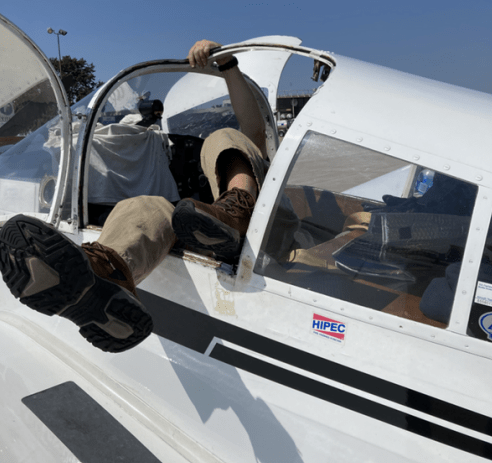
Frustrated, I apologized to Tina and we used another half hour to remove the cowling again, tighten the bolt and put the cowling back in place. Then we loaded the plane, got some gas, and used the bathroom. Now we were ready to file and fly.
Story will continue next month…stay tuned.
 Calgary Recreational Flying Club YYC