
Our Model Aircraft flying field was next to the Winter’s Indus Air Park (CFY4). In the late 80’s, the airport, and Blue Yonder flying school owner Wayne Winters was providing ultralight training in a Merlin aircraft.
In the Calgary Herald there was a daily ad showing a picture of the Merlin with the caption “This is an Ultralight.” This ad and seeing the Merlin continuously doing circuits got the best of me and I decided to go for an introductory flight. With hours of Microsoft Flight Simulator under my belt, flying was pretty straight forward.
Most people, hearing the word “Ultralight”, will imagine a flying lawn chair. Only in the USA is an Ultralight a flying lawn chair. Throughout the rest of the world, they are modern aircraft capable of carrying an all up weight of 1300 lbs. That is enough for two, 200 lb pilots, baggage and enough fuel for 500+ mile trips.
These aircraft are reliable and safe, but also expensive. A new factory-built aircraft will cost somewhere between 75 and 200 thousand dollars. In the USA, any aircraft under 254 pounds (115 kg) empty weight (excluding floats and safety devices), with a maximum fuel capacity of 5 U.S. gallons (19 L) and unable to exceed 55 mph (88 kph) can be considered an ultralight. It can be flown without any type of aircraft licence or permit.
In Canada, you must have at least an Ultralight Pilot Permit to fly this same aircraft. A Canadian pilot with only an ultralight permit is not allowed to carry a passenger or fly into controlled airspace.
The Merlin, that Wayne Winters used for training, was a rugged high wing aircraft powered Rotax 912 UL (80 HP) engine. Wayne introduced hundreds of pilots to flying, and trained them in this aircraft.
Within a few days of this introductory flight, Wayne sold Blue Yonder to Bev Befus. In addition to Wayne’s Merlin, Bev owned a second “White” Merlin that was used for training and rentals.
After early morning model flying, I often dropped in to visit. On one occasion Bev was busily trying to replace a bent axel on the white Merlin.
He had a rental and lesson scheduled within a few minutes. I ended up doing the repair while Bev took a student for a lesson in the other Merlin. Over time I was doing a lot of small maintenance and repairs. I took a few flights with Bev when there were no rentals or lessons happening. Somewhere along the way an AME (Aircraft Maintenance Engineer), Ted Orlick, started showing up at the field.
One day, a cop that brokered aircraft, showed up trying to sell a 1960 Cessna 172 to Bev for $10,000. Ted took a quick check of the aircraft and we all ended up sitting around a table somewhere on the airport.
A small unpainted section of the right wing indicated it had been repaired in the past. Ted told the cop (I considered him something like a “car curber” doing the same with aircraft) that it had significant previous damage that had to be redone. The Curber said “how about $6500.” Ted kicked me under the table and I blurted out “OK.”
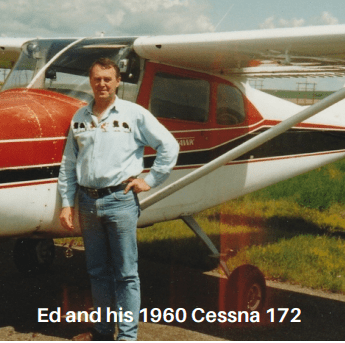
I didn’t have any type of aircraft permit or licence, and had never even been in a small aircraft! So here I was, the owner of a Cessna 172. The aircraft came with logs complete back to its original sale in 1960. Review of the logs showed the damage was from a strong wind while the aircraft was tied down outdoors. The repair had been done by Cessna in Wichita. Ted was not happy with the repair so I had it checked and a few pieces added at a local aircraft repair centre.
Cessna 172’s and 150’s are often used as training aircraft. The 150 is a 100 hp two seater whose use at our 3500 ft altitude is a marginal performer. The four seat 172 preforms much better at our altitude.
Another hangout at Indus was a Certified Flying Instructor (CFI) whose name I forget, so we’ll call him “John”. He offered instruction for $20.00 per hour in my aircraft. I had to pay $500 up front. In the meantime, I signed up for a weekend crash ground school at the Calgary Flight Training Centre. The good thing was once I paid for the course, I could take it as often as I wanted for no extra charge.
John and I flew the Cessna out of Indus. I’d meet at his home, do the flight briefing and then we’d go to Indus and fly for an hour, do a review and head home. John trained “by the book.” He was not able to understand what the problem was if things weren’t turning out as he wanted. An example was circuits at Airdrie. He taught circuits as: climb to 500 ft AGL (Above Ground Level), turn left and climb another 500 ft to 1000 ft AGL. Turn downwind, at midfield, announce Downwind at 4500 ft, announce turning base and final and land.
At Airdrie circuit height is 900 ft AGL. Because of the shortened circuit downwind I never had enough time to announce downwind at midfield. John was getting irritated and told me that I had one more chance to do it correctly or we were cutting the lesson short. We cut it short. I later figured that all I had to do was do a longer climb out before turning crosswind. Next time we went out I did the circuit according to John’s liking, then asked him what I was previously doing wrong. He had no idea so I took him back to Indus.
I soloed after 7 hours of instruction. I let John have the $360.00 credit, flew alone to Springbank, parked at the Calgary Flying Club and asked about instruction. I obtained my Private Pilot Licence (PPL) under the direction of two excellent instructors, Paul and Paula.
Shortly after that, Wilf Stark purchased a Rans S-12 kit that he planned on assembling and renting to Bev Befus at Blue Yonder Aviation. Wilf was a great starter but lousy finisher of many things.

I purchased a fifty percent interest. Barry Halliwell, Don Ward, a 3500 hr Hercules pilot, and SAIT aircraft engineering instructor, and myself assembled the aircraft in a rented heated warehouse in SW Calgary. We had it flying within six months of starting construction. Most of the assemble was done by Don and me. We were both very good at misplacing tools.
We worked on Sundays and Wednesday evenings. We usually stopped work on Wednesdays when we ran out of tools. Wilf never did help with the assembly but he always showed up sometime between Wednesday and Saturday, cleaned up our mess and put our tools back where they belonged.
I enjoyed flying the Rans S-12 much more than the Cessna, so after a few years I sold it. When I purchased the 172, because of liability issues, no manufacturers were building or selling light aircraft. In 1994, the US passed legislation putting an 18 year limit on manufacturers liability for Light Aircraft. When Cessna again started producing 172’s the price was in the $100,000 range. This resulted in the public immediately realizing the value of used aircraft and used prices more than tripled!

 Calgary Recreational Flying Club YYC