
Question:
“Is there a quick way to calculate the crosswind component for a crosswind landing without a fancy PFD or flight calculator?”
Jeff:
“Yes there is, and it’s easy enough to do in your head. First, determine how many degrees off the runway heading the reported wind is. So if you’re landing Runway 18 and the wind is 160 at 10, the wind is 20 degrees off the runway (180-160=20).
Now picture an analog clock face. How far is the wind angle number in minutes around the clock face? A wind angle of 20 degrees means 20 minutes around the clock face, which is one-third of the way around the clock face.
The crosswind component is one-third of the total wind. In this example, 10 knots * 1/3 = 3.3 knots of crosswind.
If you like charts, you can lay out common numbers and interpolate between them:
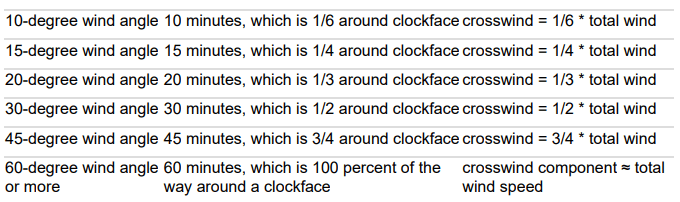
A 60-degree wind angle or more is 100 percent around the clock face, you might as well treat it as a direct crosswind.
You can also do this to determine headwind/tailwind, but you must take the wind angle and subtract it from 90 first. So as above, landing Runway 18 with the winds 160 at 10:
Crosswind = 20 degrees -> 20 minutes -> 1/3 * 10 knots = 3.3 knots crosswind
Headwind = 90 – 20 = 70 -> 70 minutes -> 100 percent * 10 knots = essentially 10 knots headwind
This second calculation is more important if landing with a tailwind. Remember that adding 10 percent to your approach speed over the ground due to a tailwind increases your landing distance by 20 percent.”
Tip courtesy of Pilot Workshops
—————————————————————————–
Basically, when I’m in a crosswind situation I fly final in a sideslip, maintaining aircraft alignment along the runway centerline. If I don’t have enough rudder/aileron authority to keep the aircraft axis straight along the runway centerline with enough bank angle to keep from drifting I know the crosswind component is too strong and I’ll either use another runway or go to a different airport. I have landed the C140 in 90° 20 mph crosswinds using this technique. Of course, I always had the option of using the x-wind runway. Was fun to practice! I have also landed the C195 in 22G25 knot 90° crosswinds which increased the pucker factor immensely. Did it twice the same day with no crosswind runway available – only option was to fly 8 miles to another airport which had more favourable runways.
Brian
 Calgary Recreational Flying Club YYC