
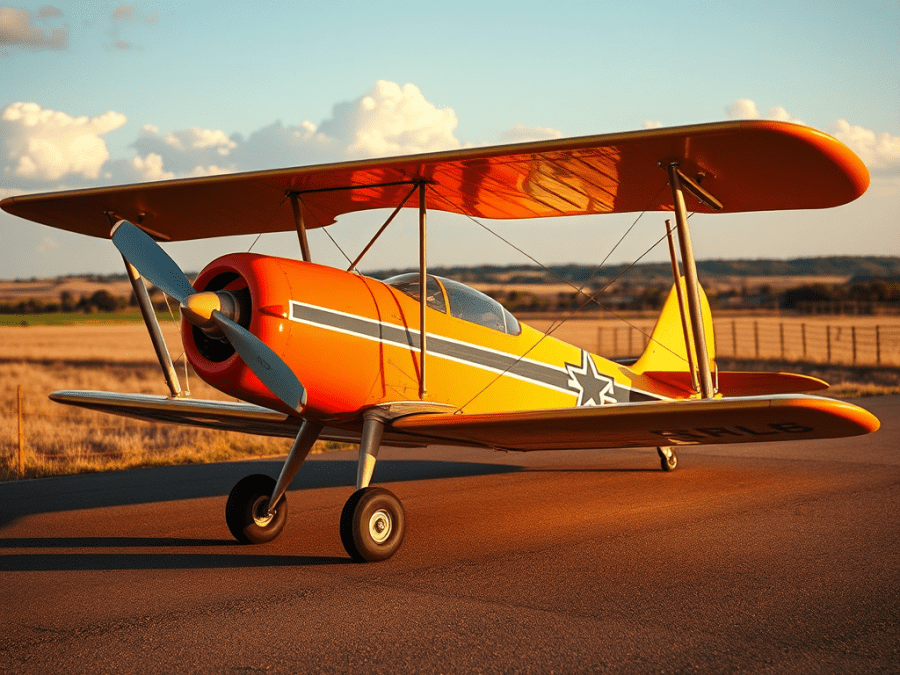
The mission was simple: Go get Bob Kirkby’s newly purchased biplane. Completing the mission turned out be not so simple, but it did turn out to be a pretty good adventure.
In 2016 Bob Kirkby decided he wanted a Stolp Starduster Too: a two-seat, homebuilt biplane. He owned one many years previously, but eventually sold it.
Bob and I, as well as Bashar Hussein, flew our planes to central California last September to look at a Starduster there, but it wasn’t up to Bob’s standards. He kept looking.
He finally located one in late 2016 at a little airstrip in a place called Gage, Oklahoma. The price was right, it had most of what he wanted in a ‘Duster, and it was in pretty good condition, though it hailed from 1974. Bob purchased the plane and cut a deal with the owner that it could stay in Gage until Bob could safely retrieve it in the spring of 2017.
As soon as I learned Bob had bought the plane, I offered to fly him to Gage in my Cavalier and then escort him home. Bob readily and wisely agreed. It’s much safer to have a wingman when ferrying a new-to-you airplane 1200 miles, especially considering some of the regions the route home traverses.
Naturally, Kirkby wanted to get the Starduster home as soon as he could. It’s fretting enough to own an airplane and wonder if it’s ok at your home airport. To have it sitting more than a thousand miles away causes even more anxiety. So, it didn’t surprise me when Bob proposed a departure date of April 10th to go get the Starduster, but I had my doubts the weather would permit such ambition.
The weather was actually worse in April than I thought it would be and even continued well into May. There were numerous severe thunderstorms and tornado’s in Oklahoma and Kansas, so I can only imagine Bob’s concerns. Yet it was other delays that caused us to postpone the trip; delays that, due to the atrocious weather across the whole continent, actually worked in our favour.
The first problem was a paperwork one. I could go into details, but it comes down to governments simply making work for themselves and moving at the speed of bureaucracy. The paperwork didn’t actually get all sorted out until May 15th.
I caused the next problem by incurring a minor prop strike on my airplane. That happened ironically on April 1st. However, with the help of Gerry Macdonald, Gary Abel and Wade Miller, I had the Cav back in the air on May 3rd. I put about ten hours on the re-built engine prior to our newly scheduled departure date of May 22nd.
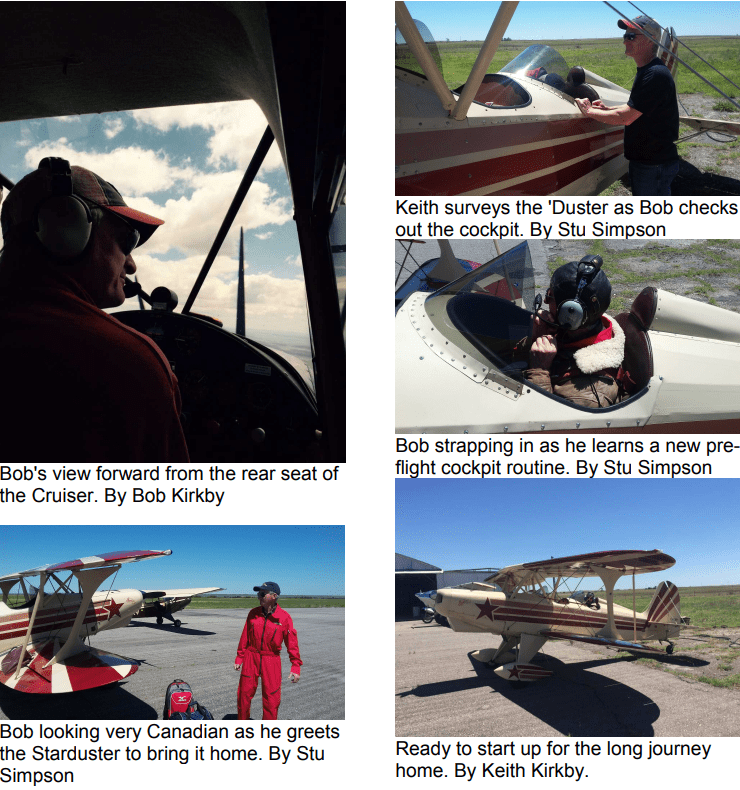
During all this, Bob introduced an especially enjoyable facet to the whole enterprise. He offered his son, Keith, the indefinite use of his pristine Piper PA-12 Supercruiser. Keith, a commercially rated pilot, lives in Colorado Springs, Colorado. The new plan was for him to hop an airliner to Calgary, and he and Bob would then fly the Cruiser south. Once we retrieved the ‘Duster Keith would angle off westward to the Cruiser’s new home at the Denver Front Range airport. What a terrific adventure for a father and son to share. I’d be tagging along to carry luggage and do the escort home.
We were leaving on a Monday and Bob and I both wanted to be home the following Saturday to honour other commitments.
Headin’ South
These trips normally depart early in the morning, but since Keith couldn’t make it to Calgary until late morning, we set 1230 as our launch time. Keith spent less than six hours in Canada and only a little bit of that time on the ground. He’d fly the Cruiser from the front seat while Bob guarded the back.
We felt the thermals bubbling skyward as soon as we lifted off Kirkby Field and turned south toward Cut Bank, Montana, to clear customs. We had a few knots on the tail, which we welcomed as we do all tailwinds.
My Cavalier will cruise at 120 to 125 knots. The Cruiser is more comfortable at about 90. Somehow, I had to find a way to shed 30 knots of airspeed and still remain comfortable doing it.
With the Cav such a chore is pretty easy. I simply set my engine RPM at about 2275, dropped flaps to 30 degrees, and found I could keep station on the Cruiser’s left side with very little difficulty. Occasionally I’d catch a thermal that Keith and Bob missed, and I’d find myself surfing the heat wave, slipping out ahead. So, I’d just ease in some left stick and wander out that way for half a mile or so. Then I’d turn back in to resume my position. Sometimes I’d fall behind a bit, but all I had to do was pull the flaps up to 15 degrees and I’d start wandering ever closer again to once more have the Cruiser just off my wing.
Our adventure was finally underway. So, despite the wind gusts and the afternoon bumps, I was smiling and pretty happy with my lot in life.
As we neared High River we heard some familiar voices on the radio. It was Joe Harrington and some of the other Lethbridge Sport Flyers headed west into the mountains in their Zenair CH750s. We chatted briefly, then wished each other good flights and continued on our way.
We crossed the border right on time and landed in Cut Bank within minutes of our scheduled ETA. The Customs officer was friendly and helpful, and she was genuinely interested in our trip. She wished us a good flight and we were soon gassed up and gone. Next stop, Lewistown, Montana for the overnight.
Central Montana looks a lot like Alberta, except for the occasional mountains that simply sprout up out of the flat lands in the middle of nowhere. In Alberta our mountains don’t go wandering off across the prairies. They stick together on the western horizon.
Lewistown’s airport used to house a B17 training base during WWII and is similar to the old airbases that dot the Canadian prairies. Some of the old runways are still intact, though rather worse for wear. About ten miles out I could see the runway and was impressed that it was so darn big. What I didn’t realize was that I was looking at one of the old runways that’s now used as a racetrack.
My landing on the correct runway was poor in the gusty wind, but it was good enough that I could taxi to the pumps and plan on using the plane again the next day.
Day 2
One of the mountains that juts out of the Montana prairie towers up just south of Lewistown. Named Big Snowy Mountain, it’s a stunning site in the morning sun. Keith and Bob worked the Cruiser up to 7500 feet and I flew Sturns as we climbed southeast bound to clear its high eastern slopes and make our way toward Wyoming. The air was clean and calm, and we appreciated each minute aloft in those great conditions.
Billings soon drifted by to the west while we took photos of each other’s airplanes. Eventually, Sheridan, Wyoming, drifted into view and then into the past as we coursed toward Buffalo, only thirty more miles south.
Now the wind really picked up. The crosswind on approach was minimal, but still gusty and rough. My landing was just ugly. Keith’s was much more passable in the Cruiser. We fueled quickly in the cold wind and were on our way again.
On takeoff I watched from my trail position as Keith firewalled the Cruiser’s throttle and trundled off down the runway. It took longer than usual for the PA-12’s wing to bite, and I watched anxiously as it stepped up into ground effect, but no further.
A few tense hear beats later the Cruiser got what it needed and finally started climbing. Keith told me later that an unexpected upslope wind boosted them up, the result of the north wind climbing the falling terrain at the end of the runway. Nice to have some convenient turbulence for a change.
We headed out across the Wyoming badlands. The amount of thermal turbulence climbed along with the sun, and the wind’s bluster only magnified it. We droned on side-by-side, mostly in silence, but chatting occasionally about things like a tabletop mountain below, or what type of radar the radome beneath us was hiding.
The spring weather had been snowy and wet, so Wyoming’s wild grasses and other low vegetation displayed a deep green across rough, desolate terrain that normally resembles sandpaper. Few roads run through the region, lots of which are barely more than dirt trails. There’s virtually no farmland and only a few ranches.
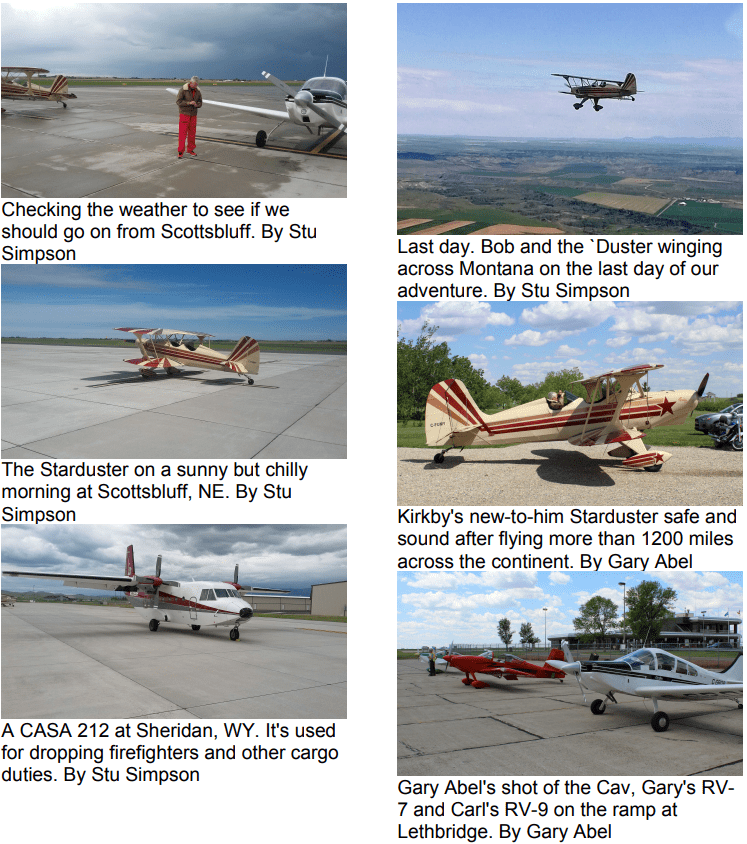
We coasted past Torrington, our originally planned fuel stop, and headed beyond to Scottsbluff, Nebraska. That airport had much better aligned runways for the strong wind at our backs. It was certainly pushing us along, sometimes giving us as much as 125 knots of ground speed, but it wanted to toss our little airplanes around on the ramp like beach balls. We had to tie the airplanes down while we had lunch in the terminal.
Just before heading off to eat, I saw a group of people walking from the FBO to a Pilatus PC-12 tied down two spots over from me. I had my suspicions that the corporate pilot of the Pilatus wouldn’t give a damn about where his propwash went, and I was right. This bozo decided I needed even more wind, so he treated the Cav to his direct propwash as he taxied out. He could have rolled ahead on the empty ramp for another fifty feet, but apparently the company fuel ledger took priority over safety and simple courtesy. What an ass.
We continued on from Scottsbluff for another two hours, clipping the northeast corner of Colorado and ending the day at Goodland, Kansas. I elected to land on the grass runway oriented straight into the wind, while Keith made an excellent crosswind landing on runway 30. We totalled six hours for the day and we were knackered. It felt good to climb into bed and think about meeting the Starduster tomorrow.
Oklahoma Bound
Kansas is flat. It’s like, Saskatchewan flat. In fact, it might even be flatter, if that’s geometrically possible. The farmland below was a pretty even mix of circular pinwheel irrigated plots and regular square sections. One by one, little towns and hamlets drifted past. The map proclaimed them as Winona, Marienthal, Montezuma, Meade and others.
Did we have the same view just then that a barnstormer had in 1923? How would he judge the town of Copeland from the air to decide if it was worth landing to hop rides or perform aerobatics for the awestruck farmers and townsfolk? How would he know if another pilot had been through there the week before and already stolen his thunder?
It was a bit tough to fall headlong into such nostalgia, though. We were sporting at least two GPS’s in each plane, we could instantly send photos of each other’s craft to anywhere in the world, and we were flying easily at speeds half again as fast a Jenny pilot could achieve. Still, those long-gone days are nice to think about every now and again.
I have but one regret about this trip. It’s a silly one so bear with me. There’s a place just east of our route called Dodge City, Kansas. I was hoping, forlornly as it turned out, to be able to stop there for fuel, or maybe overnight if it worked out. Absolutely the ONLY reason is so that when we left I could for once say it and mean it, “Let’s get the hell outa’ Dodge.” Such are the dreams of a childish man who flies airplanes.
We crossed into Oklahoma and Gage’s airport showed up a few minutes later. Bob and Keith landed first on the paved runway, while I elected to try the parallel grass strip. The Cav caught a geyser of heat spewing up from the ground on short final. I tried slipping to shed altitude, but it only increased my speed with no loss of height. I finally set down on the runway, but it was 50/50 as to whether I’d get stopped before the end.
I bailed out. I firewalled the throttle and the Cav leaped back into the rocky air for a trip around the circuit. The same thing happened again on my next approach to the paved runway, but with nearly twice the distance to play with there was no real problem.
The guys at Gage gave us an unbelievable welcome! They were friendly and inviting, and more than a little thrilled that some Canadian pilots had flown all the way there. David and Ron invited some of their local EAA chapter members and they even had a barbecue for us. The hangar and ramp there were filled with all sorts of interesting and unique airplanes.
The highlight, though, was Bob’s Starduster. First flown in 1974, most of the exterior looked brand new even though it was last covered and painted in 1987. Bob excitedly set about readying himself and the airplane for the first steps on the 1200-mile trip to the ‘Duster’s new home.
We spent a little more than two hours with the guys at Gage and were disappointed to leave their enthusiasm and hospitality behind. Bob’s plan was to do one circuit to check things over and then head to Woodward, about fifteen miles northeast. Keith and I would follow, and we’d get gas there for the hundred-mile flight to our overnight stop in Garden City.
As Bob flew past us, Keith and I taxied out to make the short hop to WWR. The temperature had risen since we landed, and the thermals were terrific. The wind had dropped, though, so something was going in our favour.
Our planes got a fair bit of attention at Woodward. It’s clear not many transient Canadian aircraft show up there, especially ones as unique as our three. Keith took off in the Cruiser as Bob was strapping in again. We figured we’d catch him fairly quickly.
Bob was tying on his kneeboard when I spotted a drip from behind the panel. Or did I? I waited and watched. Sure enough, another drop fell within a minute. I’d been smelling a strong fuel odour and I was worried there was a fuel leak from the primer line or the fuel pressure gauge line. Bob caught the next drop and sniffed it on his hand. He said it smelled like gas.
This was a full stop. No way was Bob taking off if there was a fuel leak right next to the panel’s wiring with drops falling near other electronics! I quickly sent a text message to Keith as Bob unstrapped and climbed out.
I retrieved my tools from the Cav, and we set to work removing the panel’s back cover. We spent the next 45 minutes tracing down the leak. Keith was happily shooting circuits as we worked.
Keith eventually landed and we eventually realized there wasn’t a fuel leak at all. The smell was coming from the main fuselage tank overflow vent as the fuel expanded with the rising heat. The fluid leak was actually coming from either the compass or the turn coordinator. Bob could fix that later.
Feeling relieved and a little silly we reassembled the panel’s back cover and started the departure process all over again. As I sat in the Cav warming the engine I heard a faint click and some static on the radio. I called Bob and then heard more of the same in reply. Keith and I could hear each other five by five. After a few seconds of hand signals, pops, clicks and static it was clear Bob now had a radio problem.
I figured this one would be pretty easy to fix. It had to be the result of us messing around behind the panel. As expected, Bob and Keith soon traced the problem to a faulty connection that we’d jiggled loose earlier. We were back in the game.
The three of us took off for the bumpy but uneventful ride to Garden City and the end of a long, hot day.
Day 4
Keith and the Cruiser bugged out early. It didn’t make sense for him to travel any further with us since his new home airport was a couple hundred miles west. He got up early and departed around 7:30 that morning.
I was disappointed Keith couldn’t fly on with us. We really got along well, and I enjoyed his company immensely. I’m glad he could be part of this air adventure.
Our day started with problems on the ‘Duster. On pre-flight Bob discovered the firewall mounted fuel pump leaking at its end cap. Once more the tools emerged, and we set to work.
It took us a few minutes to remove the cap and identify the problem; a cracked rubber gasket inside the end cap. The FBO clerk steered us to one of their engineers. He happily produced a can of Seal Lube, which Bob applied in all the right places. It was easy to then replace the cap, but it took us several minutes to properly safety wire it in place due to it’s awkward arrangement.
Just before Bob mounted up, he noticed the ‘Duster’s tires were low. Again, we approached the FBO and a couple of ramp attendants brought over a bottle of air from which Bob pressured the tires back to normal.
All of these delays ate up time. We hoped to make Douglas, Wyoming, this day, but that now seemed optimistic. At least the wind had diminished to a light breeze from the 25 knots kicking us around earlier.
We finally headed out for our first fuel stop back at Goodland. It was only a hundred miles distant, a good hop for the Starduster’s second homeward leg. It was far enough to actually get somewhere, but still a well serviced airport for any support we might need.
We bumped along in the late morning heat, and each made passable landings at Goodland, fitting in between some ag planes based there. Lunch while we fuelled was a protein bar and a bottle of water. Keith texted Bob that he was down safely at Front Range, but was sad he couldn’t continue on with us. “I’m not all flied out yet,” he lamented.
A Citation sat on Goodland’s sunbaked ramp and one of its pilots approached us. He was quite enamoured with the Cav and ‘Duster and declared how envious he was of our journey. He talked of his Mooney back home in Wichita. Honestly, this is quite a common occurrence for us on these adventures and we each have our responses pretty well practiced. Still, we always appreciate the envy and admiration.
The Citation driver warned us of some approaching weather and said we should get out of Kansas and Nebraska today if at all possible. We appreciated him sharing local knowledge and went into the FBO to check the radar.
Thunderstorms were growing northwest of Goodland encroaching on our route to Scottsbluff, two hours distant. We chose a more north-westerly course toward Sterling, Colorado, which would put us at the back end of the biggest storm then showing, but ahead of the ones building in directly behind it. After shooting that gap we’d angle more northerly toward Scottsbluff.
Bob took off after an Air Tractor and turned on course. I followed and with a glance knew immediately we’d be dancing with the weather before we reached Scottsbluff. Yes we’d squeeze through the gap we spotted on radar, despite our headwind, but I wondered what fury was growing beyond.
Just out of Goodland I called Bob about an ag plane working below right off our noses, maybe the plane that took off ahead of us. We were pretty low, too, maybe only a thousand feet, so I kept a close eye on the sprayer. The Air Tractor finished his pass, wrenched into a hard turn away from us and continued back the way he’d come. Ironic, I chuckled to myself, that he was busy crop dusting while Bob was busy Stardusting. “How’s your butt, Bob?” I radioed. I had loaned him a seat cushion to make his ride more comfortable. In retrospect I should have re-phrased the question.
“Say again?” Bob replied.
“How’s your butt. Is it still sore?”
Then from some high-flying jet: “Wow, that sounds like it was quite a night!”
I could hardly breathe from laughing so hard. I knew it was the time to simply shut up because anything I could say now would only make it worse. But for the record, the seat cushion did make made Bob’s butt happier.
The storm ahead of us grew stronger, darker and more menacing. It was moving as it was supposed to and was getting out of our way. Another cell, as we expected, built quickly in behind it, extending its leading edge toward us as we again cut across Colorado’s northeastern corner.
Rain fell on us, then rapidly intensified. I worried Bob would get soaked and be stuck with soggy clothing in a chilly open cockpit, but he reported staying completely dry. The Starduster’s design is such that rain just blows on by.
Lightning flashed from the first storm as we passed its back side, and we knew we picked the right route to avoid it. We’d just squeak past the one to our west, too, but a glance to the north revealed that another storm would likely haunt us near Scottsbluff.
Sure enough, as we got within ten miles of BFF a wall of heavy rain stretched north and south for a good fifteen miles and sat right between us and the airport. The north end was currently dousing the field.
Our options? We could fly around the north end of the storm front, or we could try the south end and come up the back side, but the rain seemed to wrap itself around there to the west. Maybe we could divert to Alliance, about 40 miles northeast, but that would push Bob’s fuel, and we didn’t know if there was any gas at that airport. Additionally, the storm was rapidly worsening and heading straight in that direction. We’d only be delaying the inevitable.
We paralleled the storm front a couple of miles east of it when I had an idea.
“Bob, what do you think about shooting through the rain wall directly west of us? I can see through the spot directly abeam me it and it’s clear beyond.”
Kirkby was silent for a moment, weighing the options and odds. “You mean fly right through it?” he queried.
“Roger that,” I confirmed. “It’s only about a mile wide and I can easily see the other side.”
“Okay,” said Bob. “Let’s give it a try.”
“Rog. Turn left to a heading of about 250. That’ll put us right through the clearest patch.”
“Left to 250,” he replied.
It’s a good thing our little window was there. North and south of it was a solid opaque downpour that we couldn’t have attempted. Any later and our little portal would slam shut, too. The sky got even darker as I approached to challenge the monster.
Within seconds the Cav was a flying submarine. Maybe this was bad choice, I thought, as the rain wall turned into some of the heaviest rain I’ve ever flown through. The horizon faded for several seconds forcing me to revert to my instruments. It all lasted only a minute, though, and then I was through. I wondered how badly Bob would get soaked in such a deluge.
He hit the rain seconds after I broke through. I continued west another mile and turned north just as the ‘Duster cleared the rain front. Bob barely got a drop on him.
We could see Scottsbluff a few miles distant, and our arrival was a non-event. We gassed up and debated whether to continue on. Though we’d only flown two legs, we spent a fair amount of time working on the Starduster at Garden City. Bob was tired, and he was cold. To top it all off, the wind at Douglas was now blowing at 20 knots gusting 30. We decided to stay the night in Scottsbluff.
Day 5
One habit that I picked up from Kirkby when he owned his first Starduster was referring to it simply as the ‘Duster. I resurrected that habit on our trip home. But you can’t do that down in the US because then others think you’re talking about an ag plane, a crop duster. Then they start looking for a bright yellow low wing plane.
When we left Scottsbluff, I finally caught myself in time and announced that I was taking off behind the biplane, NOT the ‘Duster. At last, confusion averted.
Back over Wyoming, we had just a nudge of tailwind, but mostly we broke even on the speed. Thus, we could accurately gauge the Starduster’s true performance. Bob was coming out with about 100 to 103 knots, which is pretty good for such a draggy airframe. He needed to have 2400 or 2450 on the tach, though, to get that speed.
It was a downright chilly morning that got cooler as our planes flew north. We were shooting for Buffalo, but there was weather coming over the Bighorn range just west of the airport. I worried we’d get caught in the rain there while we fuelled. Bob thought it’d stay over the mountains, but was content to fly the extra miles to Sheridan.
Sheridan’s AWOS said we could do a straight in approach to runway 32. Sturns and a 360 gave me the distance I needed to stay far enough behind Bob on final approach. He landed and taxied long to clear at the second taxiway. I was able to stop short enough to get the first one, but then I was lost. I couldn’t figure out where the FBO was.
I took one wrong turn, checked my GPS and then spotted the ‘Duster heading the right way. I made my way to the ramp just a bit behind Bob and shut down. But don’t tell him I was lost.
There were three ramp attendants waiting for us. One was a young lady who clearly took a shine to us, possibly because we were such a novelty in how polite and respectful we were. Our common courtesy seemed to take them all by surprise.
But I’ve got to hand it to Bob. He topped it all just before pulling away from the FBO. We started up, confirmed comms and were ready to go. Just then he blew the young lady a kiss, which she returned!
The balls on that guy! He’s over 70 years old, flies an open cockpit biplane more than 1200 miles across the continent, and blows a kiss to a pretty girl at a Wyoming airport!
And that’s why Kirkby is one of my heroes.
The leg to Lewistown took less than two hours. We outran the bad weather, the sun shone brightly, and I had a good friend in a biplane just off my wing. Ya, this was good living.
I was still confused, though, trying to locate the correct runway at Lewistown, especially at a distance. But I did find the right one and even made a good landing; well, by some standards, anyway. We tied down, took welcome advantage of the airport’s courtesy car, and headed to town for dinner on the last night of our adventure.
I text messaged back and forth with Gary Abel that night. I invited him to gather whomever he could fly to Lethbridge the next day to meet Bob and his new plane and welcome them to Canada. Gary thought it was a splendid Idea and quickly set about rallying the troops for the next day’s fun.
Day 6
It was a bright chilly morning when we launched from Lewistown. The forecast assured us of headwinds all day long, but we’d make it home today.
Cut Bank was our first stop after a pretty arduous leg with lots of wind, turbulence and cool temperatures. The scenery helped make up for it, though. We got back into visual range of the Rocky Mountains, and I was surprised at how I missed seeing them on the western horizon.
Gary sent a message that the Lethbridge Sport Flyers had their COPA for Kids Day going on and that things at YQL were busy. I was busy thinking more about ensuring everything was right for our border crossing.
We filed our trans-border flight plans at Cut Bank, and our border crossing notifications with CANPASS, processes that were as trouble free as they always are. We were a few minutes late getting out, but it was no problem for Great Falls radio. They amended our ETA at Lethbridge and gave us a pair of transponder codes for the border crossing.
We chatted happily about all sorts of things as we made our way back into Canada, and I soon spied Lethbridge in the distance. Our route lined us up almost perfectly for the straight-in approach to runway 30 there. I powered up and scooted out ahead of Bob, hoping to beat a Bellanca inbound from the east. I never saw him in the air, and he ended up landing after Kirkby did.
After a phone call to the CBSA we were free to roam about. Gary Abel was there, as were Brian Byl and Carl Forman. Scott Stephenson flew down with Carl in the RV-9. On the south ramp the COPA for Kids day was in full swing. A line of airplanes taxied out and soon filled the sky with a hoard of beaming youngsters.
Our guys and the Lethbridge crew welcomed us warmly and were all quite excited to examine Bob’s Starduster. They insisted we move our planes onto their ramp to add to the day’s events. We ate hot dogs, said hello to old friends and talked airplanes and flying trips. It was a grand way to end our adventure.
The thermal turbulence kicked our teeth in on the last leg home. It didn’t matter what altitude we picked; we took a beating. We talked to some glider pilots off of the Vulcan-Kirkcaldy strip, but they thought the conditions were just peachy.

My landing at Kirkby’s could have been plenty better, but at least I was down safe at home, so I wasn’t complaining as I taxied to the fuel pump. Kirkby rolled up in front of his hangar a few minutes later and Gary and I each snapped several photos of the Starduster’s homecoming moments.
Brian Byl landed his Cessna 195 a few minutes later and was quite pleased to receive the C-195 t-shirt I got for him at Goodland. Carl and Scott landed just behind him.
Bob did it; he flew a 43-year-old open cockpit biplane across the continent with hardly a hiccup. He left one old friend in good, trusted hands, but welcomed home a new one. With good luck and Bob’s skill, I think the Starduster will be around for quite a number of years. I look forward to seeing it in the air again soon, just off my wing.


 Calgary Recreational Flying Club YYC