
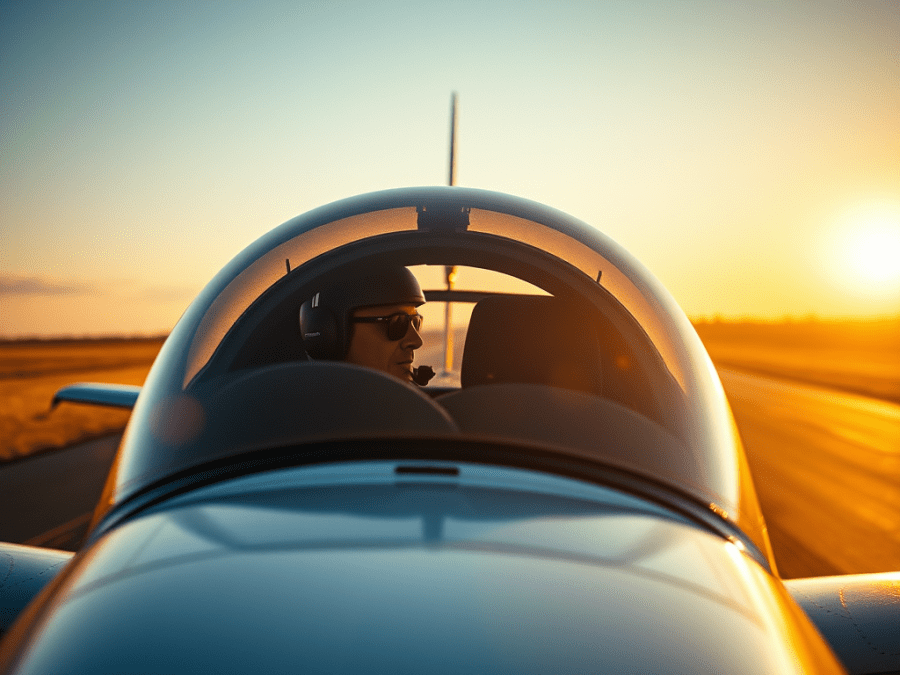
Something was wrong. Or was it? I was in the Cavalier one November day, rolling down runway 16 at Kirkby Field. Gerry Macdonald was beside me as we were about to launch on a test flight to check some work we’d done on the Cav’s alternator.
But the Cav didn’t seem to accelerate like it normally does. I tried to discern the reason with the few seconds remaining before my decision point. I decided to abort. I pulled the power and told Gerry that things simply didn’t feel right. But I just couldn’t pinpoint why.
We did a 180 and returned to the end of the runway where we did another engine run-up. All looked good so I released the brakes, and the Cav seemed, maybe, to move a bit more sprightly.
The takeoff was successful, and I spent most of the flight trying to put my finger on why the first takeoff run was so subdued.
I eventually crafted a theory: I’d installed a much coarser prop on the Cav earlier in the year. This was the first time I’d flown that prop in such cool temperatures, hovering just over zero Celsius. Perhaps the prop’s bite in the cold air was a bit much. But I even argued with that idea because the colder air should have given the engine more power to overcome that coarseness.
And once in the air the engine just didn’t sound like its normal smooth self. Gerry said he couldn’t detect anything wrong. It started and ran well, and the run-ups were normal. But in cruise the sound was just a little bit off, a little bit rougher than normal. It continued to niggle at me.
Weather from then to the end of December was terrible for flying. Just before the end of the year I made another flight, this time up to Carstairs. Again, things sounded just a little off in cruise. Or did they? I didn’t know for sure, but it seemed something was amiss.
I did a touch and go at Bishell’s, waving as I went by to Mike Sweere and Richard Schmitt. On the overshoot things started to deteriorate. It was very subtle at first, then developed into a more noticeable roughness. I tried carb heat but there was no change. Same thing when adjusting the mixture.
I headed back to Bishell’s and made a safe, though long landing. On the ground I once again couldn’t locate any fault. The engine ran smoothly on run up and the takeoff roll, so I decided to head home.
There was some more engine roughness enroute to Kirkby’s and I tried in vain to diagnose the fault in the air.
I spoke that evening with Wade Miller and he felt the likely culprit was carb ice. The weather conditions were about right for ice, but the Cav’s never, ever shown any propensity for it. I have a deep respect for Miller’s knowledge on such matters, but I was still unsure.
The next flight was short and close to home. The roughness persisted, but only subtly, and still I wondered if it was real or just a result of running the engine in colder air with a coarse prop. I just couldn’t replicate the stumbling and abnormal roughness on the ground. Nor could I definitively attribute it to carb ice.
I started troubleshooting in earnest. With Bob Kirkby’s help I checked the quality and resistance of the spark plugs. If anything looked worn or dirty I fixed it or changed the plug completely. Fuel checks showed nothing anomalous.
I flew the Cav one perfect afternoon in January and the engine stumbled just slightly and for only a second. There was nothing left to speculation at that point. There was very real problem, not an imagined one, and it wasn’t carb ice, mixture or fuel.
I grounded the Cav until I could locate the fault.
Late in the month, Kirkby very generously donated warm, well-lit hangar space so Gerry Macdonald and I could dig into the engine in detail. We pulled the gascolator and checked it. We found only a very small amount of debris in the screen and in no way did it block fuel flow.
Gerry found a broken manifold pressure sensor line for the electronic ignition on the right side. The broken line spoiled the mag’s sensing ability, and thus, its ability to optimize the ignition performance. Gerry repaired that and we thought we’d found the smoking gun.
We also discovered the carb heat airbox flapper axle had worn through it’s bushings and was way out of whack. Gerry and I rigged up a field repair that will hold it until I get the new airbox I’ve ordered.
I changed one SCAT tube that had worn through, and finally, Gerry discovered a dead short in the wires to my landing light in the nose. He and Bob repaired it and installed a new LED lamp that only draws half an amp. The Cav should be a bit easier to find in the sky with that lit up, even in the winter.
Gerry then did something really remarkable; he listened to the engine. He placed a mechanic’s stethoscope into each cylinder and slowly turned the engine over. The stethoscope can detect sounds like grinding, parts slapping, and other noises that indicate anomalies inside the engine. In this case there was nothing but normal, smooth action from the O-320’s innards.
The next day I did a test flight to check the results of our work. The first thing apparent was an immediate improvement in ignition smoothness all the way through take off. The repaired MP sensor line clearly made a positive impact on performance. However, on powering back after climbing out, the slight roughness was still present, though measurably reduced.
I stayed up for about half an hour within a mile or two of the field trying all sorts of combinations of power, mixture, carb heat and mag settings. I completed two touch & go’s and one full stop landing. Very consistently the left mag, a Bendix one, was running the engine very roughly, especially at high rpm. Now I’d found the real culprit in this mystery. The other issues were merely accessories to the crime.
It was quite a relief to have a clearly identifiable problem to attack. The left mag was from the Cav’s previous engine, an O-290. My engine re-builder had tested the mag prior to installation on the O-320 and reported that it tested fine. Then it ran beautifully right up until it didn’t anymore.
Now on to solving the problem. When shopping for an AME for the Cav, I’d spoken with club member Doug Eaglesham who highly recommended Brad Kingsmith of High River AirMotive. The next day, with Bob Kirkby flying escort for me, I flew the Cav down to Brad’s shop so he could examine the left mag.
I really debated about flying the Cav to HR. On one hand the engine was definitely acting up. On the other, I felt confident after weighing all the facts that I could get the plane there safely. As it turned out the flight from Kirkby’s to HR took about seventeen minutes and was totally uneventful.
Brad removed the mag and I left to fly back with Bob before Brad had opened it up completely.
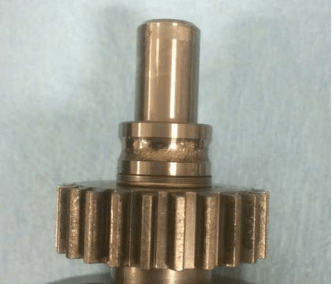
Just after Kirkby set the Cherokee smoothly down on his runway, Brad sent pictures of the mag’s internal bearings. As you can see from the photos, the bearings were all in terrible condition. The main bearing was oval shaped, and the bearing race on the mag’s rotor was heavily pitted. Brad felt the mag was a few minutes from a catastrophic failure.
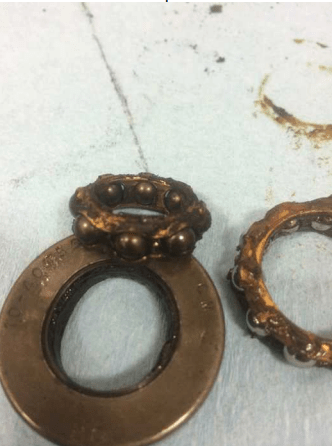
It only took Brad a few days to rebuild and reinstall the mag. On the flight home the difference in the engine’s smoothness and performance was easily noticeable. The roughness and hesitation had vanished. To my great relief, the Cav was back to normal.
How did the mag get that bad? It’s clear I should have been more diligent in getting it checked. I’m not sure how many hours were on it since the last service or inspection, and that’s clearly my responsibility. I put just shy of 300 hours on it since installing the engine in April 2015. I’ll certainly be more attentive to the mag in the future.
We’re naturally very closely attuned to our airplanes, their burps and bangs, their gasps and gurgles, and their surges and sighs. And the more often we fly, the more sensitive we become.
My airplane had been talking to me. I was trying to listen, but I was unsure exactly what it was saying. I tried my best to interpret, I just didn’t know the language well enough. It took quite a while and quite an effort, but eventually I heard what the Cav was telling me. It certainly pays to listen when the airplane speaks.
 Calgary Recreational Flying Club YYC