

This little stick-on detector is an important item that can tell you if you should declare an emergency or assess the situation.
This day I was coming back from west of High River on one of my local flights. I had visited a friend for coffee and was on my way back to my home field just west of Delacour. About 10 miles SE of Ben Stefanic’s Field, I noticed a subtle change in of how the engine sounded. I tried different power settings, but the sound grew louder and louder. After powering back to lessen the possibility of further damage I switched the GPS to nearest airport, which was Kirkby Field, 6 miles away. The engine was strong but the sound was getting louder. I could now smell engine exhaust and so I looked down to the newly replaced carbon monoxide detector on my panel. It was changing to dark green. CAUTION. I opened all the fresh air vents and thought, “exhaust system problem”. It was a relief to know that engine failure was probably not imminent, however I still had to deal with fumes and be wary of the possibility of heat damage under the cowl. I was now within reach of Ben’s airfield. Although almost 2 miles further than Kirkby’s I knew that at Ben’s I would have access to tools and equipment to hopefully do enough repairs to get me safely to my home field, about 5 miles north. Approaching Ben’s a little east of Kirkby Field I heard an aircraft announcing, “ready to roll on 34”. I asked him to wait until I was out of his way, because of my engine problems, which he of course agreed to. My approach and landing at Ben’s was uneventful.
At Ben’s I found a crack in the left front exhaust pipe. Ben had heard me coming in and he showed up to see what was up. Together we put a sleeve around the crack and with clamps secured I could make it to my home field. I have to replace the old with a new pipe and I’m in business again.
I now know why the crack developed. Where the 160° elbow comes out of the cylinder and joins the straight pipe going to the muffler, is where the crack happened. The elbow joint to the straight pipe was not lined up properly and at that point the full force of the exhaust flame was over time literately burning a hole, weakening the pipe. It was paper thin. All the other exhaust pipes are lined up properly and when tapped with a wrench, gives a clear and healthy ringing sound, telling me that they are sound. The elbows are made of heavier gauge pipe and therefore stands up to the heat that blasts out from the cylinder.
This appeared in my Inbox April 1,2016
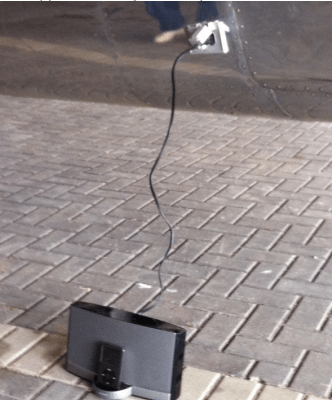
After much work I finally have approval for STC 10406102. Now you can have 120 VAC available at your aircraft when parked on the field at fly-ins, etc. Great for plugging in your music source, the required Margarita blenders or charging your iPads!
We mounted a 12VDC to 120VAC inverter behind the baggage compartment and the receptacle aft of the baggage door. So far no problems with battery life as the current draw is minimal. The covers are weather tight and I haven’t experienced any door flutter. The inverter weighs 2.3 pounds.
This STC is available to all C190/195 Club members at no cost. For further information call or email!
 Calgary Recreational Flying Club YYC