
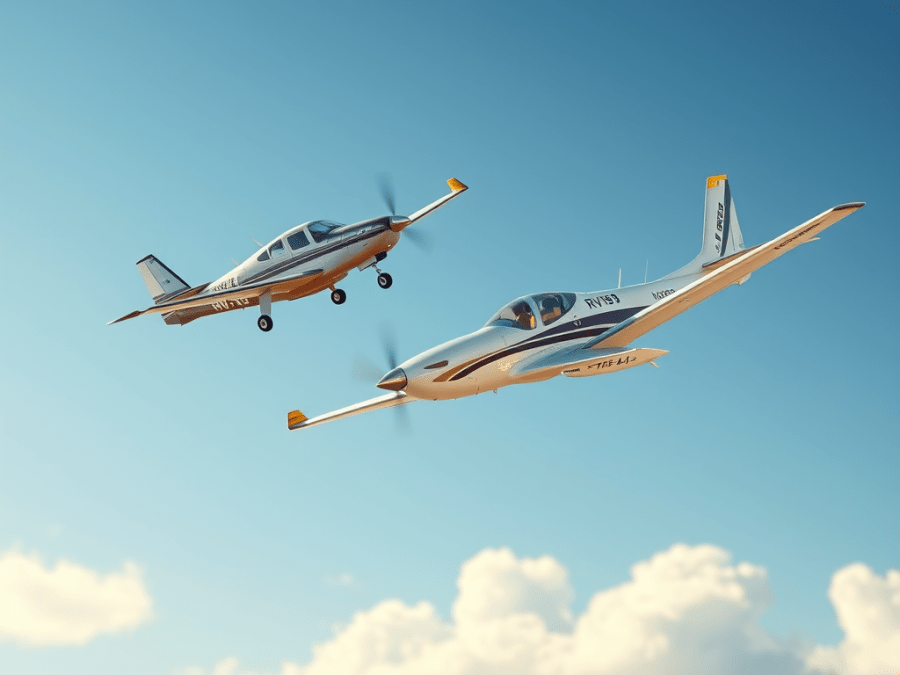
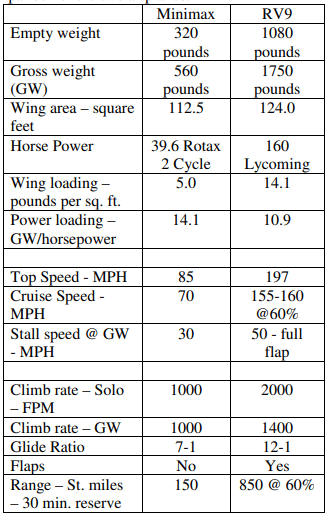
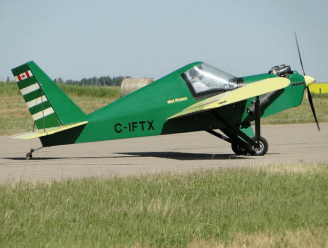
Since I joined the CRUFC in 1994, I’ve built two airplanes. I’m what they call a repeat offender. The first airplane was a Team Minimax. Its first flight was in 1998. It was considered a pretty fast ultralight in its time. By the time I sold it in 2011 it was one of the slower aircraft in the club. In 2004, I started to build an RV9. Its first flight was in 2013. There are a few faster airplanes in the club but not many. So, what is it like to transition from two such dissimilar airplanes? No table can adequately describe the differences in flying qualities of the two aircraft, but I have to start somewhere. Here is some selected data for comparison of the two airplanes.
Take off
On a dry strip, 3340 ASL, no wind, standard temperature pressure, the Minimax would accelerate like a scared rabbit and in 5 seconds be airborne – in about 350 feet. In the same conditions, the RV9 would take about 10 seconds to take off and use about 1200 feet of runway. The Minimax’s relative stellar performance is the result of several factors. The Minimax takes off at 35 MPH compared to about 60 MPH for the RV9. The Minimax’s Rotax two cycle engine provides full power early in the takeoff roll while the Lycoming builds power more slowly as it accelerates. The Minimax’s propeller is designed for a top speed of 85 MPH vs. a much courser prop on the RV9 which is designed for a top speed of 197 MPH. The initial rolling resistance of the Minimax is less than the RV9 due to its relatively large tires supporting a smaller weight.
I’ve had a few really astonishingly quick takeoffs in the Minimax off of paved strips at lower altitudes and I’m certain that I’ll be able to say the same about the RV9.
Cruise
The differences between the two airplanes really become apparent as you level off and commence the cruise portion of the flight. In the Minimax, set the tachometer to about 5500 RPM. At 70 miles per hour, you’ll have plenty of time to enjoy the scenery. There is a greater workload in the RV9.
After takeoff, quickly raise the flaps before you exceed flap extension speed (VFE) – 90 MPH. At about 500 feet, switch off the electric fuel pump – watch the fuel pressure gauge to see that the engine driven fuel pump is working correctly. Reduce power pretty significantly and trim the nose down. Lean the mixture. The speed and RPM’s continue to increase and the nose has risen and you are climbing again.
Once again, trim the nose, reduce power, tweak the mixture and again look at the altimeter. After the third tweak, things have settled down quite a bit and I can concentrate on the mixture which has to be done slowly and takes a while. This process goes on for the first ten miles. When all the dust has settled, I’m cruising between 155 and 160 MPH at 2250 RPM (60% power), consuming a little less than 6 gallons per hour. On a recent 31-mile trip to High River, I only had about 5 minutes of cruise speed before I had to start my landing procedure.
Landing
The Minimax has quite a bit of drag and relatively little mass. It slows down quite promptly when you cut the throttle. The glide ratio is about 7 to 1 and you can drop the nose quite steeply. Tight circuits and sloppy speed management are easily forgiven and become habit forming. The air in your tires are all you’ve got to cushion the landing. I got pretty good at doing a three point landing and a reasonable squeeze on the brake lever had me stopped in about 200 feet.
The RV9 is quite a different story. Virtually nothing about the Minimax applies to the RV9. I start my power reduction 7 miles from the airport, reducing power slowly to avoid shock cooling the engine. It’s a chore to get the airspeed under 90 MPH, the flap extension speed. Any attempt to push the nose down results in rapid speed build up even with the flaps. The excellent streamlining and efficient wing combine to give it a 12 to 1 glide ratio so you need a large circuit and precise speed and altitude management. With full flaps, I cross the threshold at about 70 miles per hour, 3 feet in the air. If I’m a little high and/or a little fast, I’ll have a long disconcerting float down the runway.
The spring-loaded gear legs caused most of my early landings to be a series of bounces as I waited not so patiently for the plane to quit flying. I’m nailing most of my landings these days, but it took me quite a while to get it right.
Handling
The Minimax had a powerful elevator and rudder. The ailerons – not so much. The aileron was particularly weak in the landing flair. I made a few interesting cross wind landings with the stick hard against my leg and the wings refusing to depart from level flight.
So many good things have been written about the RV9 handling characteristics that I have little to add except to state that they are all true. Although the RV9 is not an aerobatic airplane, all its predecessors in the RV line were. It shows!
Instrumentation

The Minimax had a Tach, CHT, EGT, ASI, altimeter, a portable radio and prehistoric GPS. It also had a completely useless compass whose only function was to make the cockpit look cool. The RV9 has a Dynon 180 with about all of the optional extra’s money can buy. It has a very good electronic flight instrument system (EFIS) and engine monitoring system (EMS) and I just love it.
Initially it provided too much information and was overwhelming. It didn’t take long for me to suppress surplus information. For instance, the Dynon provides 8 pages of information that can be displayed by hitting the appropriate button 7 times. I have suppressed about 5 of these pages. Now I hit the button a maximum of twice. I spend less time flipping pages and more time keeping my eyes looking out the window.
For navigation I have my GPS enabled Ipad with Flightplan.go as well as a Garmin 496 which provides information to the EFIS and the auto pilot. Other instrumentation includes an Icom A210 radio, Garmin 327 transponder and a carbon dioxide detector. I’ve also installed a compass.
Conclusion
The Minimax served me well for 13 years and was well suited for its mission –low-slow-short range. It was a great airplane. However, my flying buddies were getting more capable airplanes, and I was tired of monitoring their backsides, so I decided to upgrade. Now I’m really enjoying my RV9.
 Calgary Recreational Flying Club YYC