

My First Gyro Experience

I have to admit that last year I didn’t know what gyroplane was. However, one of our employees introduced the idea of laser scanning the project site by using autonomous air-vehicle. This had me researching the subject and I stumbled with the gyroplane.
The idea of laser scanning died but my interest in gyroplanes increased. I did research in the history of the gyros and was not very impressive based on the safety and level of accidents the gyro pilots encountered. So the word safety was blinking whenever I thought about gyros.
My search led me to look into the available brands of gyros. Auto Gyro, Cobra, Magni Gyro and Apollo Gyrocopter are among another dozen names of gyro flying in North America.
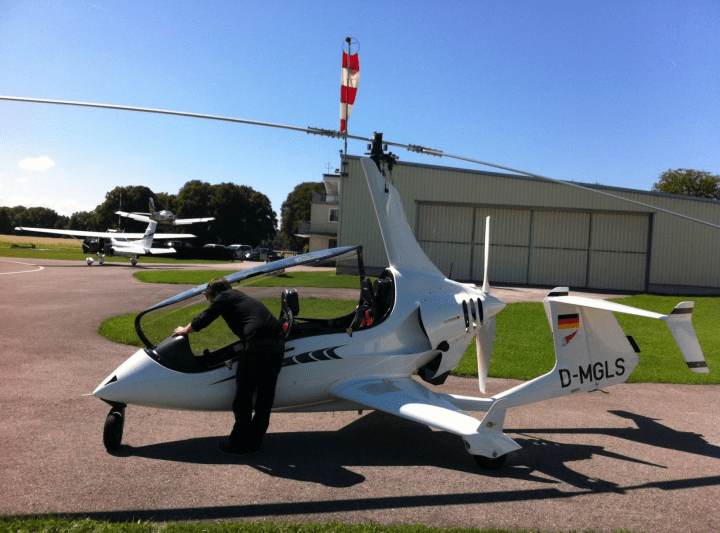
The Auto Gyro is the most popular of these gyrocopters. With their production capabilities of one to two gyroplanes per day and distribution centers, they have the lion market share. But the word safety is still blinking in front of my eyes. The Auto Gyro airframe is made of welded stainless steel with composite glass and carbon fibre moulded parts making up the airframe shell. Frankly, welded parts make me nervous, so I continued my search.
A few months back I found an Austrian company named ArrowCopter who makes a different type of gyro. ArrowCopter AC20 is made of a selfsupporting, doublewalled, carbon monocoque airframe and wing tanks for a maximum fire safety. I did contact the company and requested more information about the gyroplane and as they furnished more information, I found out that they focus on safety and they addressed my safety concerns in the design of A20.
While I was in Oshkosh, I have looked into some of the other types of gyrocopters, attending a few workshops. Then, during a trip to Europe for a family gathering, I used the opportunity to visit Austria to try the ArrowCopter. The company premises are located an hour and fifteen minutes from Vienna in a small town called Zeillern. I met Lukas, head of sales and Martin, managing partner of the company. They introduced their plan in introducing ArrowCopter. Lukas walked me in their assembly shop. I was impressed with the ArrowCopter carbon fiber airframe molded in one piece in an autoclave, seats made of Kevlar and the nicely placed fuel tanks in the wings. In fact, the fuel tanks are part of the wing similar to the wet wing concept.

We drove to an airfield 15 minutes from the offices and he took me in a 20-minute flight in the ArrowCopter AC20. The ground maneuvering is very responding and smooth thanks to the differential breaks. Turning 360 degrees was an easy task. Lukas spun the rotor up to 270 RPM. The rolling was short, and we were off the ground. AC20 is stable and the chiming to 2000 AGL was fast. Lukas introduced the basic maneuvers, and the flying envelop limitations. The descent and landing was simple and easy. My first experience in AC20 Gyrocopter was very interesting and mind changing about the new gyroplanes.
 Calgary Recreational Flying Club YYC