

At long last, we seem to be creeping out of winter and back into some semblance of spring. Of course, with spring comes annual inspection season and I’ve been finding myself too busy to fly. It has also brought around my own Christavia’s inspection time. I’ve been sneaking in a bit of time here and there to get the inspection done, but I keep finding issues.
First, it was time for my two-year recertification of the transponder, encoder & altimeter. In the past, I’ve been able to do this on my own through the graciousness of my former employer, Canadian Avionics. This year I had to pay out of pocket for the inspection… about $650.
Another thing I check for is the primer system. By running my normal priming cycle, I can check the primer system from pump to cylinder for leaks. Nothing showed up… or so I thought. I had noticed that when I checked my idle mixture, it was lean. I also had to adjust it a couple years ago for a lean condition. As I was finishing up on the last day of work on the Christavia, I noticed that the carb was covered in a film of fuel. I tried the primer again and after a couple of minutes I noticed fresh fuel leaking out of the carb at the throttle shaft. Sure enough, there was about 1/8” of play in the shaft. It looked fine when I ran the throttle through its movement, but when actually checked the shaft, it was worn. Air leaking past the shaft was causing the lean condition at idle. So, it’s another $500-$900 for a rebuilt carb.
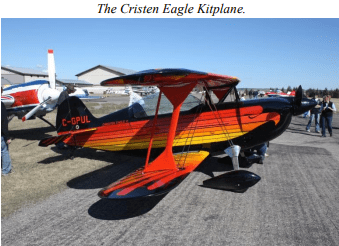
What it boils down to is that even with an AME license and a homebuilt aircraft, maintenance is still not free (especially with the $900 cost last year to have the magnetos rebuilt). Be sure to budget appropriately when you start in just in case unexpected costs arise. The Cristen Eagle Kitplane. Hopefully, I can get the carb rebuilt in the next week and get back in the air soon.
Lately, I’ve been considering the next plane for the Beanlands squadron once the Buttercup is in the air. Years ago, I had the opportunity to do a little aerobatic training in a Citabria 7ECA. I liked it! However, being a good boy, I’ve never really attempted it in Chrissy as it was both illegal and not recommended for the type. However, I’ve been taking a good look at the rules to see what might be possible for the next plane.
In a nutshell, Aerobatics can be flown in certified aircraft approved for aerobatics and homebuilt airplanes that have demonstrated the ability to perform aerobatics. On the ultralight side, aerobatics are prohibited in AULA, but I could not find anything specifically prohibiting aerobatics in BULA’s.
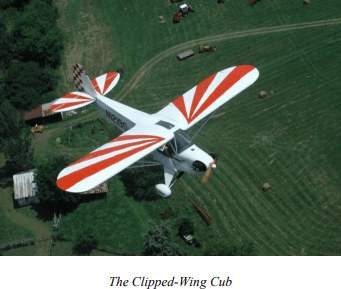
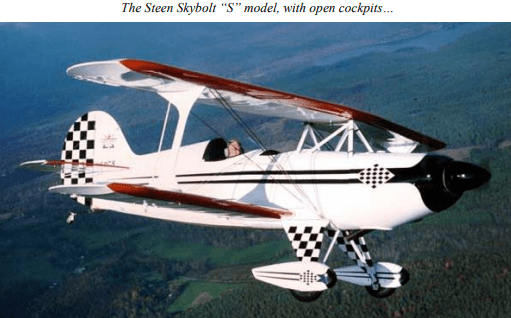
Of course, my preference is amateur built so I looked into their requirements more closely. There are a couple of different ways to demonstrate the aerobatic capabilities. The simplest way is to select a plane that has been previously accepted as aerobatic. Unfortunately, the selection isn’t great. There are a couple of Acro Zenith planes, which are no longer available. There are a couple of the more obvious designs such as the Pitts Special designs (S1 & S2) as well as the Christen Eagle. The Steen Skybolt has also been accepted, but only when configured with open cockpits. Finally, there is the oddball… the Wag Aero Acro Cuby (now called the Sport Acro Trainer)… essentially a Reed Clipped-Wing J-3 CUB!!!
So, let’s assume that it’s not a biplane or Cub that you’re interested in. How do you go about getting your Rans S9 Chaos, Rhin DR-107 One Design or Vans RV-8 approved for aerobatics? After all, these designs have been proven aerobatic mounts in the US, what more needs to be done? Well, the regulations allow for you to acquire a flight permit to perform aerobatics for the purpose to perform an aerobatic evaluation. Sounds simple enough until you look at the pilot requirements to do the demonstration. Without going into the details, you will need a professional aerobatic pilot to do the evaluation. This could be a demonstration pilot, instructor, military, etc. This may be difficult to find, especially if you hope to get your one-of Wizz Bang 2000 design signed off. After all, the pilot you find will need to fly your plane and be comfortable doing so.
So, what will I do? Well, first I’m going to finish the Buttercup . Fortunately, I do like both the Cub and biplanes, so I’ve been looking at those planes. My first thought was to build a light-weight single seat Pitts with an economical O-200 or O-235 and wood prop up front. After sharing some e-mails with Pitts Expert Budd Davisson, it was suggested that this may not work. After all, I’m not exactly a light-weight myself. With a light firewall forward package, the plane would perform nicely, but my weight plus the required chute would put the CG too far aft. I could install a 6-cylinder and constant speed prop to move the CG forward, but the result would be a plane too heavy to lift me and the required fuel. Besides, that would be just too expensive to own and operate.
OK, well that leaves the two seat Pitts or Christian Eagle. Unfortunately, plans for the Pitts S2 are no longer available and the Eagle is just too rich for my blood.
Well, that leaves the Skybolt and the Cub. Let’s face it, the Cub is a pretty, easy to fly plane that I could definitely see myself building. From an aerobatic point of view, it’s certainly not the performer the biplanes are even with 40” chopped from the inboard of each wing. It’s also a relatively cramped cockpit with a mere 23-1/4” between the longerons (the Christavia is 29”). In fact, it’s been said that the most difficult maneuver in a Cub is to get into and out of the plane. However, a little cockpit reconfiguration to make it a single-seat plane would improve that a little. In fact, I do have some time in a PA-18 and quite enjoyed the experience. With an O-200 or O-235 and configured as a lightweight single seater, it would probably make for a fun aerobatic mount. That brings us to the last entry on the list. I’ve had plans for the Standard “S” Skybolt since before starting he Buttercup. Steen Aero Lab sells plans for two variants of the Skybolt: the S and D models. The S model has a single piece upper wing and is the one approved for aerobatics in Canada. The D model has a 3-piece upper wing and is supposed to be stronger than the S model, but was not the one evaluated. It does have a comfy, wide cockpit and is quite capable of handling a portly pilot. The bonus of a usable second seat makes the plane a bit more versatile. The performance is quite good with easier landing traits than the Pitts. Most aerobatics can be performed easily. However, to make this machine perform well at this elevation, I’m looking at an O-360 or IO-360. Anything bigger and the empty weight will be too high for me, fuel and chute to stay below the aerobatic gross. It’s certainly an option though it’s a bit more plane than I had planned.
There is one final option that I have not discounted at this time. With my AME license, it may be practical to find a clapped out Citabria, Decathlon or Pitts S2 in need of some TLC, that I could rebuild. It would certainly get me doing aerobatics much quicker and might make for a good investment. The ability to get some good aerobatic training in my own plane is also a bonus.
Also, if I’ve read the regulations correctly, a Rans S-9 registered as a BULA might be a fit. However, once the Ultralight rules are written into the CARS, that loophole may go away…
Oh well, so many planes and so little time to build them. See you all on Wednesday evening.
 Calgary Recreational Flying Club YYC