

Getting Ladies into the Air
March 8, 1910, Raymonde de Laroche of France became the first woman in the world to earn a pilot license. On September 16, 1910, Bessica Medlar Raiche soloed in the airplane she and her husband Francois Raiche built together at their home in Mineola, NY. The Aeronautical Society of America would accredit her as first woman aviator in America. On March 13, 1928, Mary Eileen Vollick became Canada’s first licensed female pilot.
March 8 marked the first Women in Aviation Day. When Raymonde de Laroche earned her pilot license in 1910, number 36, she represented about 3% of the pilot population at that time. One hundred years later, women still only constitute about 6% of the pilot population in most western countries.
Piloting is an activity anybody can do and can excel at if desired. But why is it that only 6% of the pilot population is female! It supposed to be 50%. Should we face it and declare that, for the last one hundred years, aviation has been standing on one leg only?
The barriers that stop women from flying can be the myth that women are not interested in aviation, the myth that aviation is demanding, a lack of interest, a lack of confidence (fear of flying), a lack of exposure, a lack of emotional support from family and friends (flying is too dangerous), or possibly a lack of community support.
To start with, I hope that all of you agree to discount that the myth of aviation is demanding, because women work in much more demanding fields.
As part of the Women of Aviation Worldwide Week March 3 – 9, pilots around the world are offering free flights to women and girls in “Fly it Forward” events. Women of Aviation Worldwide Week founder Mireille Goyer said that “the number of flights logged during the week has grown to more than 5,000 in 2013, and there is never a shortage of demand—proving that the low representation of women among pilots may be for lack of exposure, but not for lack of interest”.
So it is lack of exposure not lack of interest, but what about lack of confidence (fear of flying). It is obvious that lack of confidence is due to the lack of exposure and lack of education. Once the female pilot takes the control and find out how simple and easy is to fly the machine the lack of confidence will disappear.
Lack of exposure can be reduced in many ways; early in a young girl’s life they should be exposed to aviation as a great opportunity. This can be done via teachers in school, educating system and counselors. The message must also be promoted often and be a consistent part of their career options throughout a girl’s early life. Aviation should also be promoted as an attractive and affordable sport.
Lastly the community is supposed to play a great role in supporting female in aviation. Here I’d like to mention the note a male passenger left for pilot Capt. Carey Smith Steacy, a WestJet pilot flying from Calgary to Victoria on an airline napkin:
“The cockpit of an airline is no place for a woman. A woman being a mother is the most honor, not as ‘captain.’ Proverbs 31. Sorry not PC”. It goes on to say, “I wish WestJet could tell me a fair lady is at the helm so I can book another flight!”
The passenger, according to Smith, also asked flight attendants whether she had enough hours to be the captain as safety was important to him.
Smith posted a photo of the napkin to Facebook along with the note:
“To David. Thank you for the note, you discreetly left me on your seat, I respectfully disagree with your opinion that the ‘cockpit,’ (we now call it the flight deck as no cocks are required), is no place for a lady. In fact, there are no places that are not for ladies anymore.”
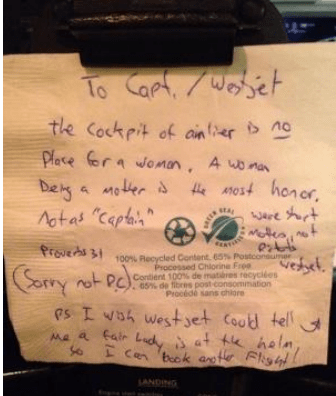
WestJet declined to be interviewed by CBC, saying “it felt no need to lend credibility to the author of the note”. Way to go WestJet.
The airline goes on to say, “it has 1,118 male pilots and 58 female pilots, and that WestJet Encore has 96 male pilots and 10 female pilots”. Oh, again the famous 6%, isn’t it? With 68 women among 1,214 pilots, the percentage is 5.6% in WestJet’s case, but I will round it up to 6%!
One person commented “I hope WestJet is happy with Capt. Steacy for her eloquent, intelligent and appropriate response”. I agree with the comment.
Finally, in order of supporting and encouraging women’s into aviation, let’s challenge the status quo and the false assumptions. Let’s reach out and genuinely invite women to join the challenging and rewarding world of aviation, not as an accessory but as a desired partner. Let us bring the whole family to the aviation, make the airports more welcoming places, put them in the left seat and give them introductory ride, let them get the feel for the control, lighting the spark for flying and most importantly stop 19th century thinking, and live in the 21st century.
 Calgary Recreational Flying Club YYC