

I was enjoying a coffee with a former CRUFC president, and he made the comment that he had tried to search the archives of our club website, to check some of the articles he had written when he was president. He wondered what foolish things he had said twenty years ago that might be an embarrassment to him now. Wow I had never considered that what I am writing is going to be around to haunt me twenty years from now. It’s kind of sobering.

That being said, I want to expand on the info I presented at the last meeting. I mentioned that I had experienced three motor outs. The reasons behind the motor stoppages were varied but one that I am able to control to some degree is a cold seizure. The Rotax 582 is known as a motor prone to cold seizure. It occurs when the water super cools the piston sleeve, shrinking it and causing the piston to stop. The best way to avoid the seizure is to warm the motor for at least eight minutes when cold and I will go five minutes if the motor has been running but has been shut down for a bit. You want to make sure the thermostat is open and water is flowing from the rad through the motor.
The one time I did not follow my own rules with the Avid I felt it as soon as I lifted off. I knew the engine was not coming up to speed but hoped it would make the circuit. Here’s a tip. Don’t hope it will make the circuit.
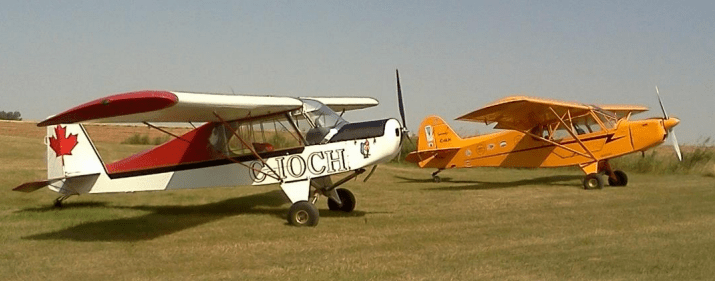
Have a plan before you take off. Put the plan into effect. Have a plan in place every time you take off. Put it right there on the check list. Flying with Brian Byl, he calls out the minimum altitude before he will attempt a turn back to the runway. (In case you didn’t know Brian is also a motor out veteran.) Do you have a minimum altitude that you reach before you turn back? Do you know where you are going if the motor quits on take-off. Is there a row of trees in your way, a power line or other obstacle that would make landing difficult?
The one thing I will stress is when an emergency happens, fly the plane. My instructor used to tell me the most important thing to do is Aviate Aviate Aviate. Fly the plane was his advice. I have been lucky that all of my motor out experiences have resulted in a positive experience. A friend just let me know that an acquaintance of his had just been killed in an aircraft accident. Not sure what happened but the accident occurred on take-off.
This event further prompted me to encourage everyone to have a plan for a failed take off. The first thought that came to mind when my motor quit was to keep the airspeed up. I am sure we have all heard “Keep thy airspeed up, lest the ground rise up and Smyth thee.” I know in all cases I have pushed the nose down first and then checked airspeed to make sure I was well above stall speed. I did not care where I was going till I was sure the airspeed was going to keep me going. I believe it is better to run into an obstacle under control than it is to stall and spin into the ground. Luckily, I have not had to experience either.

When an engine failure occurs, it seems to happen in a second or two. That second or two is enough time to react. As I recall when the motor stops, it seems to slow not an immediate sudden stoppage. I had time to think get the nose down. One of the things I am in the habit of doing is to not climb out at such a steep angle that I am on the edge of a stall. When the motor quit, I was able to easily put the nose down and not stall the airplane. I have heard that when a pusher motor quits there is a tendency for the plane to pitch up. I cannot confirm this as I have never had an engine out in a pusher, but it would seem even more important to get the nose down immediately.
Visiting with Bert Lougheed at coffee the other day he talked about “the magic number”. He told me he loved his SeaRay as he would fly at 100ft above the water looking at the cottages and waving to the fishermen. He would cut the mags and shut the motor down to practice motor out landings. Now I had heard that landing a seaplane can be a challenge without power, but Bert assured me it was no different than landing with power as long as you had you magic numbers pined. What a great opportunity to practice motor out landings. The closest the rest of us can come to this is to put a pair of skis on our planes and try the frozen lakes near out flying fields.
In summary I cannot stress enough if the motor quits, GET THE NOSE DOWN and KEEP THE SPEED UP. (Know your magic numbers.) Your landing may not be the smoothest one you have ever done, you may even end up on your back, but chances are you will walk away from the event and live to tell the tale. That is what you are trying to do. Remember, should you encounter a motor out, Aviate Aviate Aviate.
On another note, the flying at the end of October was amazing. I had a couple of afternoon flights that were so smooth it was unbelievable. With the crops off, the flight at 100 to 200 feet seemed normal. In fact, it would have been tragic to not enjoy the low-level scenery. I enjoyed a flight with fellow club member Bert Hoskins and another flight with Royal and his Savage Cub.
I learned that Bert’s Merlin seems to be slightly faster than my Buzzard but the performance of each is close enough to enjoy flights together. The Savage Cub with the 100hp Rotax is much faster than either the Buzzard or the Merlin. Flying the back seat of the Cub is a treat as the side-to-side visibility is great. Flying beside the Cub and watching the little yellow plane dance in the sky off my wingtip is a joyous sight. Yes, we had some great flying weather at the end of October. I hope you got to enjoy some.
Wednesday, we hear from Troy on his STOL build and Brian has some slides from the 195 Fly-In. See you then. Smooth Skies and Good Lies
 Calgary Recreational Flying Club YYC