

What a busy month. I’ve been able to get in a few flights taking advantage of the fabulous weather early in the month. Wind has kept me grounded for the last couple of weeks.
One of the things I enjoy is airplane shopping. I often peruse the listings of Barnstormers.com or the back pages of the COPA newsletter. I don’t really plan to buy anything, but it’s always interesting to see what’s available and how the prices fluctuate. Sometimes I do so to help other club members as they look for the ideal plane.
Over the past few years, I’ve helped owners import or perform that first annual inspection of their new aerial treasures. Often, this is the point where the love affair comes to a crashing stop. This month I will outline some ways to avoid some of the pitfalls of purchasing a new-to-you airplane.
When considering a new plane, your investigation should start with the initial advertisement. There are a number of clues that can be found there and a list of questions can be formulated for the owner. Let’s considering the following fictitious ad:
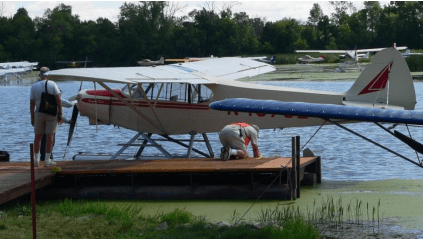
1958 PA-18-160 Super Cub for sale. 2500 TTSN, 1300 SMOH Boerer Prop, May annual, Mode C, Nav/Com, Wheels, Skis, Floats, Estate Sale $70,000. Contact Jim @ (709) 555-1212.
On the surface our fictitious ad this looks like a great deal, but let’s dig deeper. The first thing you should always have done (even on a homebuilt or ultralight) is a thorough, independent pre-purchase inspection. Ideally, a full annual inspection is the best way to go, but it can be pricier than you can afford. However, the alternative to a thorough inspection can be an expensive inspection down the road.
Issues usually start when the initial paperwork inspection is assessed. Things like two-year transponder/altimetry inspections, Airworthiness Directives, Mandatory Service Bulletins, five-year or ten-year prop inspections or current weight & balance reports are found to be lacking. As an estate sale, some of the documents for our PA-18 may have been lost. Also, a plane that was serviceable when last flown may have slipped out of tolerance on some of these out-of-phase items.
Some of these issues can be more than trivial to rectify. A typical two-year transponder/altimetry inspection can cost around $650 if no issues are found. If the plane hasn’t been checked in a few years (or decades) the costs can mount. Many of the older transponders have cavities, which is a fancy word for vacuum tube. These will degrade and fail over time requiring an expensive repair. It’s usually best to cut your losses and replace it with a solid-state (ie. no cavity) version like a Garmin GTX 327… at a cost of $2000 or more. Altimeters, encoders and airspeed indicators can also be found unserviceable and need to be replaced. Leaky pitot/static systems can also take a few hours to troubleshoot and repair. Bottom line: make sure this inspection is current.
The 5-year fixed-pitch propeller inspection usually comes in at about $750 and is applicable to both certified and homebuilt aircraft. One of the things checked is dimensional tolerance. Over time, nicks in the leading edge of the propeller need to be filed out. As this is done, the blade gets progressively smaller and eventually falls below limits requiring a replacement costing $2000-$3000. By the way, water splashing into the prop during water operations will also erode a propeller blade quite effectively!
Constant speed props are good for 10 years. At that point, an overhaul is required which can cost $3000 or more. If your propeller is getting close to that time, it may be prudent to have that done by the previous owner before buying the plane.
Next, let’s consider the engine. The biggest question: When was the overhaul performed? Lycoming recommends 2000 hours and 12 years for most of their engines. I think that the 12 year period is a little on the conservative side, but once engines get to be 20-30 years old, it may be time to consider an overhaul.
Another question that should be asked is: Why the engine was overhauled the first time at only 1200 hours? It may indicate a hidden damage history especially if the logs don’t go back to the first overhaul. It’s also useful to note that although the Lycoming O-320 has a 2000-hour TBO now… it didn’t always. It’s worth doing a little research to see what the original TBO was. If it was 1200 hours then this makes sense.
Given the Newfoundland area code and its moist, salty environment, the possibility of internal engine corrosion is a real possibility. It’s also worth asking how the engine has been operated. Many aircraft on the east coast are laid up for the winter meaning that the engines sit without running for up to 6 months. This is tough on engines if they are not appropriately pickled. For the same reason, the “estate sale” and “lost medical” planes should be questioned as it may mean that the plane has been improperly stored for an extended period.
Next issue is the history of the plane. Obviously, a complete history going back to manufacture is best. However, it’s useful to have records going back to at least the last overhaul. When analyzing the logs, have a good look at the overhaul work order to ensure that all the service bulletins and AD’s were addressed.
Now for the floats and skis. You may find that the plane hasn’t seen wheels for decades. I’ve seen wheel gear that had been stored for 10 or more years which required replacement of the brake calipers, disks, tires and wheels. That was an expensive fix! Another plane was missing master cylinders and brake lines, which was also expensive to replace. If you plan to bring it to Alberta, you’ll need to swap out the floats for wheels which can be a little pricey and take a bit of logistics to perform if it’s sitting on strait floats.

The next question is: What avionics are installed? Unfortunately, avionics have a shelf life. Sure, they will continue to function, but their value drops significantly more than the plane they are installed in. For example, the King KX-170 line of NAV/COM was one of the best radios on the market… in the late 1970’s. Now they make a great back-up radio, if placed behind your aircraft’s wheel to keep it from backing up! Companies like Narco have gone out of business orphaning their equipment. This means that if you have radio problems, you will likely have to replace the radio with something out of this century as parts for the older Narco’s dry up. When you test fly your airplane as part of the pre-purchase, make sure you get a good radio check from the tower or another aircraft and thoroughly test all the gear.
The last thing I’ll touch on is the airframe itself. Careful attention should be placed on looking for hidden corrosion and cracks. Evidence of previous damage should be looked for. Things like internal parts with different colour primer, panels or control surfaces of different colours, poorly driven or smoking rivets, etc can all indicate previous damage to the structure. Previous damage is not necessarily a bad thing. As long as the damage was properly repaired and documented, it can be as good as, or better than new.
Paint, interior and glass condition should be looked at. Fortunately, this is something that prospective buyers see first and will use as the basis of making their purchase decision. However, I’ve things like “Well the paint is OK, but we’ll plan to have it redone in a couple of years.” Unfortunately, repainting a plane is an expensive process to do correctly. A typical Cessna will run in the $10-$15K range to disassemble, strip, repair, paint, balance and reassemble.
At the end of the day, it’s important to look at all the costs to get your new bird up to your standards and compare them with the value that these repairs and upgrades will bring. Keep in mind that most upgrades and restorations do not add as much value to the plane as they cost to perform. It’s always better to look for a plane that already has everything done that you want in the plane. Let the previous owner take the loss.
Well, I know that this has been a little long-winded. That’s what you get when you don’t submit more interesting articles for the Skywriter. Hope to see everyone on Wednesday night!
 Calgary Recreational Flying Club YYC