

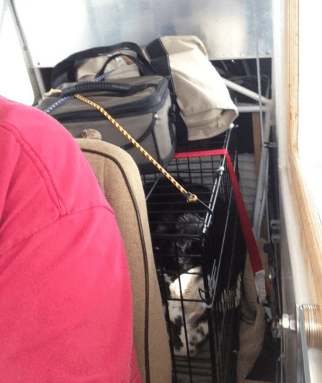
So, there I was about 90 miles southeast of Yorkton, SK at 4500’ trying to punch a hole through the rain. Suddenly, I felt a mild vibration through the airframe that seemed to have a frequency of two or three cycles per second. It didn’t feel like a control issue, and it was too slow for anything on the engine. Could I be getting a low frequency flutter from the rain? I took a look around the cabin and quickly realized how stupid I was. Big Boy, one of the seven border collies we had come to Winnipeg to rescue was panting! I had forgotten all about him as he had been a model passenger for the past two hours and my concentration was firmly outside the cockpit, looking for a break in the rain. I opened the window a crack and after a minute or two the panting, and resulting vibration ceased.
How did I end up over southern Saskatchewan with a large border collie to keep me company? Well, it started a couple of days before when I received an email from Gini Green of the Pilots N Paws Canada organization. A group of 27 border collies had been seized from a hoarder in Winnipeg. All but seven had been rescued from the pound, but they were now scheduled to be destroyed in five days! A rescue group in Cremona, Alberta was willing to take them all, but they had no transportation available.
After reading about Bob Kirkby and Carl Foreman’s adventure of relocating a pair of Brittany Spaniel rescue dogs from Wyoming the month before, I was pumped to help out. Unfortunately, the most I could ever hope to fit in my little two-seat Christavia MK1 was two dogs. I sent the word out to all my flying buddies to see if anyone else was available to help on such short notice. Fortunately, a number of our membership is either retired or self-employed and a fellowship of four pilots and three planes formed up. Glenn Bishell committed with his four-place Bush Caddie and Richard Schmitt followed with his Stinson 108-2. In addition, Reid Huzzey volunteered to ride along and to provide accommodations in Winnipeg through his sister, Patty. With as many as seven dogs returning with us, an extra pair of hands was welcome.
E-mails, texts and phone calls were flying around fast and furiously as we tried to get everything lined up for an early morning departure. We were planning to leave Saturday, July 5th, overnight in Winnipeg and then return on July 6th, again leaving as soon as it was legal day. Fortunately, we all keep our planes at Glenn’s airstrip, Carstairs/Bishell (CGB2), which made the planning easier. The planning was somewhat complicated by the fact that none of us could fly at night and that the Bush Caddie has no transponder. Before long, we had a flight plan drafted which would take us through Lucky Lake, SK, Yorkton, SK and on to St. Andrews, MB, a satellite field north east of Winnipeg.
Next came the preparation of the airplanes to house the pups for the 10–12-hour trip home. I had originally planned to stack two dog crates where the rear seat normally resides. After trying a number of iterations, I decided that this simply wouldn’t work. Plan B was to install the cargo liner behind the rear seat and harness a dog or two back there. I had made the liner when I built the plane, but had never fitted in. Instead, I normally use a large duffel bag strapped to the floor as a lighter, simpler solution. After about four hours of work, the liner was in. I also had to build a box to cover the rear control stick stub and the aileron pulleys that sit above the floor on either side of the rear seat. I built a strong box from 2 x 4 and plywood and clamped it to the rear seat mounts. Once that was all done, it looked like the larger of the two crates I had might fit. Sure enough, it was a perfect, tight fit.
By this time, Glenn had removed his rear seats and discovered that the monster sized kennel he had would fit easily and should be able to carry three of the smaller border collies in relative comfort.
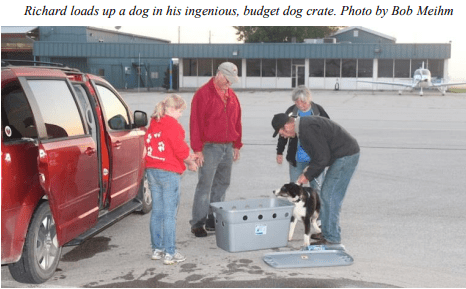
Richard came up with an ingenious idea. With no crates readily available, he bought three Rubbermaid bins large enough to house the medium sized dogs.
Large holes were augured into the upper edge of the bins for breathing and smaller holes were drilled through the lid and upper lip of the bins so that they could be secured with tie-wraps. With his rear and front right seats removed, there was plenty of room for the three improvised crates.
Finally, all was set. For some bureaucratic reason, the dogs could only be picked up on Saturday, July 6 th which meant that Sally Hull of the Hull’s Haven Border Collie Rescue would have to board an additional seven dogs as well as the 15 she had already rescued from this group. The other five had made it to a British Columbian rescue group earlier in the week. Sally was okay with that, so everything was a go!
Unfortunately, Mother Nature had a different idea. An intense line of thunderstorms stretched right across our track through southern Saskatchewan, and we simply didn’t have enough daylight to go around the system. We were already looking at 6-8 hours of flying, depending on the winds, plus stops for fuel. Saturday was scrubbed, but fortunately we were all available for the trip the next day. It did allow me to attend Bob Kirkby’s Fly-in Breakfast, even if I did drive in to the event.
Sunday morning was beautiful and with the exception of some lower cloud in around Regina, it was clear right through to Winnipeg. At 5:45 AM, three sets of wheels left the turf, and we were on our way! The winds aloft were forecasted to be from the west and to be better the further up and further east we went. Unfortunately, Yorkton would not be available Sunday due to weather. We decided to head to Leader, SK and then Regina with a final fuel stop in Brandon. We had a pretty good push at 9500’ and made Leader in 1:45. After a quick fill-up we were on our way again.
Regina was still reporting IFR conditions under a broken cumulus layer but was forecasted to clear before we got there. Our tailwind had risen considerably so we started thinking about skipping Regina and heading on to Brandon. When we got near Regina, we skirted their Class C airspace to the north of the airport and had to drop to about 1200’ AGL to avoid the clouds. Unfortunately, our tailwind faded away at that altitude and I started to become concerned about making Brandon. We did have a couple of options in between, but nowhere that was guaranteed to have fuel available. However, after about 45 minutes the broken layer petered out to a scattered layer, and we climbed above it into a smooth 40 knot tailwind. Brandon was now within reach. This leg was to be our longest of the trip at 3.5 hours. With 4.5 hours’ worth of fuel in the tank, this is about my limit.
On our way into Brandon, both Richard and I were surprised to find a large, concrete airport about 15 miles west of Brandon. We both thought we had just passed the airport when we were sure we had miles to go. I eventually located the notation on the map indicating that it was the abandoned Rivers airport. Richard ended up calling Brandon to let them know that he was now south east of what he thought was Brandon instead of 15 miles west. The flight service specialist was very understanding and explained that it was a common mistake and that Richard was exactly where he thought he was.
After a leisurely lunch at the “Yes Chinese Buffet” in Brandon, we were off on the last and shortest leg of the day. We planned to stay below 3000’ MSL on the way into St. Andrews to avoid the Class C airspace. Although it wasn’t required, I called Winnipeg Terminal and was met with a very friendly reception when I explained that it was our first time in the area. We then continued on to the Oak Hammond VFR route into St. Andrews. The St. Andrews controller was equally friendly and extremely helpful providing guidance all the way to our tie-downs. It really is worth telling these guys that it’s your first time in the area when traveling to new airports.

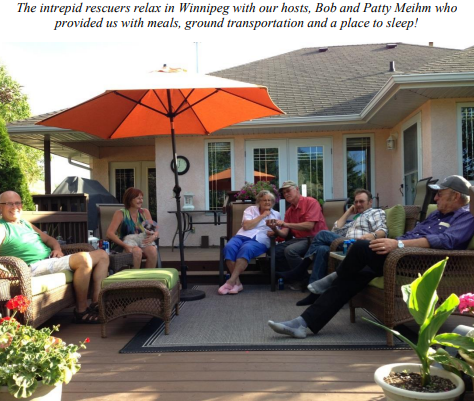
We were met on the ground by Reid’s brother-in-law, Bob Meihm and by a CBC television reporter. After fueling up the planes and getting them all secured for the night, we gave an interview and headed to Bob and Patty’s for the night. Since we landed just after 4 PM, we had lots of time to visit with Reid’s family and rehash the events of the day. They were great hosts and put on an excellent steak dinner for us. They also volunteered to get up at 3:30 the next morning to take us to the airport. What great people!
We started getting a little stressed later that evening when we couldn’t get in touch with Sally to confirm our meeting time the next morning. At midnight, she finally called. Somewhere along the way she had gotten the impression that we were leaving at 8:00 AM with the dogs and had arranged with Global News to film the loading and departure. We explained that we were hoping to get in the air at around 5:30, both to give us as much daylight as possible to operate in and to provide the pups with the smooth air of the morning. Sally understood the logic in our plan and agreed to meet us at 5 AM… now less than 5 hours away.
With some breakfast and much needed coffee under our belts, we arrived just before 5 AM to find the airport blanketed in a thin layer of fog. We prepped the planes and before too long, Sally and the dogs arrived. Unfortunately, with everything that had been going on for the past couple of days, several of them had been sick and had “accidents” on the way. To be honest, the best word to describe them was SLIMEY!
Since the crate I had gave the most room, I took the largest male, named “Big Boy” by the rescue. These poor souls were all very reluctant to leave the crates in the van, but we eventually had them all loaded up for the flight. With the fog still persisting, I thought out loud that it would be quite ironic if we couldn’t leave until after 8 AM. I got a pretty dirty look from Sally at that comment . Fortunately, by 6:30 we were clear enough to go.
Our departure from St. Andrews was very pleasant and uneventful with the sun playing with the pockets of mist in the lower areas. We flew along the south end of Lake Manitoba enjoying the cool, calm air. The smell from the dogs that we were all a bit worried about, turned out to be a non-issue. There was enough airflow through each of the planes to keep any smells at bay.
We talked to a Cirrus pilot on 126.7 MHz who was also heading to Yorkton. He suggested that we angle our track from west northwest to a more westerly heading to avoid the showers ahead. We had been warned by flight services that morning of a high-level wave along our path with some light showers associated with it, but were told it was fairly isolated and easy to avoid. With the help of the Cirrus’s XM weather, we were able to avoid most of it and finally passed through a hole in the showers as I described at the beginning of this article.
At Yorkton we tried to get in touch with our contact in Lucky Lake for fuel. Although we didn’t have the tailwinds of the day before, we were still making out okay with groundspeeds around 85-90 kts. As long as this continued, then I’d have enough endurance make Leader. There was another field just north of Lucky Lake and a call to the number provided in the Flight Supplement was successful in lining up fuel there if we needed it.
By the time we left Yorkton, I think we were all getting tired from rising at 3:30 AM, three days in a row. After a few sloppy radio calls, the Yorkton/Regina radio controller bid us adieu and good riddance! In fact, this was our only “unfriendly” controller of the trip. The rest were exceptional! I found that my decreasing radio proficiency was an early indicator of fatigue. My flying skills were still fine; I just couldn’t get my tongue to work right. Unfortunately, with seven dogs with us, we didn’t have much choice but to push on.
With favorable winds, we were able to make Leader in just over three hours, where we filled up with cheap 100 LL (the cheapest on the trip at $1.75/litre) and sandwiches made by Patty that morning! By now, the forecasted rain had started in Calgary and along the last half our final leg. We decided to stay along the north edge of the system by following highway 9 to Hanna, AB and see what the situation was there. It also allowed us to avoid the hills and radio towers west of Drumheller. We finally decided that we were not going to make it through and landed at a wet Three Hills airport to wait it out. It was a short, 30-minute wait with both the Environment Canada radar and my wife, Renée confirming that the rain was dissipating and that Carstairs/Bishell was clear.
We saddled up for the last 30 miles and flew into rain. We still had more than three miles visibility and about 3000’ worth of ceiling. The bright yellow canola fields were really helpful in providing a horizon to fly by even in the reduced visibility. Before long, Carstairs was in sight. None of our landings were worth writing home about as the wet windscreens played havoc with depth perception, but we all arrived safely!

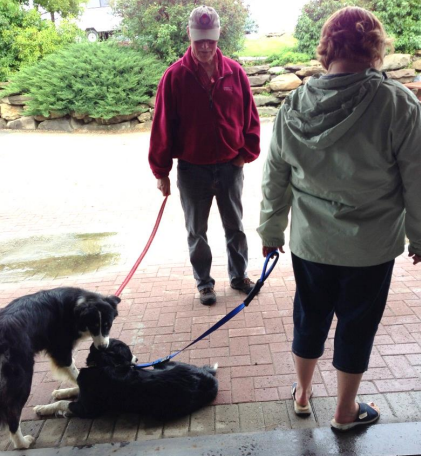
We were met there by Renée, Glenn’s wife Alice, daughter Marilyn and granddaughter Erin and by Cindy Swiney from the Alberta Herding Dog Rescue, the new home for our wayward passengers. It took about an hour to unload all the planes and to coax the dogs out of their crates. Surprisingly, they were now all relatively clean having somehow groomed themselves through the 11 hours of traveling. All the dogs were withdrawn and obviously frightened. Glenn’s English collie, Chico came down to greet the newcomers. Within a few seconds, he was able to put the dogs at ease, something we couldn’t achieve despite our valiant attempts.
Since Monday, the dogs have been enjoying their new digs at the rescue. They will be fostered out for a month or so with experienced dog handlers to determine their attitudes and will then be up for adoption. If anyone is interested in providing a home to these great dogs, please contact Cindy through the Alberta Herding Dog Rescue at swineyc@xplornet.ca .
So, now for the numbers: The total distance covered was 1340 nm. We spent a total of 15 hours in the air: 6.5 eastward and 8.5 heading home. We rescued seven deserving border collies and had no additional bodily fluids leak out of them. In fact, none of them made a sound throughout the entire flight; even the three sharing a crate together. We may have rescued more than seven, as one is suspected to be pregnant.
We all had a great time on the trip. We met some wonderful, hardworking volunteers along the way and every time we explained what we were doing, we were given a great reception. Patty and Bob were fantastic hosts and extremely helpful providing us with food and a place to crash for the night. Looking back on it now, we were able to enjoy a great flying adventure and do something worthwhile as well. Does it get any better than that! I’m already looking forward to the next rescue!
 Calgary Recreational Flying Club YYC