

Unfortunately, this month has not been stellar for flying. Poor weather and muddy field have left many of us ground bound. Fortunately, the end is in sight if you can believe the long range weather forecasts.
Having had the advantage of reading Norm’s column before the rest of the membership, I thought it might be worthwhile commenting on it from a general aviation pilot’s point of view.
Norm made a couple of comments illustrating how ultralights may be safer than general aviation type aircraft, but it’s interesting to note that the definition of “ultralight” has changed over the past few decades. Years ago, the ultralight field was dominated by Lazairs, Weedhoppers and other light aircraft at or around that magical 254 lbs empty weight. An Avid Flyer would have been seen as a “general aviation” aircraft due to its weight, speed and registration. Today, with aircraft like the 180 mph KR-2 and 140 mph Sonerais being registered as ultralights, while J-3 Cubs and Aeronca Champs fall into the general aviation category, the waters become quite muddy.
A couple of years ago I flew a Flight Design CTSW ultralight and wrote a comparison article to the Cessna 150 I owned at the time. In every respect, the CTSW outperformed the 150 except for stall speed, which was the same. In fact, many of the general aviation aircraft in the current fleet can meet 39 knot/45 mph indicated stall speed requirement of Transport Canada’s Ultralight specifications (including both the Christavia MK 1 and Buttercup). In other words, the landing speed difference between modern ultralights and general aviation type aircraft is small to non-existent.
If we go back to a more traditional definition of ultralight, that being a powered aircraft with a light wing loading and slow cruise speed, then other factors need to be considered. True, the speed at which you travel and mass of the aircraft reduces the energy to be dissipated in the event of a crash. However, the lack of structure which creates this low mass also reduces the protection afforded to the occupants.
The light wing loading, and slow speeds of these aircraft also introduces other potential issues lessened by faster, heavier general aviation aircraft. For example, that local Sunday afternoon foray around the patch can turn ugly when the winds suddenly pick up to 25 knots, which can happen in a heartbeat here on the prairies. Two summers ago, I got caught in a heavy squall on approach to Carstairs. The winds came up in seconds from a light southerly 5 knot breeze to a howling 45 knot storm, leaving me in an interesting situation. Fortunately, the higher wing loading of the Christavia and the ability to penetrate the approach at about 80 knots made for a safe landing. At no time did I get any further than 25 miles from Carstairs on that flight.
There have also been a number of occasions where we’ve gone flying only to have the winds come up to 20 kts or better. In a traditional ultralight with a cruise around 60 mph, that 20-25 mph jaunt from the field could turn into an hour-long flight home. Given the short endurance of most traditional ultralights, this could easily lead to an off field landing due to low fuel. The general aviation aircraft cruising at 90 kts or better, would only see a delay measured in minutes.
As for the long cross-country flights being dangerous for recreational pilots, this is easily mitigated with proper planning and allowing an appropriate amount of time for the trip. Most general aviation planes are equipped with at least basic IFR instruments and most private pilots have at least 5 to 10 hours of hood time. As a result, they are more capable of handling a situation where they find themselves in weather, they shouldn’t be in. Many of our club members have made long, multi-day trips with no real safety issues.
It’s also worth noting that when flying on one of these longer cross country trips, the options actually increase. If the weather is bad along your intended track, you can reroute around the poor weather and continue on safely. We had to do this on our return trip from Oshkosh in 2008. The weather ahead was deteriorating, but with a good weather briefing we knew that the weather south of our track was supposed to be better. Sure enough, a reroute of about 30 miles with Gerry MacDonald scouting ahead in the 182 found us a clear path around the front. At the end of the day, the re-rout cost us only about 15- 20 minutes of extra flying.
To be honest, there are a lot of light, general aviation aircraft flown quite successfully and safely by private pilots for transportation purposes. Bob Kirkby regularly flies to the southern States to visit family in his Chreokee 235. Both Ralph Inkster and Troy Branch have used their RV aircraft for family vacations. In addition to countless short haul trips, I’ve had my Christavia to Oshkosh four times and out to the west coast once, and even flew our Cessna 180 floatplane from Newfoundland to Oshkosh once. Of all these trips, the only real issue that I experienced was a broken exhaust stack on the Christavia and a blown cylinder on the C-180. Both of these were managed and landings were safely made.
So, in my humble opinion, I firmly believe that the most dangerous part of flying is the trip to the airport!
To me one of my favorite aspects of recreational flying is the freedom to make these epic trips. In fact, it was this very fact that led me to the choice of my second plane, the Buttercup.
Even before I finished Chrissy, I had decided to build a second plane. When I first started the Christavia, I was single, living in Newfoundland and had unlimited access to the Cessna 180. The Christavia was to be an inexpensive option when Dad or I wanted to do a bit of solo float flying. However, marriage and a move to Calgary changed my flying arrangement. Although I love flying the Christavia, the tandem seating doesn’t really lend itself to flying with a friend. Sure, it can be done, but side-by-side is much better for passenger flights. Also, since float flying in Alberta is essentially out with a lack of water and our high elevations, my interest turned to longer cross-country flights.

This set the early criteria for my second plane. Lately, my wife has gotten into the HGTV network. Unfortunately, this will likely mean more projects on my Honey-Do list, but more appropriate to this article have been the “House-Hunting” shows. They always start with the realtor talking to the customers about their wish list. As the potential homeowners see more and more properties and realize that the “perfect house” does not exist, the wish list whittles down to what is really important. The same process occurs when shopping for the ideal airplane. Initially, everything is on the list, and you end up with a plane that flies at 200 mph, seats 6, has folding wings, available in a $10,000 quick-build kit, burns 4 gph, stalls at 20 mph, can land on a sand bar and can be used to sleep in on those overnight trips.
For me, my requirements came down to a plane capable of cruising at least 125 kts, can climb at 1000 fpm or better at gross weight (safety margin for mountain flights), capable of flying off the grass strips I frequent, powered by a Lycoming 320 or 360 class engine and have 3 hours endurance plus reserves. Comfortable side-by-side seating and a useful load capable of carrying full fuel, Renee and I and about 80 lbs of baggage were also a must. Finally, it had to be a homebuilt that I could build in our two-car garage.
I narrowed down my choice to the Murphy Rebel, Barrows Bearhawk and RV-9. My wife nixed the RV-9 as she is really uncomfortable with the bubble canopy which left the high wing planes. Around this time, I started reading about Earl Luce’s Buttercup. With a 500 lb useful and 100 hp O-200, I initially dismissed it. However, every other aspect of the plane intrigued me. At Oshkosh one year, I noticed that the original Buttercup, built by Steve Wittman had a published gross weight of 1500 lbs, a full 180 more than Earl’s reproduction. It also became apparent that it could be easily modified to widen the fuselage 4” making it the same 44” width as the other planes on my list. The limited climb performance that the O-200 could provide concerned me. Finally, I decided to call Earl Luce and get his opinion as to how well the plane might fit my needs.
The first thing I wanted to know was whether I could mount an O-320 on the nose. I really like this engine and consider it one of the most reliable piston engines on the market. When Earl reverse engineered the Wittman Buttercup, he used the same fuselage tubes found in the structure of the later Tailwind. These routinely fly with O-320’s and O360’s. The battery would have to be moved from the firewall to the tail, but it should work OK.
Earl suggested adding a new compression tube to each wing and an additional set of drag/anti-drag wires. He also suggested replacing the drooping, leading edge flap with a conventional solid leading edge. These modifications would allow for a higher Vne of about 160 kts IAS. He was also quite comfortable approving a gross weight of 1600 lbs typically seen on the Tailwinds. His 1320 gross weight was set so that the airplane would meet the new LSA regulations approved in the US.
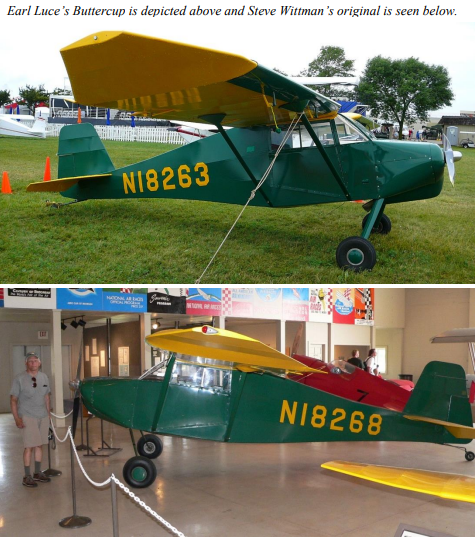
Of course, this left only one requirement not met… the 3+ hour reserve endurance. The nose mounted tank, even with the wider fuselage, would only give me 24 gallons; a mere three hours assuming an average burn of 8 GPH leaving no reserves. A few quick calculations showed that a second tank could be constructed to sit above the cargo area behind the seats and rear wing spar and hold 12 gallons. Weight and balance calculations show that this arrangement would work quite well and give a 36-gallon capacity, or 4.5 hours without reserves.
The new business has been taking up a lot of time lately, but after a four-month hiatus, I’m finally back and making some progress. The seat frames have been completed and I’m back working on the control system. I’m actually hoping that being self-employed will give me more time to finish the Buttercup and once again… BE FASTER THAN STU!
Hope to see you all at the meeting on Wednesday evening and I look forward to getting some new articles from the membership!
 Calgary Recreational Flying Club YYC