
Spring has sprung, and a good six weeks early. Don’t despair, winter will be back in April . But seriously, the weather has been unseasonably warm and clear recently and has led to a ton of flying by our membership.
I’ve been doing some flying to promote the new business. A couple of weeks ago, I decided to fly up to Drayton Valley, which is at the northwest corner of my company’s operating range. I had received an article from club member Guy Christie for the Skywriter in which he invited anyone interested up for a visit. Of course, I gave him a call. He met me at the airport, and we had a nice lunch together. The weather for the trip couldn’t have been better and there was only a four-minute difference from the trip there and the trip home.
The next morning, I headed up to Stettler. After posting some flyers there I headed for Drumheller, but quickly realized that the westerly wind was getting higher and higher making a landing on the paved north-south strip a bit too challenging. Fortunately, just as I was trying to decide what to do, I heard Mike Sweere heading into Lacombe. Decision made; I’d join them. Again, I had a great lunch with good friends.
This past weekend I had another great day of flying as I decided to visit Chestermere and catch up on Carl Foreman’s progress on his new RV-9. The plane is coming along well and he’s now preparing for his final MDRA inspection which should take place in the next week or so. I’m guessing that the first flight is coming really soon.
It seemed as though everyone was flying yesterday. I talked with Troy as I departed Carstairs. He was heading into Carstairs. Bob Kirkby was out with his Super Cruiser and landed ahead of me at Chestermere. I had a chance to see his recently painted Cherokee and it looks like new.
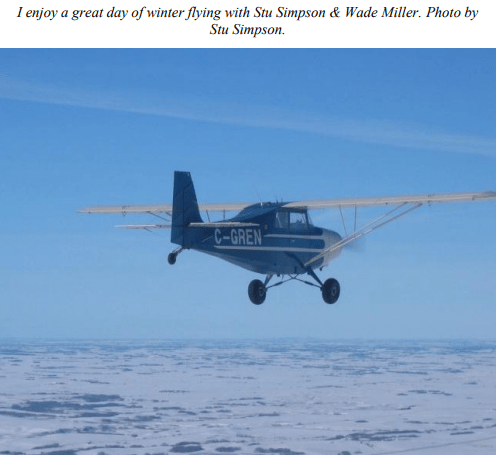
Stu Simpson and Wade Miller headed out for some aerial video work just before I departed but Wade returned with an ASI problem. Stu called me to see where I was heading, and we decided to form up so that he could shoot some video and stills. We ended up over Torrington and by that time, Wade had fixed his ASI and was approaching our location. I decided to head home. For the next 15 minutes, I listened in as Wade and Stu tried to find each other. How I wished I had some way to record the interaction. I was on downwind for Carstairs before the two daring aviators finally stumbled on each other.
I’m really thankful for these flying interludes. Work has had me really busy over the past couple of months (hence the lateness of my recent Skywriter issues). I’m finally starting to get the hang of this new business and have been making pretty good headway. I’ve actually booked in my first customer! However, for the short term I’m continuing to help out my old boss on a contract basis.
We recently performed an annual inspection on a plane we hadn’t seen before. I noticed that it had a full suite of Garmin equipment installed in 2008. Since then, a number of annual inspections had been performed, but there was no indication that anything other than the annual was performed. For those of you with certified aircraft, it’s important to remember that most of the STC’s performed on your aircraft, especially more recent STC’s, will include “Instructions for Continued Airworthiness” (ICA’s). These instructions are not optional and must be complied with for your aircraft to be considered airworthy.
Of course, you’re probably thinking “Well that’s something for the AME to deal with”. Not necessarily. If you bring your plane to an AME and ask for an annual inspection, the AME will perform an inspection in accordance with CAR 625, Appendix B & C. Your STC’s do not fall under the normal annual inspection and, in fact, are not typically due until the anniversary of the install. This may or may not coincide with your annual inspection. In addition, there may be little or no indication in your technical records that these ICA’s are due. Essentially, it falls on the owner to be aware of the modifications performed on his or her plane and to schedule the ICA tasks accordingly and to ensure those tasks were completed.
To be honest, most of the ICA’s I’ve seen simply require a visual and/or functional inspection of the installed equipment or modification. However, some do require certain other tasks to be performed. In some cases, internal batteries need to be replaced on some equipment. Some autopilot installs require adjustments to the capstan clutches to ensure that the pilot can overpower the servo if something goes wrong. The Garmin G1000 system has five lightening protection fuses that need to be changed every two years. Lubrication of certain components is also common.
Well, that’s my nugget of advice for this month. Be sure to enjoy the great weather and I’ll hopefully see you all Wednesday night. Remember to keep your stories coming in.
 Calgary Recreational Flying Club YYC