

For a long time now, I’ve wanted to extend Chrissy’s capabilities to night flying. Although Glen Bishell’s airfield is not lit, on occasion I can bring the plane to Springbank and leave it at work to get in a bit of night stick time. More importantly, I want to be able to fly VFR over the top (OTT). In Canada, you require 15 hours of hood time to receive your VFR OTT rating. Since I have about 20 hours, that should not be an issue.
Three times in the past year I could have really used that rating. Twice on our trip to Oshkosh, we were faced with conditions were proceeding on top of the cloud deck would have been preferable to scud running under them. Granted, it’s unlikely that I would have left my wingmen behind to fend for themselves.
One other time, I took off from Bashaw to find myself trapped east of a 20-30-mile-wide cloud deck with bottoms around 400’-500’ and tops around 1500’. I had to fly all the way south to Strathmore before I could swing west and come around to the south end of the cloud bank and back north to Carstairs.
CAR 605.14 through 605.17 outline the equipment requirements for day VFR, night VFR and VFR OTT. Day VFR, fixed pitch, small private planes is pretty simple:
- Altimeter
- Airspeed
- Compass
- Tachometer
- Oil Pressure
- Oil Temperature
- Fuel Quantity
- 2-Way Radios (certain airspaces)
- Transponder and Encoder (certain airspaces)
Of course, Chrissy is equipped with all of this. However, for VFR OTT the following is also required:
- DG or Stabilized Magnetic Compass
- Pitot heat
- Turn and Slip Indicator or Turn Coordinator
- Attitude Indicator
- 2-Way Radio (all airspaces)
- Radio Navigation Equipment (GPS?)
For night VFR, the following equipment is required beyond the day VFR requirements:
- Turn and Slip Indicator or Turn Coordinator
- DG or Stabilized Magnetic Compass
- Panel Illumination
- Anti-Collision Lights
- Position Lights
- Landing Light (if carrying passengers)
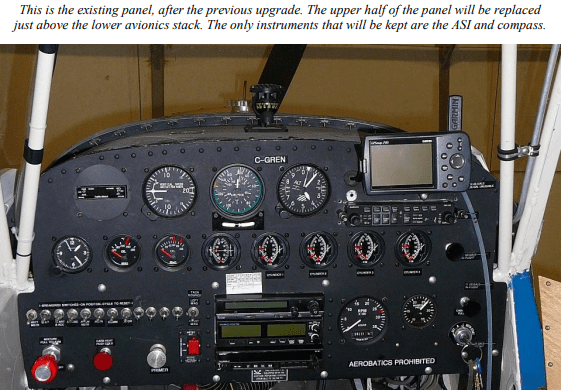
Armed with this information, it was time to take stock of what I needed, and what I already had. One of the stumbling blocks had been my 20 Amp alternator. Fortunately, it died last summer allowing me to replace it with a 50 Amp unit suitable for powering all those lights!
For night flying, the most obvious requirement is lights. Well, it just so happened that I purchased an Aero Flash wing tip system for the Buttercup. Each tip light has the appropriate red/green bulb up front and a white bulb face aft. In addition, they have a white strobe powered by a remotely mounted power pack. Landing and taxi lights will be decided on later, but I’m leaning towards cowl mounted lights, most likely a long-range driving spotlight from someone like KC.
Pitot heat was next. I looked at Aircraft Spruce and was shocked to find heated pitot tubes ranging in price from $500-$2000! To be honest, I didn’t realize that it was a requirement for VFR OTT until I read the CARs for this article. Fortunately, a quick search through my inventory of spare parts turned up a Cessna heated pitot tube from the Cessna 150 I rescued from Florida. That should be an easy install.
Now for the biggie… gyros. There are two choices here. I could load up the standard six pack, but the cost, weight and panel real estate wouldn’t allow for this. The best choice these days is to go for one of the new EFIS systems. There are three units that interest me: the MGL XTreme Mini, the Dynon and the TruTrak Genesis PFD. All three have their advantages and disadvantages. The MGL has great features, but a rather limited temperature range (operating -10°C, storage -20°C). The Dynon is a bit more money but has a great track record. The TruTrak is the cheapest and smallest, but are still not shipping despite being introduced at Oshkosh two years ago…
Along with the EFIS, I’d really like to replace the NINE engine instruments with a single Engine Management System (EMS). All three of the above mentioned EFIS also have corresponding EMS units.
With all these changes, it basically means a new panel will need to be cut. Fortunately, I think I can replace the upper half of the panel leaving the engine controls, breakers and most of the avionics in place. The new panel will actually overlay on top of the existing panel, after I carve much of it away. This will allow me to screw it in place and be able to remove it for service in the future. Even if I can slide it out a few inches, it will allow for access to connectors. I will need some new breaker switches to handle the new lighting and new equipment. In fact, an additional 10 breakers and switches will need to be added. Without a new panel, there would not be enough room to install all these new breakers.
The new panel will be designed in CAD and will be sent to one of the CNC companies in Calgary to precision cut the panel. There will be some panel changes made to the lower half as well. With the removal of the tachometer and manifold pressure gauge, there will be room for a glove box in that area. This will be a welcome addition as there’s not a lot of room in the Christavia for things like flashlights, spare batteries and maps.
While I’m at it, I plan to panel mount the Garmin 296 using an AirGizmo mount and an externally mounted GPS antenna.
Another feature of the EFIS I plan to take advantage of is the RS-232 output for the transponder encoder data. However, since my older transponder does not accept RS-232 data, I’ll need a RS-232 to Grey Code converter (available from Dynon). While I have the avionics apart, I plan on taking advantage of the altitude alerter built into the transponder. I just recently realized that it has an audible alert function.
One of the design decisions I had to make is what sort of redundancy I wanted. With a GPS on board, altitude data, accurate enough for VFR flying can be easily derived from it. That means the altimeter can go. The VSI is optional to begin with and, although useful, doesn’t need to be redundant. There goes the VSI! What I will keep (at least until a second EFIS is installed) is the airspeed indicator. As for engine instruments, I only plan on keeping my independent PropTach unit. Everything else goes! The plan is to sell all the leftover equipment to help pay for the upgrade.
As a bonus, the EFIS systems are all backlit eliminating the need for additional panel lights. All of my avionics also have built in lighting so the only two items that will need to be lit are the standby ASI and my fuel gauge (the clear tube running up the right side of the panel). I’ll likely add a pair of red LED lights to the cabin headliner to handle these.
I had originally planned to do all of this in April. However, the taxman had other plans for my spare cash this spring. The biggest chunk of change required for this upgrade will be in the EFIS and EMS units. My plan will be to stage over the next few months upgrade leaving the EFIS and EMS until next spring. Unfortunately, I do need to do something now about malfunctioning encoder. This will be replaced by the new MGL ALT-4 combination altimeter, encoder, OAT and VSI gauge. It will also give me the opportunity to check out the cold weather tolerance of the MGL systems. It also costs less than an encoder.
I also plan on installing safety cables for the landing gear and build up a set of skis for Chrissy over the summer. I got some great information from a COPA member in Ottawa who has designed and built numerous sets of skis over the years including the latest set for his RV-7! More on that later… I’ll be sure to keep you all updated on my progress as the projects progress.
That’s it for this month. As always, if you have had any interesting flights, tried any new projects, done any construction projects or just have an issue you want to get off your chest, put it in writing and submit it to me as an article. I’m always willing to help on your articles if needed.
 Calgary Recreational Flying Club YYC