
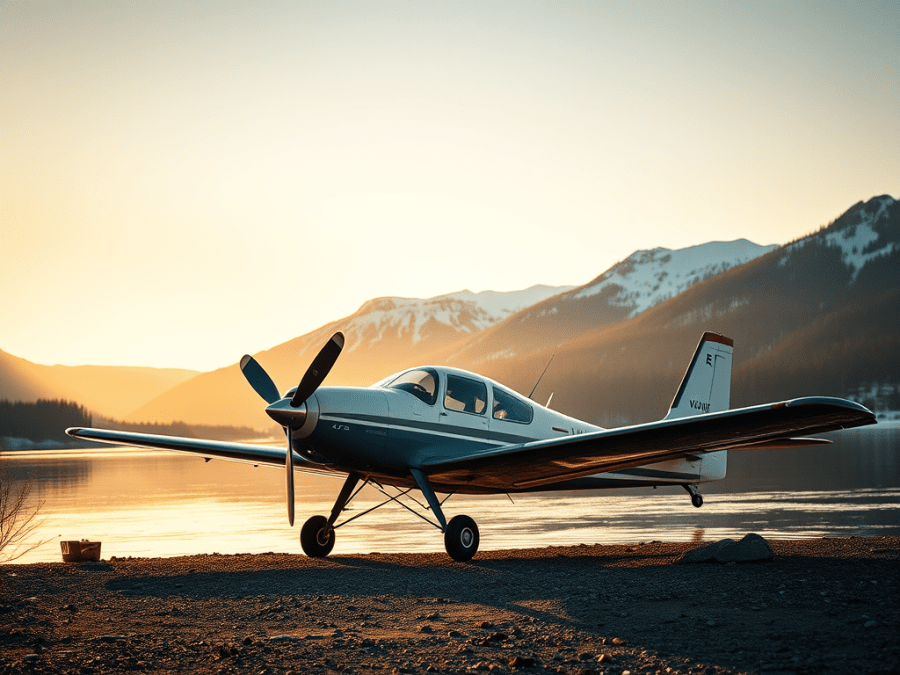
Well, it’s been another great month for flying. Despite some snow, the weather has been quite mild. However, I spent much of the month’s weekends at the lake building a fireplace. On top of all the other skills I’ve been learning, I can now count masonry among them.
With spring just around the corner, thoughts generally turn to those long warm days of flying. Unfortunately, many club members don’t get to fly a lot in the winter. This can lead to both airplanes and pilots that need a little remedial work before setting out for those first spring flights.
What I’ve noticed over the past three years working at Klarenbach Aviation is just how busy we get from March until June with annual inspections. Most aircraft owners wait until the weather turns nice before getting their planes in shape. If you do use an AMO to maintain your plane, you might find that it’s a whole lot easier to book your plane in for its annual in January or February than in March.
However, most of the folks in our club are flying aircraft that can be maintained by the owner (as long as the owner is a pilot). These include ultralight, amateur-built and owner-maintenance aircraft. It should be noted here that even though you fly an amateur-built or owner-maintenance aircraft, you are still required to maintain you aircraft to the standards spelled out in CAR 625, Appendix B and C. These outline the scheduled and unscheduled maintenance tasks you are required to have done.
More importantly, Appendix B actually outlines a checklist of items that must be inspected at every annual. What I’ve done to make the job a bit easier is to take the list as described by Appendix B and expand on it to cover the tasks specific to the Christavia.
One thing that I need to do this spring is the 500-hour magneto check. Generally speaking, both Slick and Bendix magnetos require a 500-hour check to look at points, condensers, and other wear items. Although you can do the inspection yourself (except on certified planes), I would recommend bringing them to an engine shop. The typical cost for this inspection ranges from $500-$1000 for the pair. It does require removing the magnetos from the engine and then reinstalling them, which includes correctly timing them to the engine.
Outside of the normal maintenance this year, I also plan on making a few modifications. About 5 years ago, I bought a set of vortex generators (VG’s) to install on Chrissy. I hope to finally install them this year.
Over the past couple of months, I’ve been keen on getting skis for the plane. Last month’s lake landing really inspired me to find skis to fit the plane. Although I haven’t decided what I want to install, one thing that will be required is a mount point for the front ski bungees. I also want to add safety cables to the gear legs. These cables stretch diagonally from the upper, right gear attach point to the left axle and vice-versa. They are designed to prevent the gear from collapsing in the event of a shock strut failure. Landing on unprepared frozen lakes increases the chance of a shock strut failure.
Unfortunately, finding a set of skis has been a chore. Wheel replacement skis (aka “straight skis”) are easy to come by at a reasonable price (around $1500 for the Christavia). However, our winter snow conditions are not conducive to switching to straight skis. We generally have more days in the winter without snow than with.
Retractable skis are available from a number of suppliers, but they are VERY expensive. I’ve seen certified skis from $7,000 to $15,000 to fit the Christavia. They are also quite heavy.
Ideally, a fixed, penetration type ski would work best. The skis have slots in them that the wheels protrude through. For hard surface landings, the wheels simply roll on the runway with the skis sitting about 2” above the ground. For snow landings, the wheels extend through the bottom of the ski, but the airplane is supported by the ski. There are a number of them available from vendors like Trick Air, Summit Aircraft Skis, Kehler and Airglas. Unfortunately, these seem to be selling for more than they’re worth. Prices start around $5,000 and go up to about $7,000.
There is one other option. Datum skis of Quebec have been building retractable skis for homebuilders using an electric linear actuator to slide the ski fore and aft. At $4,100, they are still a bit pricey but are closer to my budget.
The most likely option for me will be to build a set. The fixed, penetration skis are mechanically simple and shouldn’t present much of an issue to build. However, there are no plans available out there for them, so I’ll be on my own for the design.
As always, if you have had any interesting flights, tried any new products, done any construction projects or just have an issue you want to get off your chest, put it in writing and submit it to me as an article. I’m always willing to help on your articles if needed.
 Calgary Recreational Flying Club YYC