

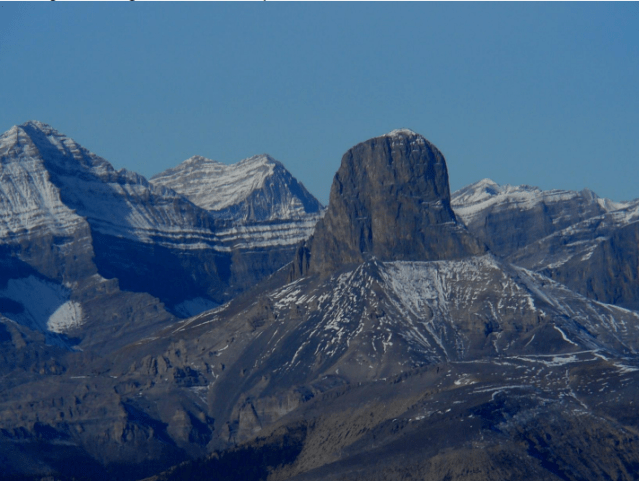
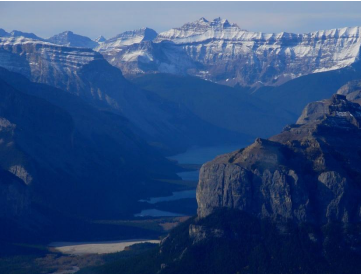
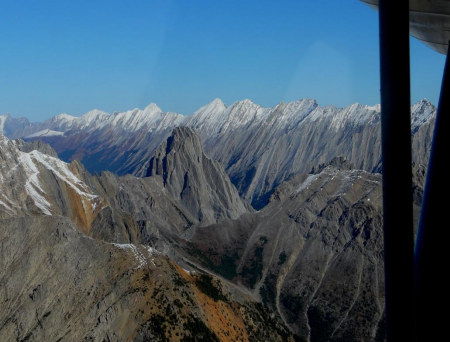
I’m happy to report that another month of fair fall flying has come and gone. October was excellent with warm temperatures, light winds, and sunny skies. I was fortunate enough to take advantage of it in the form of the COPA for Kids Day (detailed in last month’s newsletter), a great trip into the mountains (see attached pictures), and a number of local flights.
October wasn’t without its issues, though. Last weekend, I planned a Sunday flight to the lake to get a few pictures of the construction projects undertaken by our neighbors over the summer. As I leveled off at 7500’, the engine started running rough; not as rough as it had this past summer in Wisconsin, but rough enough that I decided to head for home. The engine seemed to be fluctuating about 50-100 RPM at cruise power, but was OK at lower speeds. On the ground, a magneto check showed no evidence of problems. I decided that it had to be something with the magnetos and packed it up to deal with it when it wasn’t so cold or windy.
Yesterday, Saturday, I went out to change the oil, pull the plugs, and remove the magnetos for overhaul. I ran the engine to warm up the oil and again found no unusual magneto drop. However, when I pulled the bottom plugs out of the engine, I was surprised to find them completely lead-fouled. I cleaned them up, finished with the oil, put everything back together, and ran it up. It ran like a top. A two-hour flight to the lake and back today confirmed that everything was running great.
I suspect the culprit was a couple of prolonged, high-altitude climbs at full rich mixture. In the past, I had always leaned the engine a bit for take-off and climb. Last year, I read through the Franklin’s operator handbook (one that had been translated from English to Polish and back to English again!) and noted that it recommended full rich mixture above 75% throttle. Obviously, something must have been lost in translation. I plan to go back to my old habit of leaning at any altitude above 3000’ regardless of power setting, as it seems to work best with the Franklin.
A recent conversation with a customer had me looking through the CARs to find out exactly what maintenance can be done on a plane without needing an AME to sign off on the work. Performing these tasks is known as “elementary maintenance.” The list of elementary maintenance tasks can be found in CAR Standard 625 Appendix A (http://www.tc.gc.ca/eng/civilaviation/regserv/cars/part6-standards-a625a-2458.htm). This list is considered exhaustive. In other words, if it’s not on the list, then it’s not an elementary maintenance task. It is also the owner’s responsibility to control the authorization of who can perform this maintenance on their aircraft.
I have included some of these tasks to give you an idea of exactly what is permissible under elementary maintenance rules:
(1) fabric patches measuring not more than 15 cm (6 in) in any direction and not requiring rib stitching or the removal of control surfaces or structural parts, on small privately operated aircraft;
(2) removal and replacement of tires, wheels, landing skids or skid shoes, not requiring separation of any hydraulic lines, on small privately operated aircraft;
(3) removal and replacement of skis on fixed landing gear, not requiring separation of any hydraulic lines, on small privately operated aircraft;
(4) repair of non-structural fairings, cover plates and cowlings, on small privately operated aircraft;
(5) cleaning and replacement of spark plugs, on small privately operated aircraft;
(6) checking of cylinder compression, on small privately operated aircraft;
(7) cleaning or changing of fuel, oil, and air filters, on small privately operated aircraft;
(8) draining and replenishing engine oil, on small privately operated aircraft;
(9) checking the electrolyte level and specific gravity of lead acid batteries, on small privately operated aircraft;
(10) adjustment of generator or alternator drive belt tension, on small privately operated aircraft; …
(16) removal and replacement of passenger seat belts and harnesses;
(17) removal and replacement of fuses, light bulbs and reflectors;
(18) removal and replacement of avionics components that are rack mounted or otherwise designed for rapid removal and replacement, where the work does not require testing other than an operational check;
(19) removal and replacement of aircraft batteries;
(20) removal and replacement of co-pilot control levers, wheels, pedals and pedal guard plates that are designed for rapid removal and replacement, on other than transport category aircraft;
(21) opening and closing of non-structural access panels;
(22) removal and replacement of cabin doors on unpressurized aircraft, where the door is designed for rapid removal and replacement;
I’ve left out a few items here, but you get the idea. As you can see, there is a lot that you, as a certified aircraft owner, can do on your own plane. Many of these items may come as no surprise, but there are a few that certainly surprised me when I first saw the list. In fact, much of the required tasks in a typical 50-hour inspection are in the list, and even much of the annual inspection items show up there.
I hope to see you all on Thursday evening.
 Calgary Recreational Flying Club YYC