

Well, September is here, and it doesn’t appear as though summer is going anywhere. A quick glance at the 14-day outlook shows daily highs above the 20°C mark for the foreseeable future! This is fortunate with fly-ins in Lethbridge on Saturday and Lacombe on Sunday!
For me, this has been a summer for repairs. The Christavia had its first flight seven years ago and after almost 600 hours, some problems have surfaced. I’ve already touched on some of them in previous issues, such as the starter dying before Oshkosh and exhaust issues on the trip to Oshkosh.
During the trip to Oshkosh, I also noticed an alarming increase in bus voltage, as high as 15.4 volts. It also seemed to be varying with RPM, which led me to believe that the trusty John Deere voltage regulator was no longer regulating voltage. I was tempted to buy another regulator and simply swap it out, but I decided to try the new Denso alternator mounted on the front of the O-320 in the garage (mainly because I already had it and the pocketbook was still smarting after the trip to Oshkosh). This went surprisingly well, and within a couple of hours, with a little help from Glenn Bishell, I had a new, operational alternator installed—one with an electronic regulator built in. This did mean a bit of rewiring, but nothing too drastic.
I was shocked to find that the terminal attached to the output lug of the John Deere regulator was scorched! The location of the terminal doesn’t readily lend itself to regular inspection, so I’m not sure how long ago this occurred, but it was certainly instrumental in swapping out to the Denso alternator.
The end result of the swap is a lighter, less complicated installation capable of 50 amps, 30 amps more than the John Deere.
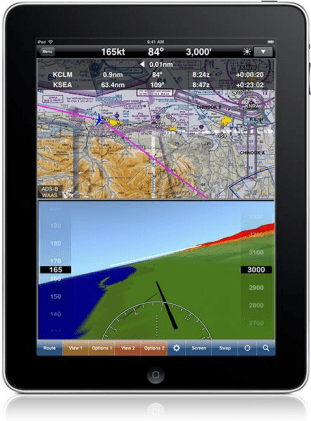
As many of you know, this year’s trip to Oshkosh was cut in half for me as I waited for parts in Rice Lake, WI. However, I did get an opportunity to spend two days wandering around the vendor areas in search of new products. Every year I have noticed certain trends when walking the grounds, and this year was no different. By far, the most prevalent new technologies centered around the iPad and iPhone platforms. It’s truly amazing just how many companies have latched on to these devices as the basis for their products. One in particular is the WingX Pro7 by Hilton software that actually provides synthetic vision with wireless AHRS. Not a bad trick for a handheld device.
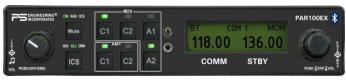
Of course, there were other neat new goodies debuted at Oshkosh. One of them was a new panel-mounted radio from PS Engineering called the PAR100EX. What makes this neat is the fact that they’ve built in a lobotomized audio panel capable of providing a four-place intercom, control for an additional transceiver, and up to two additional audio devices. OK, that’s pretty cool, but the best part is that it has Bluetooth® built in. That means you can listen to your favorite tunes or answer a phone call from your smartphone and have the audio piped to the radio wirelessly to your headset! The only drawbacks to the unit are that there is a remote box that houses the transceiver which needs to be mounted somewhere, and that it’s available for experimental aircraft only.
Another new player in the avionics field is a company called Trig. They are specializing in ADS-B transponders. These new transponders will be required by 2020 to help negotiate the congested airways of the US. Today, the most beneficial advantage to the ADS-B transponders is that they can be used to provide traffic information in the cockpit overlaid on a GPS display. Trig makes a number of GA-type transponders including traditional stack-mounted types and remote head style that use a 2-1/4” instrument for the control head.

Another new product is the Flightline Systems Auracle line. These LCD engine monitors are designed for certified airplanes and can be used to replace the original steam gauges. They are available for twins and single-engine aircraft. The cool thing is how they install. The engine data is collected from sensors on the engine and brought back to a module mounted ahead of the firewall. From there, a single wire bundle is brought back to the display head in the panel, making for a very neat installation. In addition to the Auracle booth, a number of airplanes on the field were sporting them.

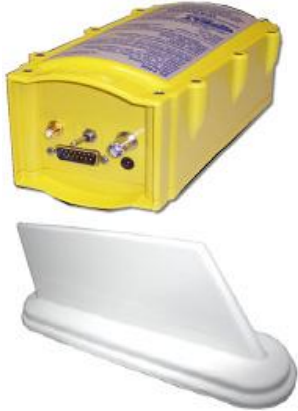
One final product that caught my eye was by a company called Emerging Lifesaving Technologies, which makes (now here’s a stretch) ELTs. The neat thing about these ELTs is that the GPS is built right into the ELT itself. They seem to have given the product a lot of thought and in the US, are able to get away from having to take the ELT to an avionics shop for its annual checkup. It uses an onboard diagnostic tool that the owner can activate, eliminating the need to have it inspected. Canadian regulations currently do not allow for this as there is a current draw test that has to be done, requiring an avionics shop to be involved. They also use a very robust blade antenna to help reduce damage to the system during a crash. Unfortunately, it is not equipped with a 121.5 transmitter, which is holding up certification in Canada. However, they were optimistic it would come soon.
Well, that’s all I have for this month. You may have noticed that this issue is a bit thin. I’ve run out of articles and, frankly, I’m running out of things to say. Please, if you have had any interesting flying adventures, or have used an interesting aviation product, or have had a new flying experience, put it in writing and send it to me to share with the club.
I hope to see you all on Thursday night.
 Calgary Recreational Flying Club YYC