

OSHKOSH 2011 – THE ADVENTURE!
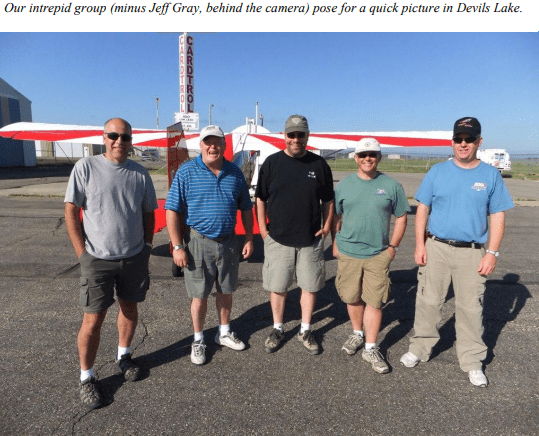
As in previous years, a team of intrepid pilots from the CRUFC decided to make a group flight to Oshkosh. This year’s team included Pat Cunningham in his Cessna 120, Jeff Gray in his 1974 Citabria 7GCBC (150 hp), Barry Wood, Gerry MacDonald, and Joel Charest in their Cessna 182, and me in the Christavia MK1.
The plan, as in previous years, was to leave at sun-up on July 22, the Friday prior to Oshkosh. Pat and I were departing from Carstairs, and the other two planes from Springbank. Due to the higher speed of the 182 and Gerry’s hatred of early mornings, they had decided to leave around 7 AM and head directly to Regina. Pat, Jeff, and I left just before 6 AM, heading to our first planned stop in Leader, SK.
Before we actually arrived at Carstairs, both Pat and I noticed an active thundershower directly over Carstairs. Our first thought was that we would be delayed. Fortunately, the weather radar showed the storm heading directly north, and by the time we departed, it was no longer a factor. The overcast cloud deck to the east appeared to be around 2000’ to 2500’ AGL. Once we got to altitude, we noticed that the overcast was getting progressively lower. Our weather check indicated that we should only have cloud for the first half of our trek across Alberta. Unfortunately, there isn’t a whole lot of weather detail on the eastern half of Alberta.
We finally poked out under a low cloud base as we worked our way over the Red Deer River to gain more altitude. Ahead was a clear sunny patch, and as we passed into it, we were blinded by the rising sun. Pat and I started drifting up to take advantage of the clear sky when the sun disappeared behind a cloud. In front of us was a wall of fog! I quickly keyed the mic and told Pat to turn right. We were in a sucker hole about 2 miles wide and 20 miles long stretching north and south. We headed south into the clearing and popped up over the fog to find that it was a mere 2 miles wide and entirely clear beyond that. We were out of it and had clear weather for the rest of the leg to Leader. Unfortunately, we left our 15 knots tailwind behind with the cloud. Once at altitude, we made radio contact with both Jeff and Barry and gave them a weather update. They were both dealing with the same weather conditions and were encouraged to push on with our reports. Before long, Jeff, Pat, and I were safe on the ground at Leader as we watched the Cessna 182 pass overhead.
The leg to Regina was uneventful, and we all made it safely there despite having a crosswind landing on their only open runway. Unfortunately, we had forgotten to tell Jeff (the newbie of the group) that we were planning to refuel at the Regina Flying Club. He ended up paying significantly more at the Shell FBO. After a bite to eat from the terminal and a few phone calls to open flight plans and arrange our customs arrival, we were on our way. Oddly enough, we were told to keep our transponder codes for the border crossing. This was new for us, and we didn’t really trust that the tower guy was right about that. As we got close to the border, we called Grand Forks Flight Service and got new codes that we used to cross the border.
Our port of entry was Minot, ND. As we got closer, we heard the tower calling the winds at 20 knots gusting 25 knots right down the runway. Unfortunately, that runway was closed, leaving us with a 90° crosswind! There was more than a little chatter as we discussed the upcoming landing. Eventually, we sucked it up and all made it down safely. Customs was a piece of cake, and we were soon on our way to our first overnight stop, Devils Lake. The nice thing about crossing at an international airport like Minot is that the customs guys are far more understanding of the issues of flying. One of our number had accidentally filed his E-APIS report for the 29th instead of the 22nd. The customs guy showed him to a computer terminal with the E-APIS screen loaded and simply asked him to file a new one with the correct date. That was it. No muss, no fuss!
Around 30 minutes out of Minot, Jeff called us and asked, “Should we have closed our flight plans in Minot?” Uh-oh! At first, I thought that the tower would have closed it for us, similar to how they do in Canada, but Gerry piped up and said that he had closed his with flight services before landing. Jeff made a quick call to Grand Forks FSS and was told that they had called the Minot tower after an hour passed from our arrival time and were told that we had arrived safely. We apologized for our transgression and were basically told that it was no big deal and that they realized that we were used to the towers automatically closing our flight plans in Canada. It was a friendly, professional exchange. This was to be our experience throughout our travels in the US while dealing with ATC and FSS. Unfortunately, the same cannot be said for the Canadian guys. The impression that you’re generally left with when talking to our local controllers is that we are interrupting their busy day.
The trip through Minot and Devils Lake revealed the devastation they recently experienced with flooding. The City of Minot usually hosts a huge fair during this week, making hotel rooms scarce. This year, the fair was canceled as hotel rooms were filled with displaced flood victims. The same was the case for Devil’s Lake, so there wasn’t a lot of choice as we reserved the last three rooms in town.
We finally arrived at our hotel. What a disappointment! Barry and Pat’s room smelled as though it had been under water for a month. Fortunately, the restaurant next door to the hotel was great, and we had a very nice evening enjoying food and drink and talking with our very friendly waitress, Emily.

The next day, Saturday, July 23, turned out to be a weather day. Poor weather along our track had Flight Services giving us that dreaded “VFR is not recommended” warning. With Sunday’s weather looking much better, we called Rice Lake, WI and moved our hotel reservation up to Sunday night. This was done simply as a precaution since with only six hours of flying left to go, we hoped to make Oshkosh on Sunday. We spent the day going from restaurant to restaurant waiting out the weather. We did make the six-mile return walk to the airport to check on the planes, although not all our members thought the walk was such a good idea.
Sunday morning had us delayed an hour or two as we waited for the low-level cloud to burn off. Fortunately, I noticed that the winds at 9000’ were forecasted to be 31 knots out of the west! We actually ended up with tailwinds in excess of 40 knots at 9500’ as we made our way to Rice Lake. We had originally planned to stop at Park Rapids, MN for fuel, but with the winds, we decided to bypass that airport and head directly into Rice Lake. For me, it was a 3:05 trip which made it the longest flight in Chrissy, both time and distance! Along the way, I had noticed that the engine was running differently than it had been. This has been a normal phenomenon for me as we got into lower elevations. Manifold pressure gets up to 27” rather than the normal 24” and it simply runs differently. So, when I had the impression that the engine was running a bit rougher than normal, I chalked it up to the low elevation effect.
After borrowing the airport car and getting a bite to eat, we departed Rice Lake and started heading east on our last leg to Oshkosh. I noticed that I had a fouled plug on the run-up at Rice Lake and was able to clear it with a full power, leaned run. Again, I chalked it up to the change in elevation and part of the reason the engine felt different. No big deal I thought.

I leveled off at 5500′ and started leaning out the engine. I normally lean until it peaks, and I get a 100 RPM drop lean of peak. Then I adjust back to 25°F rich of peak on the EGT. This time, I got a 2600 RPM drop as I passed peak EGT!!! Yup, the engine quit! I jammed the mixture in and it refired right away, but I could only coax 2300 RPM and it was shuddering badly. I also had no EGT reading on the #3 cylinder. I made a quick 180° turn back to Rice Lake (and into the headwind) and radioed my situation. Although all three planes volunteered to follow me back, I told Pat and Barry to head on to Oshkosh and accepted Jeff’s offer of help. Fortunately, the engine continued to run at a stable but rough 2300 RPM and the plane was maintaining altitude. The landing was uneventful, and I radioed the guys to let them know I was OK. Jeff landed shortly after. To my surprise, the FBO guy showed up as I started to tie down. He had been just closing up for the day as we departed the field but had heard my radio call and decided to wait and make sure we were OK. He quickly geared us up with the airport car for the evening.
After checking into the hotel, we returned to the airport ready to attack the engine and find out what was wrong. A quick inspection revealed a completely separated exhaust riser, just 1/2″ below the #3 cylinder. Although bad, it was a lot better than a cracked cylinder. With the 15 lb tool bag I had brought with me, Jeff and I were able to drop the entire exhaust system. I was impressed with the planning I had performed in packing the tool bag.
We decided that there was no real need for Jeff to remain in Rice Lake. Monday morning, I took him back to the plane and he left for Oshkosh. In the meantime, I had put together a plan to fix the exhaust. Acorn Welding in Edmonton had originally built the custom exhaust, which consisted of four 6” risers and a 4-into-1 exhaust system. The risers use a slip joint into the cylinders where clamps secure them against a bead in the riser. The risers also slip joint into the exhaust with a pair of tabs and a bolt securing the pieces together. The crack started at the end of the weld for the tab on the riser and propagated around the entire circumference. I called Acorn, and they leapt into action building me a new riser and FedExing it to me in Rice Lake.
The part showed up on time Tuesday morning but didn’t fit! It fit into the cylinder fine, but not into the exhaust pipe. It was too small. I went to a muffler shop that helped me out, and I finally got it to fit. Starting the engine revealed that repairing the exhaust did absolutely nothing to fix the rough running engine! I found both of the #3 plugs and one of the #1 plugs completely fouled with oil and lead. Fortunately, a local shop let me use their bead blaster to clean them up, and I finally had a clean running engine. To be honest, the local support was great, as was the support from Acorn Welding.
One of the helicopter paramedics based at Rice Lake, Joel Timblin, wandered over to chat with me Tuesday morning. I had met him in 2008 when he was considering building a Christavia. He eventually decided on a Wag Aero Sportsman 2+2, but was still keenly interested in my plane. When we found that the riser didn’t fit, he gave me the keys to his truck to go and get it fixed. You got to love the aviation community.
The plane was fixed, and I calculated that if I left then, I would arrive at Ripon just as the airport reopened after the daily airshow at 18:30. This was looking great, and I finally took off at 16:50. As I closed in on Ripon, I could hear the planes being stacked up over Rush Lake in anticipation of landing as soon as the field opened. Unfortunately, the call came out that the field would not open to arrivals until 19:00. Poor weather in the morning had left a large backlog of departing planes that needed to get out before more could come in. I was just passing over a pretty little airfield called Wautoma (Y50), just west of Ripon, so I decided to land and wait. I refueled the plane and had a burger provided by the local EAA chapter 1331 (the first food since 6 AM that morning). It was a beautiful spot with a couple of dozen planes camping there and a shuttle bus to the show.

I took off at 19:10 but again had some plug fouling which I cleared. There was no getting into Oshkosh due to traffic and the fact that the field closed at 20:00. I made the decision to head to Appleton instead. Barry, Joel, Gerry, and Pat decided to stay at Appleton this year and had rented a couple of hotel rooms and a car. They had offered me the floor in their room if I needed it. I arrived there just before 20:00 and called Barry to let them know I had arrived. Fortunately, there was a room available for all three nights, so I didn’t have to resort to an air mattress and sleeping bag. I had thought about flying into Oshkosh Wednesday morning, but I would have lost much of my two remaining days at the show. As it turned out, the next two days were IFR to marginal VFR at Oshkosh with CBs, haze, fog, and rain. By far, the worst two days of weather I had ever spent at Oshkosh. I LOVED it!!!
I’ll leave the details of Oshkosh to a later article. Needless to say, we had a great time and have a lot of stories including our escapades at the bikini beer bar we found in the parking lot of Oshkosh!
I will tell one short story, though. I decided to build a Wittman Buttercup early in 2006 and ordered up the plans. The plane was originally designed and built by Steve Wittman, but he never made plans available. His prototype is at the Wittman Hangar at Oshkosh’s Pioneer Field, but you can’t really get near it beyond the velvet cords that protect it. Earl Luce, a noted Wittman Tailwind builder and guru, reverse-engineered the Buttercup after Wittman’s death and made the plans available.
Since starting construction of my Buttercup, I traveled to Oshkosh three times with the hope of finally seeing a flying Buttercup. I took many photos of the Wittman prototype, but I kept missing Earl… until this year. As I walked through the homebuilt parking area, I spotted the familiar green and yellow Buttercup! Not only that, but parked next to it was the first customer-built Buttercup built by Mike Mattes of Churubusco, IN. Although Earl wasn’t around at that point, I did get to meet Mike and his wife and chatted with him for a while. His plane is powered by an O-235 whereas Earl’s has an O-200. Due to the prop extension, the front end looks quite a bit different than the first two.
On a later visit to the Buttercups, I found Earl and had a great, long chat with him. We discussed balanced controls for the elevator and ailerons, which I’ll be employing. I also got the opportunity to finally sit in the plane and make airplane noises while playing with the controls. I’ve now decided to go with the original center control stick setup rather than dual sticks. Despite all the trials getting there and the short stay there, it was all worth it to get a chance to poke around this ship.
There was yet another Buttercup there, but it was an unfinished skeleton built by William Wynne of the Fly Corvair fame. They had decided to sell the plane in favor of a finished Tailwind. The plane was brought to Oshkosh to deliver it to the new owner. It looked fairly complete with the wings, tail, fuselage, and landing gear completed but uncovered.
All too soon (especially for me), it was time to head home. We left late on Friday morning due to fog and made it back to Devil’s Lake. We had hoped to get to either Regina or Brandon that night, but with the possibility of a long stop for Canada Customs, we decided to wait until the next morning. Chrissy and I were still suffering from trust issues, but as the trouble-free miles flew by, my confidence was improving.
Saturday morning was another late start as the remnants of a front sat directly overhead in the form of a line squall when we awoke. After taking a leisurely breakfast at a local restaurant, the weather passed and left beautiful, clear skies in its wake. The first leg was to International Peace Gardens where we cleared customs and said goodbye to Pat as he went north to Dauphin, MB, to meet with family. Customs was a breeze, but with the headwinds we were pushing, there was no way for Jeff and me to make Regina safely on the fuel we had. We went to Estevan, SK instead. We had planned on Swift Current next, but they had no fuel. The owner at the FBO in Estevan suggested that Lucky Lake, north of Swift Current, may have fuel and gave us a number to call. Sure enough, they did, and we made arrangements to have someone meet us there. An older gentleman named Tom met us as planned and helped us with fuel. We left for the last leg home. This leg was 301 miles, more than I would have previously planned for. However, with the headwinds forecasted to diminish, and the confidence I had gained from my previous 3-hour leg, I decided to go for broke. There was also the safety net of Hanna sitting about 100 miles east of Carstairs if I needed more fuel. I didn’t need it and made Carstairs in 3:07. This is now the longest air time I’ve logged in Chrissy. The leg from Devil’s Lake to Rice Lake was two minutes shorter, but it still holds the record for the longest distance I’ve covered in one flight at 385 miles. The only issue I had on the return trip was higher than normal oil temps on the first leg out of Oshkosh and the last leg into Carstairs when my oil cooler control cable slipped in the clamp reducing the airflow to the cooler. A new clamp will fix that permanently.
The entire trip took nine days and 28.2 hours of airtime (31.2 flight time) for me. Although I haven’t tallied up the entire trip’s expenses, I know it was more than previous years, primarily due to the $160 per night hotel room in Appleton, plus two extra nights in Rice Lake and the rental cars. As we discussed the trip on the way home, my first response was that this was my last trip there with Chrissy. With a week to finally think about it, I’ve now decided that it really wasn’t that bad and, yes, I may do it again. It’s really hard to ignore the call of Aviation’s Greatest Show!

 Calgary Recreational Flying Club YYC