
First off, I have to apologize for the late date of this issue of the Skywriter. My vacation took up the first two weeks of July. The second week was spent at the cabin working on tiling floors. Fortunately, my vacation wasn’t all work. The first week was spent on the CRUFC 2010 Air Adventure Tour. I won’t get into the details here as Stu Simpson has done an excellent job of narrating the trip in his article, the first part of which can be found in this issue.
There are a few details that I will talk about. One is actually a confession. Stu mentions an incident which occurred between Castlegar and Creston where the Christavia’s engine oil temperature became quite warm. To understand what happened, I’ll take you back to June 19th, the morning of Glenn Bishell’s fly-in breakfast.
I was finishing up the annual inspection on Chrissy that morning, with only the cowls and propeller installation remaining. The propeller was removed so that I could finally install a proper spinner on the plane and conduct a dynamic balance. By installing the spinner, I closed in a 2”-3” gap in the cowl around the circumference of the prop hub. I was pretty confident that this wouldn’t cause any cooling issues, but it was one thing I had planned to watch on the first flights.
After a thorough inspection of the engine, I installed the upper cowl followed by each of the lower cowl sides, and finally the “chin” cowl over the air intake box.
The next morning, after a brief flight test flight that showed no issue with cooling, a group of us headed to High River for the Father’s Day Fly-In Breakfast. Everything went well until I joined the downwind on the return trip to Carstairs. The oil temperature gauge was at 210°F, about 30° higher than normal. I elected to do a touch and go to reproduce the cruise conditions and see if it was a gauge error or real problem. The temperature stayed pegged at 180°F with no faltering. During all of this, I had also cycled the air valve that controls the cooling air directed to the oil cooler.
After landing, I did a thorough check of the engine compartment and found nothing out of the ordinary. I suspected one of two things, either there was a gauge error, or the air valve had stuck partially closed. I have been using the valve to help warm the oil during cold starts, much the same way that cowl flaps are used on other airplanes.
Next came the prop balance. This went quite well, and I was able to reduce the vibration from 0.6 ips to 0.04 ips; an order of magnitude less. In addition, I cut about 1.5” off of the right rudder pedal return spring to eliminate the left turn tendency in cruise.
The test flight revealed a great reduction in vibration. Although I still need right rudder pedal in climb and at high cruise settings, I can fly feet off in economy cruise. I was feeling quite confident about the Portland trip as the plane was flying better than ever!!!
The first two flights of the trip from Carstairs to Chestermere and then from Chestermere to Cranbrook proved to be trouble free. However, on the short flight from Cranbrook to Creston, the oil temperature once again came up to 210°F and held steady. This was surprising as the outside air temperature was only 6°C. This time, I noticed the oil pressure drop to the bottom of the green which confirmed that it wasn’t a gauge error.
In the previous flight I had used the air valve to bring up the oil temperature from 160°F in the cool air at 8500’. I was starting to suspect that the air valve was stuck, and the cable was simply bending. Attempts to cycle the valve didn’t fix the issue. I decided to continue on as the temperature was still in the green and holding.
In flight, I had decided that if the air valve was OK, I would remove the chin cowl and fly with it off to see if the cooling issue would go away. On the ground at Creston, I pulled out the tool bag and started in. First, I checked the air valve control, and it appeared to be working fine. Next, I removed the air duct from the air valve to the oil cooler to see if there was a blockage in the hose or at the cooler. Again, no faults were found. Finally, I removed the chin cowl and decided to fly that way for the next short hop to Porthill.
We went up to the terminal to relax but my mind was still contemplating the problem. I realized that although I had checked the air valve control on the back of the baffles with the hose off, I hadn’t looked to see if there were any issues ahead of the baffles. The nose of Chrissy is over 6’ high with the baffles being above eye level. I opened up the cowl and stretched to see the top of the engine. To my horror and relief, the problem was quite evident!
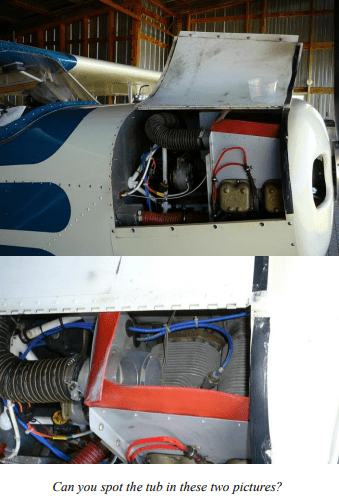
Over the past few years, our dog’s food has been coming in clear, plastic tubs about 4” in diameter. As she goes through two every three days, I’ve been cleaning them and using them as parts tubs. I’ve taken them to school, work and my hanger. For the most part, they work great. However, I was now looking at one of those tubs sitting neatly over the intake end of the air valve completely sealing it off!
I was now confident I had identified the problem… but how did it get there? I distinctly remember taking a close look over the top of the engine before installing the cowls. I’ve made this a practice to ensure I haven’t left tools sitting on top of the engine, an easy mistake to make.
That night at the hotel, I was preoccupied with this issue until it finally dawned on me what had happened. The first cowl I installed was the upper cowl which has the two upper side cowls attached by piano hinge. As I attached the lower side cowl, I had the upper side cowl open. As I attached the last two screw/bolts, I placed the tub on the open cowl (now open and upside-down). When I went to install the second, lower cowl, I would have closed the first upper cowl and opened the second one. That was when the bucked dropped down inside the baffles to rest on top of the cylinders.
When I did the pre-flight inspections after the annual, the tub must have been sitting down tight against the baffles where I couldn’t see it from one side, and the fact that it was clear prevented me from seeing it from the other side (remember, I can only open one upper cowl at a time).
What was happening in flight was that the tub would occasionally work its way over the oil cooler intake air and seal it off. The first time it happened, I did a touch and go immediately after that must have dislodged the bucket, leading me to improperly diagnose the problem.
After this issue was sorted out, the rest of the trip was trouble free. In fact, I made a climb from 22’ MSL to 9500’ MSL to clear the Cascade Mountains at maximum rate of climb on a warm, 25°C morning and the oil temperature stayed below 210°F, dropping to about 200°F above 6000’.
One other thing I learned on the trip was just how great some of the new technology is. I bought an iPhone 3Gs this spring. With the new audio panel, I can plug it in and listen to tunes or audio books while making these long trips. This feature was pretty obvious.
One that wasn’t so obvious was just how helpful the iPhone was for other things. One of the legs brought us into some unstable weather with a number of thunderstorms in the area. I was able to bring up a weather web site showing real-time radar info. With the built-in GPS in the phone, I was able to determine where the rain showers were and pick my way through them. Yes, I know that XM weather built into the new aviation GPS’s will do the same thing, but since I already have the data plan and the phone, this is a free service. XM on a Garmin GPS almost doubles the cost and you need an XM subscription to make use of it. Of course, you do need 3G cell coverage to make use of this, but I had coverage for about 90% of the flying.
I also have a GPS navigation application on the iPhone that works great for flight planning and as a back-up GPS in flight.
Even the text messaging works well when traveling with a group. At one point, I had come out of the mountains west of Springbank to find the entire plains under fog and cloud. Fortunately, I could tell that Sundre was clear, but I wanted to let Stu and Warren know of the conditions as they were not as predicted. They were on the ground in Invermere, so a quick text message was sent to warn them. So far, I’m quite impressed.
Well, that’s it for this month. We had an incredible trip with a number of memorable moments and fantastic scenery along the way. See you all in September.
 Calgary Recreational Flying Club YYC