
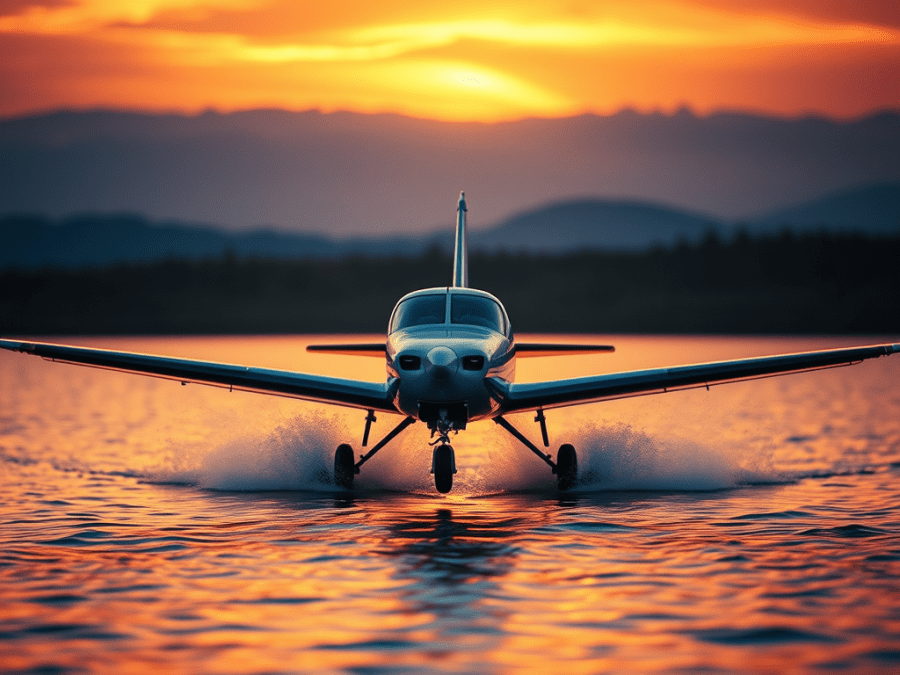
Sunday, September 14, was a beautiful day at Red Deer. About 6:30 PM, I left the airport for a short flight to Sylvan Lake to do some water landings—not “touch and goes.” We never do touch and goes with water landings; there are too many uncertainties. Red Deer Flight Service had suggested that the wind was calm, so I used Runway 34. About a mile east of the lake, I passed over a farm where they were burning some brush. I always try to find something near the lake that will give me an accurate indication of the wind direction. The smoke trail told me that a slight breeze was coming from the northwest.
I set up for my first landing about a quarter mile from the north shore, parallel to the shore, which runs in a northwesterly direction. I made a mental note that the water was fairly smooth but not glassy—no reflections. The first landing was perfect. I touched down and slid to a stop. I reset the flaps and trim according to the checklist, then took off and continued paralleling the shore. I flew for about another mile and set up for my second landing.
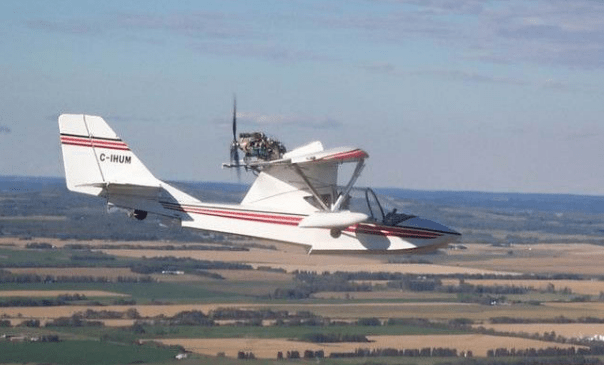
Everything for the second landing was set the same as for the first one. There were again no boat wakes or apparent problems. I maintained the 100 ft/min descent, held the nose just above level, and anticipated the smooth sound of the landing. At the instant the plane touched the water, an “explosion” took place at the front of the hull. In a millisecond, the plane flipped inverted. By the grace of God, I was not knocked unconscious. My four-point harness held well. I opened my eyes underwater and remembered the rules of water egress as outlined so many times by “The Dunker Guy” in the COPA magazine. I held my breath, opened my eyes, determined which way was up, released the seat belt, and pushed out toward the light. I do not remember pushing out on the sliding window. I came to the surface, pulled the cord on my Mustang inflatable jacket, and found myself standing on the underside of the wing, which was about four feet down in the water. The belly of the plane was sticking out of the water about 12 inches. The plane did not sink because I had built extra flotation into it when I did the construction. Within three minutes, a wonderful family came over in a boat, rescued me, and called 911.
Two days later, when the salvage company pulled the plane out of the water, we found that the front deck was gone, the windshield was gone, the entire instrument panel was back by the engine, and the sliding canopy windows were both slid to the very back of their travel. My headset was tangled up in the engine at the back of the wing.
It would appear that there was a major compression fracture in the fiberglass hull. On close inspection, several of us feel that an error in the construction of the hull was the culprit. There was a considerable amount of hardened fiberglass resin in the area of the chines. There was no fiberglass cloth or mat embedded in it. The hulls are manufactured by another company that supplies them to the company that markets the airplane. Quality control? The investigation continues.
 Calgary Recreational Flying Club YYC