

It’s hard to believe that summer is over. OK, technically there’s another two weeks before autumn officially arrives, but the weather this week is certainly fall-like.
Fortunately, this is my favorite time of the year. I’m quite happy with temperatures in the mid-teens and the lack of mosquitoes and other nasty critters. Of course, some of the best flying conditions occur in the fall with the airplanes loving the cool, stable air.
Monday, I took advantage of these conditions and flew up to Stettler for their annual fly-in breakfast. I met up with Brian Vasseur, Guy Christie, and Stu Simpson in Three Hills. Fortunately, Brian and I arrived just before they closed the airport for an R/C aircraft demonstration. Unfortunately, Stu and Guy ended up having to hold until the airport reopened.
Earlier this year, I picked up a Monroy Traffic-Alert monitor to help detect nearby aircraft. On Sunday, this inexpensive little device paid for itself. As I was returning from Stettler, the device informed me that there was a target at my altitude 5 miles away.
However, I have had one small issue with the unit. On occasion, I get a false report of traffic at my altitude and nearby. I’ve been able to determine that this false signal was some sort of reflection of my own transponder. Flipping the transponder to standby will usually make the target go away.
However, on Monday, the target stayed and was now only 3 miles away. I decided to descend 500’ to give us a little separation. A minute or so later, a Mooney blew directly overhead about 500’ above! I’m totally sold! Later investigation showed that Carstairs lies directly under the course from Stettler to Springbank.
The only other issue that I have with the Monroy is its reliance on the ATC radar interrogation to force a signal from the transponder. In more remote areas, the Monroy sits silent for extended periods. Fortunately, the biggest need seems to be around the busier airports, which are radar equipped.
Another issue is the lack of direction of the other aircraft. More expensive units have this ability but were out of my price range.
Despite its shortcomings, I’m quite happy to have it. By the way, the unit will work with aircraft that are not transponder equipped, but it will give the other aircraft’s pressure altitude (i.e., the altitude indicated at 29.92” hg.). Definitely a useful tool!
Speaking of new devices, I’ve had a chance to put the SPOT device through its paces over the past couple of months. As easy as the unit is to use, I managed to mess it up while en route to Oshkosh and never did activate the tracking mode. On the return trip, I finally got it working, but still forgot to turn it on for at least one leg. So, I can certainly understand the issues that SAR has with a device that needs pilot intervention to operate.
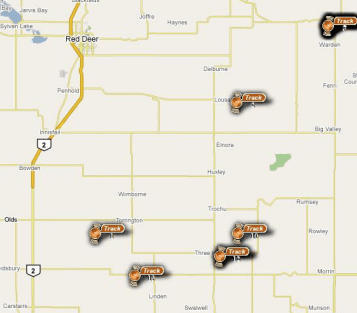
The other problem I have with it is the 10-minute interval between “breadcrumbs.” It turns out that the 10-minute time is a minimum and, quite often, it’s quite a bit longer than that. Below is the map from my recent trip to Stettler.
As you can see, there are some large gaps in the track from Carstairs to Stettler via Three Hills and back to Carstairs. The HAM radio APRS technology may be better for this, but I don’t think it’s as robust as the SPOT device in the event of a crash. In the event of a crash, the SPOT unit would probably survive and continue pushing out your location, making you easy to find.
Since we’re on the subject of ELTs, I did get a chance to look at the Kannad 406 Compact ELT kit at Oshkosh. This new unit was just recently approved in Canada and runs for $864 from Aircraft Spruce with an additional $137 for the ANT-200 antenna. This appears to be about the cheapest available. If we have no choice in installing them, at least they are becoming a bit more affordable… well, for us homebuilt owners.
 Calgary Recreational Flying Club YYC