
I’ve always wanted to vacation in Eastern Europe and finally got my chance this fall. The last part of our vacation took us to Krakow in Poland. We flew from Budapest to Vienna and then on to Krakow. The first leg of the flight was on a Dash 8 400 series which sported six-bladed props. I had never heard of a six-bladed prop on an airliner before but assumed that the six blades were needed to absorb a lot of power. I was not disappointed as the acceleration on takeoff was incredible. The “400” has a top speed of 400 miles per hour. The Krakow leg of the journey was in a 300 series Dash 8 with a four-bladed prop. It accelerated and climbed smoothly but was no match for its larger cousin. The 400 was also 60 miles per hour faster.
I struck up a conversation with a fellow passenger on the Krakow leg of my journey who told me about the Polish Aviation Museum in Krakow. The museum apparently got its start when Hermann Göring (late of the Third Reich) decided to move his personal collection east to avoid Allied bombing during WWII.
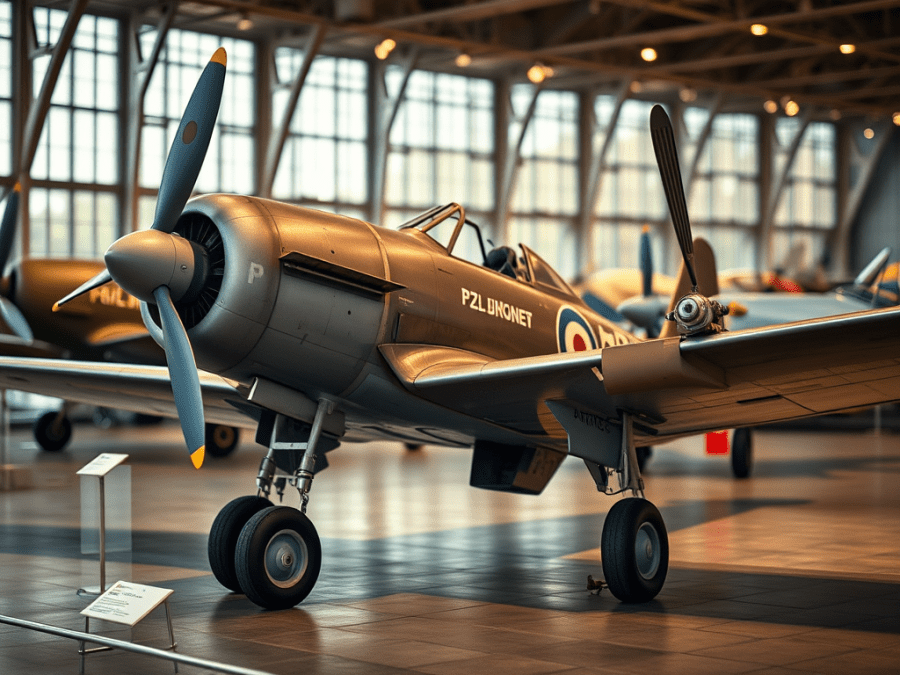
It has a collection of over 200 aircraft, including gliders and helicopters, as well as about 100 aircraft engines. Several of the aircraft displayed are unique. The museum is different from others that I have seen in that it displays mostly Eastern Bloc countries’ aircraft. There are all sorts of MiGs, Ilyushins, Yaks, and Sukhois. There are fighters, Soviet-era transports, and lots of other special-purpose aircraft including a Spitfire LF Mk.XVI.

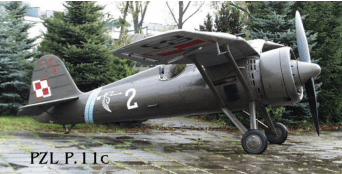
By far and away the most interesting airplane is the Polish PZL P11.c. This was the top-of-the-line Polish fighter in September 1939. The prototype first flew in 1934. It had a fixed undercarriage, strut-braced upper wing, open cockpit, and was powered by a 600-horsepower radial engine. Top speed was a paltry 230 miles per hour and the service ceiling was 26,000 feet. You can imagine how brave the Polish pilots must have been to fight against the ME 109 which would have been about 100 MPH faster and considerably more powerful. The Poles nevertheless managed to shoot down 120 German aircraft. It is the only surviving Polish fighter from the September 1939 campaign and is the symbol of Poland’s lone struggle with the German Luftwaffe. As such, it is considered the most precious exhibit in the Polish Aviation Museum.
I spent 5 hours at the museum to see everything. If you are interested in seeing their website, just type in “Polish Aviation Museum” on a Google search. It takes you right there. The website is good but no substitute for being there.
 Calgary Recreational Flying Club YYC