

Welcome to 2008! We certainly started it off on a high note. January’s meeting was held at SAIT’s Art Smith Aerospace Center at the international airport. The school opened its doors about four years ago and has been a showcase of aircraft maintenance training in Canada. The institute boasts a piston engine rebuild lab, a turbine engine lab, a helicopter lab, and several sheet metal, composite, and wood shops. There are also specialized avionics and aerodynamics labs.
SAIT instructors Brian Goddard and Rod Deneve volunteered their time to provide us with a tour of the facility. Although all of the facilities were impressive, the favorites seemed to be the engine lab and the hangar floor (especially the Harvard!)
I was pleased with the positive response received from the meeting and tour. The club will be making a donation to the school’s graduation fund in appreciation.
Despite the cold winter conditions we’ve been facing this past month, I was able to get in a few hours this month. I had a great flight on January 12th. For about two weeks, I had been trying to get together with a couple of buddies of mine, Steve Whitenect and Gilbert Tessier. Gil and Steve were my wingmen in 2006 on our trip to Oshkosh. Dad and I flew in Chrissy with Gil and Steve in Steve’s Murphy Rebel.

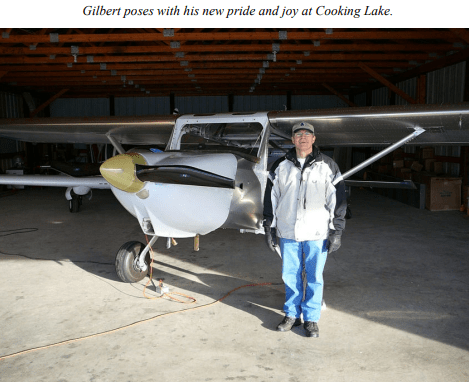
Early in 2007, Gil finished his Murphy Elite, and I had been anxious to have a peek at it. With our plans to meet at Tipitina’s going bust, I made a last-minute decision to fly up to Cooking Lake and see Gil. I couldn’t have picked a better day to do it. Conditions were calm, and it was reasonably warm for January.
Gil informed me that Camrose was the best place for fuel, so I planned a stop there on the way up. As my track took me directly over the lake where we have our cabin, I decided to make a couple of photo runs to capture some pictures of the cabin under construction.
Sure enough, fuel in Camrose was about 15¢ less than Olds/Didsbury. Ten minutes after leaving Camrose, I was landing in Cooking Lake. I was quite impressed by the facilities there but, of course, any aerodrome with a seaplane base will get my attention. As I taxied in, I saw Gilbert out to guide me into his hangar.
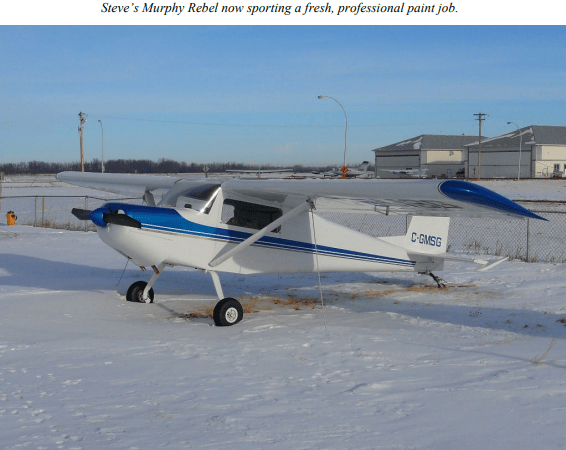
After we chatted for a few minutes and looked over his handiwork, he offered me a hop in the Elite. We decided to fly over to Villeneuve and check out the new paint job on Steve’s plane. Unfortunately, Steve was in the bush hunting and couldn’t join us.

Gil is a relative newcomer to the sport, having received his license in 1999. However, he’s racked up over 2000 hours of pipeline and power line patrol work since then. Needless to say, I was not too concerned about bombing around the Edmonton Terminal area with Gil manning the radios.
What a wonderful sightseeing tour over the city! We flew directly over City Center on our way through. On our approach into Villeneuve, Gil was able to show me some of the maneuvering capabilities as we tried to keep clear of a couple of confused student pilots.
Speaking of capabilities, I was quite impressed by the Elite. With an O-360, the climb performance is very brisk, and it cruises comfortably over 130 mph and seems to top out at around the 140-mph mark. It was quite comfortable to fly in and fairly easy to get in and out of. Control forces were quite light, and it responded as expected. In fact, it was hard not to compare it to Troy’s RV-9.
Unlike the RV-9, the plane dissipates energy quite easily as you pull back the power. Adding flaps really puts the brakes on.
About the only thing I could complain about was the typical tin can noise that I’ve experienced in other Rebels. It is most prevalent at low RPMs and while taxiing and seems to go away at higher RPMs. Gil is still working on soundproofing and other minor details before committing to a paint job.
The flight back was uneventful and enjoyable. Boy, I love winter flying.
See you all next week at the normal place and time.
 Calgary Recreational Flying Club YYC