

Changes for the Buttercup!
OK, I distinctly remember promising myself that I would not make any changes to the Buttercup plans. Well, that was before my latest acquisition.
As many of you know, the Buttercup was the forerunner to the popular Tailwind design. The Tailwind was first built in 1953 and had a knack for extracting every ounce of performance from its engine. Steve Wittman designed this 2-place speedster in response to the fledgling EAA’s members’ request for an economical 2-place homebuilt. This spawned the Continental powered W-8. Performance numbers were very good with speeds in the 150+ mph range on a C-85 to O-200 powerplant.
Of course, builders were not satisfied with simply bolting on a little four-cylinder Continental; they needed MORE POWER! Today, there are W-10’s with up to 200 hp on the nose! At the 2005 Airventure Cup Race, an O-320 powered, fixed pitch W-10 beat out every single RV, including some with 180 hp! Not too shabby for a 50-year-old, rag-and-tube design!
About 6 months ago, I happened across a Tailwind in the back of the Springbank Air Training College hangar. The fuselage and wings were essentially completed and covered, but most of the firewall forward still needed work. I asked the hangar’s owner about it and learned that it was for sale. Although I wasn’t that enthused about the plane, the recently overhauled O-320 on the nose was of great interest. That would make the Buttercup absolutely scream!
I got in touch with the owner and made an offer. At first, he seemed interested, but he also had some other interested parties looking at it. Since my offer was well below the asking price, I let it go.
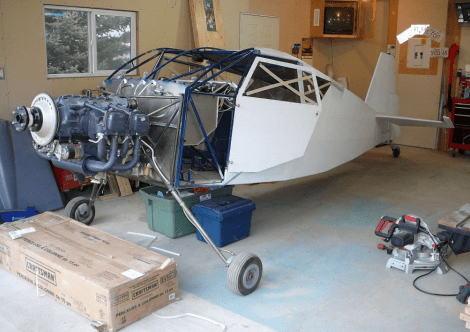
Well, a couple of weeks ago, I got a phone call from the plane’s owner. He still had the Tailwind and was willing to accept my original offer. Since I was still interested, a deal was struck.
Before we shook hands on the deal, I decided to make a call to Earl Luce, the gentleman responsible for producing the modern Buttercup plans. To date, only two Buttercups are flying: Earl’s prototype and the one built by Wittman himself, which currently resides in the Wittman Hangar on EAA’s Pioneer Field. Both of these planes were powered by four-cylinder Continentals. Earl’s has an O-200, and the original has a C-85.
Although the O-200 powered version does the job well for Earl, I have been worried about the effects of our density altitude on the performance. The Cessna 150 has the same engine and although it’s a reliable airplane, the performance is somewhat anemic, especially with a load on a summer afternoon! However, that same airframe with an O-320 on the nose is quite a different story. Climb speeds well in excess of 1000’ are possible with only a 60-70 lb weight penalty. So, the first question I posed, after explaining the situation, was whether he would go with the O-200 or upgrade to the O-320 if he were in my place. He wholeheartedly endorsed the O-320.
Switching to a fire-breathing O-320 in place of the sedate O-200 would mean a few changes. First, a heavier engine and additional 10 gallons of fuel would result in a weight increase of about 140 lbs. Second, the additional thrust would likely result in a cruise speed of over 160 mph… well above the 150 mph VNE.

Of course, the first question was whether the structure could handle the additional weight and vibration of the engine. Since Earl essentially copied the Tailwind’s structure and built it in the shape of the Buttercup, he saw no issues in putting the O-320 on the fuselage and is confident it will handle a 1600 lb gross weight. It certainly helps matters that the engine is equipped with a dynafocal mount.
The next question was about the fuel capacity. The 22-gallon nose tank is simply not enough for a 7-8 gph fuel burn. Fortunately, Earl’s in the process of helping a customer build a wide-body, O-290 powered, nose wheel version of the Buttercup. Earl simply expanded the tank to 32 gallons. It’s still a little small, but with the excess power this plane has, the cruise power will likely be around the 55% range rather than the normal 75%. Also, I plan on equipping the engine with an electronic ignition system such as the P-Mag or Lightspeed units. These are typically good for another 1 gph fuel savings or so.
The Vne issue was the next topic. It turns out that one of the Buttercup’s most unique features is also its weak point. The leading edge flaps that Wittman installed on the Buttercup reduced the stall speed from about 48 mph to 40 mph. However, they are held in place with three AN-4 bolts in the hinges and two more in the actuator arms. Although adequate, it limits the Vne significantly.
Earl’s solution is very simple… don’t install leading edge flaps. Instead, build the wing with a simple wrap of aluminum around the leading edge. Having employed this on the Christavia, I know that this provides significant torsional stiffness and additional strength to the forward spar. I’ll test the plane for a 175 mph Vne. The additional power for takeoff will more than compensate for the lack of LE flaps. In addition, it will save about 150-200 hours of build time.
Earl also suggested adding a fourth compression strut to each wing so that it has 3 bays instead of two.
In all, the changes are relatively minor and should give me a far more capable plane… look out Troy, that green streak that passed you might be a 70-year-old design!
Oh yeah, anyone interested in a Tailwind project?
 Calgary Recreational Flying Club YYC