

Rumours are true; I am back in the air! I too, like many other pilots, have learned the lessons of flight the hard way.
It all started just over a year ago when I sold my RX-550 Beaver that used to be Dan’s and was Winston Brown’s before that. I had it for three summers, putting on over 150 hours and had a lot of fun flying to most of the breakfasts and BBQs the club put on. I really enjoyed it since the view was great and it landed easily, but it was not a “fast & far” plane. Now I know it’s not the destination that counts, but my farthest flight to Lethbridge and back was a grand total of 3.8 hours, which is a lot like driving there. So I put up my plane for sale and looked to set out my requirements for my next plane.
I wanted a 2-seater that had the ability to carry a passenger. The passenger should be sitting next to me, not behind me, as the view of the back of my head is not very exciting. I wanted to be able to cruise at 80–100 mph and have 3 ½ – 4 hours of range. I really liked the high wing of the old Beaver, so another high wing would do. This would also help out by allowing a quick assessment of the terrain below… once you’ve had a Rotax moment, you will never forget it! I would like a 4-stroke, 4-cylinder engine, but I knew it would not fit into my $25,000 budget. So the 2-stroke, 2-cylinder was a given (until the next plane!).
So with this criteria, I started out on my search. I started at the Barnstormers website. 25 grand Canadian would get me some listings, but mostly airplanes in the USA. This price had to include all costs, including delivery. I found quite a few Challengers and Titan Tornados and thought about it for a while, but I wanted the side-by-side seating. My wife said she might go flying with me if it did not look like the Beaver (go-kart with wings). There were a few Rans planes, but the price was starting to get higher.
The other thing I had to decide was “the landing gear configuration.” Was I going for a tricycle or tailwheel style? I took my training in tricycle, but Stu Simpson said that “anyone” could fly with training wheels! I will argue the point that the Beaver was not tailwheel, but I did not say at any time that I would need to have three wheels up front. As I looked further, it seemed that moving the third wheel to the back of the plane makes it a little cheaper!
I wanted to buy Troy Branch’s Avid, but I did not have my plane sold quickly enough, and I could not have been able to get the “own two planes” deal past my wife. Someone beat me to the Avid, and it was my loss. Troy did take me up for a flight, and the fact that it was a great 2-seat side-by-side plane which cruised at 85 and had a 3-hour range was not lost on me.
I did find another great plane in B.C., but when I told the seller of the 2000’ grass strip at 3400 ft AGL, he said it was not the plane for me. I thanked him and kept on looking. Now an older Cessna would be another option; I looked at the size of a 150 and found out that it would not fit my current hangar, and I did not have the extra money to buy another hangar.
I knew then that a taildragger was going to be a better fit in my only hangar. I also knew that a certified airplane was also going to have a greater cost in the long run, and it may be a choice I would regret later. The 150 at Indus uses a lot of runway, even in the early morning, and would never be considered a short field lander.
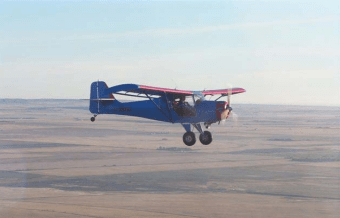
I continued on with my search on the Internet. I did see an interesting plane at the Indus airport one morning and found out that Tim Vader had finished a great looking Kitfox Model IV! I talked to Tim, and after a while, Tim said that he knew of another one that was for sale, but it was only a Model II. I got the name and number and called the guy. Yes, Harold Line still had his Kitfox Model II for sale, but it needed some work.
This was a plane that I thought would be a good fit to my criteria as it had 2 seats, side by side, 2 doors, an 85 MPH cruise, a 4-hour range, plus it was a homebuilt and it was a taildragger! I took Ken Beanlands with me to take a look at the Kitfox.
The owner was only 20 hours into the test flight phase, and he was not having as much fun with it as he thought he might. It is interesting how feelings at the start of a project are different when it is all done. I know that Harold said he enjoyed building the plane, but it did not fit his lifestyle now. It did not take me very long to decide that I wanted this plane, especially with it being a local buy that I could get back into my hangar and still not blow the budget.

The home storage of the folding wing airplane with fuel still left in the wing tanks caused some damage to the paint as it sat waiting for the next time to fly. I worked out a deal, and with the help of Garrett’s trailer, I was able to get it back to Indus safe and sound. I found that my new plane fit very well in my hangar. It even gave me some extra room, as the wingspan of the Beaver was longer than that of the Kitfox.
I did have to do the paint repair, and with both wings off, I re-sloshed the 13-gallon wing tanks for that extra feeling of safety. I ordered the paint, which was the water-based AFS system, and went off to work getting the needed repairs done. I finished up the repairs just about a year ago in July. After putting everything back together, it was time for flight.
Now this is where my mistake took place. Simply put, I should have taken training in a taildragger, but I did not. I did do many high-speed taxi runs and felt quite comfortable in it, but it was different than the “Beaver.” So after 1.1 hours of its first flight with me, I brought it in for the landing. I forgot that the toe brakes were set ahead of the pedal, and as I landed, I had one toe on the right brake but not the left one. As I went down the runway, I was going to the right but I was pushing on the left pedal. Had I just cut the throttle and landed, I would have probably been able to figure it out, but since I was trying to touch and go, I touched and slid off the side of the runway. The damage to my pride was more than the damage to my plane, but it was a lesson learned!
I had to replace one landing gear leg, but since my friend Tim Vader had an extra set from his kit, I replaced them both. I also had Ted Beck do some welding of a few new tubes that were bent by the landing gear. With help from Ken Beanlands and Jim Corner, and with the fabric donated by Fred Wright, I was able to get the repair done and the Kitfox readied for its second attempt.
I took a couple of hours of tail dragging time with Wayne Winters in the Merlin (which is another great plane). I was set up for success and on June 17th, 2006, I hopped into my plane (after Wayne was done with me) and took off for six circuits consisting of one successful takeoff and one successful landing, with the other five done to make sure I was setting up correctly for a good landing. Ted Beck even had the opportunity to witness this event. Ted may tell stories of hearing a loud “Yahoo” at the end of my landing, but I think it was the angels in the outfield that he really heard.
I felt that the training worked very well for me to help me get the feel of my plane and the way it handles on landing. I found the plane to be very responsive, and it has a good feel to it. I have since flown off the rest of the flight hours required for the 25-hour test time. My blue with red Kitfox Model II C-GHKC has been a joy so far, and I know that flying to Lethbridge will be a little bit quicker the next time I go, which should be pretty soon.
I would like to thank everyone that helped me out with making this another reason to belong to our great flying club, and I look forward to putting in many hours with many smiles at the end of the day of flying.
Thanks All
 Calgary Recreational Flying Club YYC