

The planning for this trip was a long time in the making. My first step was to find an airplane right for the job, build it, and upgrade my ultralight permit to a private pilot’s license. I had rebuilt an Avid Aerobat and had been flying it for a while. The plane was great fun, but I did not feel it was the right plane to make the trip that I had always dreamed about… flying across Canada was my goal.
I hadn’t been involved much with aviation in my hometown of Bathurst, New Brunswick. I guess that is not quite true; I had been flying model airplanes since grade six, but there was never any opportunity to pursue general aviation. The closest place to work towards a private license was Moncton, New Brunswick, a 2.5-hour drive. Not an option for a young buck fresh out of college.
My girlfriend and I moved to Alberta in 1998, and I started to investigate economical ways to get into the air. The first point of interest was paragliding. It was cheap to buy (relatively), cheap to run, and I could store it in an apartment closet. It was fun, but my patience ran thin after making so many two-hour drives to go flying, only to find the conditions would never become soarable! I found a solution for that problem and bought a paramotor to get airborne – lots of fun, but one cannot go far at 20 mph!
An ultralight was my next step. I obtained my ultralight permit through Blue Yonder Aviation, and that is when I started rebuilding the Avid Aerobat. Once the airplane was complete, I test-flew it and proceeded to put many hours on it. (I will not mention how many hours I had under my belt before I became the test pilot for my own aircraft!) The trouble-free flying that I got out of that aircraft, hitting all the breakfasts from Lethbridge to Edmonton, sure was fabulous. The trouble was that you could not take your hands off the controls in the rough afternoon thermals, nor could you go very far before requiring gas, and of course, the two-stroke engine up front did not bode well for the bush and lakes of Ontario.
I began researching several kit options and tried to decide in which direction my recreational aviation adventure should head. (I knew it was East, but how would I get there?!) Ultralight or amateur-built. I wanted a four-stroke engine up front, good load-carrying capability, and speed. Regarding the speed issue, how fast was fast enough? I remembered one day flying the Avid and the GPS reading 130 mph with a good tailwind; I figured the way the ground was moving by, that that would be a good number to look for in a cross-country aircraft. At the time, I only had an ultralight permit and really did not consider anything else. When I started to look at cost and the numbers began creeping up rather high, I started to look into an aircraft that would require a license upgrade.
The RV aircraft had always caught my attention. They had great short field capabilities, good useful load, great speed, and a certified engine up front. What more could I ask for! I really did not look at it seriously at the beginning because I assumed the cost would be out of range of what I could afford. However, after more review of all of my options, the costs were approximately the same. The decision was made, and I took the plunge, bought the empennage kit, and about $4,000.00 in tools. And I would use the plane to upgrade my license.
Next surprise – we found out we were going to be parents! The race was on, nine months to get as much done as possible because after that, the project was going to stop. (Article Editor’s Note (‘Editor’ being Jody-the girlfriend): The project did not stop.) Empennage done in 3 weeks… wait a month for the wing kit… wings done in four months, which included them all getting closed up as I got them inspected… wait a month for the fuse kit… fuselage arrives one month before Emma arrives… tailcone and center section done… Emma is here – she won the race!
Things slowed up for a bit (Article Editor’s Note: Right… sure it did…) as we got ourselves in a new routine. New babies do lots of sleeping, so that is when I did lots of building. The Avid was sold, and that June the RV made its way to High River, where Jack and Jean Dueck were kind enough to have their hangar ‘babysit’ my new aircraft. It was one year and five months from crate to first flight with Jack Dueck at the controls. (Remember I only had an ultralight permit, so I could only start flying after the first 25 hours were done.)
That winter, I was finally able to bring passengers in my new airplane, and what a machine it is! The plan for the trip east went to the next step – when do I leave and who do I bring? Emma, by this time, had been doing lots of flying with me, but at 18 months old, her first cross-country flight being 2300 miles times two would not have been a great idea!
I had lots of people step up and offer to pay for half the gas to tag along. Who wouldn’t want to go? Great airplane, and you cannot beat the food in the Maritimes! There was one fellow that had always been there when I was building my Avid, was always there to fly in formation with, and had been kind enough to keep my rag-wing Avid out of the weather. He was also the only one I knew that could leave at the drop of a hat if the weather was good to go – Garret Komm was my choice. He is a great pilot, and I figured I could put up with his shoulder hitting mine for 5000 miles!
We decided to depart around the first of June. I printed out weather maps across the country for approximately three weeks prior to our departure. I was able to get a good feel for how long the weather was taking to move on, as well as how bad it could get. The plan was to leave when the weather looked best. As the time got closer, I decided if the weather looked good on June 1st, we would leave. That would get us there on the 2nd to celebrate my 30th birthday!
Once this date was decided upon, we prepared the plane. We had to be able to jump in and go! With no fuel in the tanks, it gives the worst aft CG condition, and with both Garret and I in, we could still haul 140 lbs. I had labeled the luggage at 100 lbs, so we used that as a goal number, and a bit over would still be fine. We would not be able to get to the gross weight of the aircraft. We brought everything out and started weighing everything up. We soon realized that we were “slightly” overpacked! We opened up our bags and started sorting out what we had both packed the same items of. We both had everything for survival in the bush if the worst was to happen!

Once we had made decisions on what would and would not come, we packed the plane for good. Keeping all the food on top for easy access for in-flight snacking! The gas tanks and oil were full; all that was needed was good weather for June 1st to leave.
The night before June 1st, the weather was on our side. We planned to be airborne a half an hour before the sun greeted us. That would get us airborne before 5:00 a.m. The iffy part regarding the weather was in the Thunder Bay, Ontario area, where thunderstorms had been forecast for after lunch local time. We planned to meet at the airport at 4:00 a.m. – the race against the weather was on!
Not much sleep was had that night! The dream I had worked so long and hard for was hours away. Three o’clock a.m. came quickly, and I jumped in the shower to wake up. Kisses to Jo and Emma, and I was off to the airport. (In a way, it felt like a normal trip to New Brunswick – North to the Trans-Canada and West to the International – except the drive West was only to Chestermere-Kirkby Field!) Garrett was waiting, trying to warm up after the cold morning drive on his bike. The hangar door was quickly opened and the plane pushed out. It was still quite dark, but by the time we were strapped in and the plane warmed up, it would be time for ‘wheels-up’. With everything checked and double-checked, the engine was primed and fired up in the darkness on the first blade.
Strobes on; Navigational lights on; Taxi light on; we were ready! All run-up checks completed, the throttle was pushed into the stop. This was the first take-off run close to gross weight off a grass strip and in less than 1,000 feet, we were airborne – it was time to relax and enjoy the view!
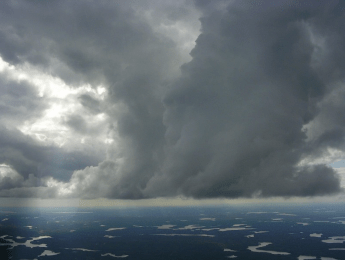
We made a steady cruise climb to 7,500 feet for the first leg to Regina, Saskatchewan. It was a 2 hour and 15 minute non-event flight with no new scenery. The turnaround in Regina was great – 20 minutes maximum from touchdown to wheels-up again. Next leg was to St. Andrews Airport in Winnipeg, Manitoba. We started to get excited as we headed into new territory! Two hours later, we were touching down in Winnipeg, with scattered cumulus clouds starting to show; other than that, there were no clouds across the prairies. We fueled up and had a quick snack before getting on our way. We spoke with some pilots that had just come from Marathon, Ontario, and they reported showers, but they had been able to pick their way through. During the weeks prior to departure, that type of weather had always been appearing on the weather maps I had studied. Therefore, I knew if we got there soon enough, we would be in good shape. It was just after 11:00 a.m. local time, and the towering cumulus clouds to the East were showing the instability of the air mass. Time would tell….
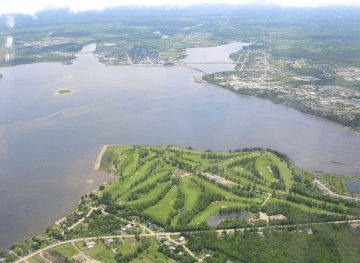
As we climbed out of St. Andrew’s Airport, the control tower handed me off to Winnipeg for clearance to climb into their airspace to the East. The plan was to stay above the scattered towering cumulus clouds as long as we could. It made for great scenery and a smooth ride. The lakes did not have a ripple in them, and the cloud reflections were breathtaking. There were trees and lakes as far as the eye could see. No roads to land on like the prairies!
We stayed fairly north of the Trans-Canada Highway, as south had the towering cumulus clouds topping out over 20,000 feet. As we pressed on, we soon knew we had to get down into the bumps and dodge the rain showers. The safe choice was to stop in Dryden, Ontario, and get the fuel tanks topped up because we knew it was not going to be ‘straight-line’ type flying with the weather that was ahead. As we taxied up to the fuel pumps, we got dumped on with rain and waited for it to stop before we got out. The sky to the East did not look promising for flying!
 Calgary Recreational Flying Club YYC