
The 2006 Air Adventure was a great success. Not the trip to Oshkosh, mind you, but the real adventure into the mountains. The trip this year took us from Calgary to Hinton, to Prince George, south to Salmon Arm, Nelson/Castlegar, and back to Calgary via Pincher Creek. The trip took five days.
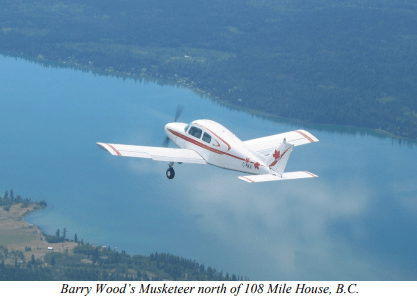
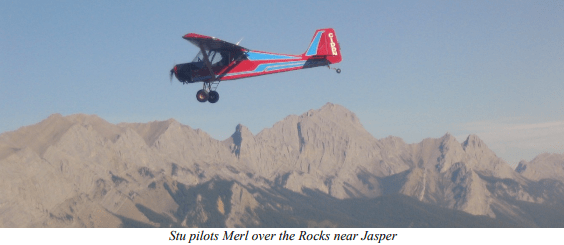
Four of us made the journey: me in my RANS S12; Stu Simpson in his Merlin; Barry Wood in his Beech Musketeer; and Gerry MacDonald in his Cessna 182. We did the trip taking only what we could carry. There were no fuel trucks or motor homes to back us up. I cheated a little and pawned off a few items on Gerry and Barry because there’s physically just not enough space in the RANS for what I needed to take.
With the wide range of speeds among the participating aircraft, we didn’t see much of Gerry except on the ground. And Barry stayed with us for a while, but usually ended up passing us on the way and meeting us at our destination.
This was my first Air Adventure, and without ground support, it took some extra planning to get together everything I needed. In addition to a week’s worth of clothes and a case of 2-stroke oil, I had to bring metric tools, mountain survival gear, an air compressor, a camera, water, and of course, maps and a CFS. Stu’s plane looked equally crowded, and Barry removed his back seat to carry his stuff. Gerry’s back seat was pretty full, as well.
Getting Underway
On the first leg, we’d planned to meet in Red Deer to get fuel and have breakfast. I arrived at Kirkby Field at 6:00 a.m. so I could get all my gear stowed and see what I’d have to leave behind. Stu showed up about 7:30 and pointed out that a storm was moving in. We quickly said goodbye to Bob Kirkby and Carl Forman, who were on their way to Oshkosh in Kirkby’s Cherokee. As it was, we got on our way just ahead of the approaching weather.
After battling headwinds of anywhere between 15 and 35 mph, we got to Red Deer only to find out there wasn’t any gas at our regular location. We called the Esso dealer on the field to find out there was little, if any fuel available at all. After our reassurance that we’d need only about 20 gallons in total, the dealer agreed to sell us some. It turns out that Esso had shut down a major gasoline refinery for unexpected repairs. This wasn’t a good start to the trip, but we were able to refuel and get a good breakfast, so we decided to push on.
The next leg to Drayton Valley was equally slow due to headwinds and some rain, but with good visibility otherwise. At Drayton, Gerry and Barry had already called for fuel, and after a short wait, we were able to top up and be on our way to the Hinton/Entrance airport. As we left Drayton, I realized that there were now only a few good places to land in an emergency, and I began to think about whether there was anything I forgot to check on the Rotax. The leg to Hinton featured my first introduction to flying the RANS over the bush. Near Edson, we spotted a number of Fire Cat fire-bombers inbound for Edson. Their bright white and red paint schemes contrasted sharply against the lush green forest below.
The headwinds finally eased once we passed Edson, and we were able to achieve a decent ground speed for the first time that day. But after a full day of fighting the wind, we were completely tired out and ready to quit flying for the day.
Hinton/Entrance is a very nice grass airstrip with very good facilities, and it’s a good place to stop before heading into the mountains. It’s hidden away in the trees, and if you didn’t know it was there, you might fly right past it. We had to wait a few hours for fuel, but that was okay, as it gave us time to rest and relax. Our brightly colored mounts attracted the attention of a fire crew stationed there who were really interested in what we were flying. We got a ride back to town and ended the day with a very good supper at the hotel restaurant. Because of our really early start and 6.4 hours of flying, I barely stayed awake to finish eating.
Into the Rocks
For the start of day 2, we’d be going into the mountains, with our first stop at Valemount. Overflying Jasper, with steep mountains all around, I began to realize just how small I was and what a change this was from flying on the prairies. Gerry and Barry had gone on ahead of us, and there were just Stu and I to enjoy the experience. Each of us was stunned by the area’s beauty and the experience of seeing the mountains this way.
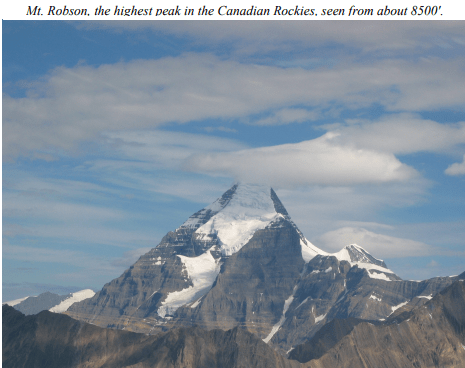
As we rounded the corner to head west from Jasper, we could see Mt. Robson in the distance. For the next half hour, it seemed to tower over us, even though we flew at 8000 feet. It was truly awe-inspiring to see the mountains from this perspective, from the snow on the peaks to the ever-changing colors of the lakes and rivers below.
Once past Mt. Robson, we began descending to land in Valemount, where we refueled again. Our four airplanes were the most activity that airport had seen in a long time. Most of what we saw there were gliders, but we met some very friendly people, too. We got fueled up and began our next leg to Prince George. I liked the place so much I left my credit card at the airport for everyone else to use. Luckily, Barry was able to pay my fuel bills for the rest of the week.
We’d thought about stopping for fuel again in McBride, an hour north of Valemount, but there was no gas available there. Instead, we pushed on to Prince George. I had an extra 30 liters of fuel in the airplane and an electric pump to refill the main tanks. As we got close to McBride, I started the fuel transfer with the idea that if I had any problems, I’d have a nearby place to land. I successfully got all 30 liters pumped to the mains with no problems, and I congratulated myself on my in-flight refueling system. Unfortunately, this transfer system had a design flaw that would later allow me to evaluate the RANS as a glider.
Barry and Gerry pushed on ahead to Prince George while Stu and I stayed together. After the mountains at Jasper, the wide valley on this leg didn’t seem quite as exciting, so this leg seemed to really drag on. I was almost at the point where I was ready to get out and stretch my legs when Stu and I came around Tabor Mountain and could finally see Prince George. On a 10 mile straight-in approach, we heard a Grumman Mallard pilot calling his position inbound from about 20 miles back. There was a Bonanza and a Merlin turboprop somewhere behind him. The tower controller naturally kept everyone well informed about everyone else.
Trying to be polite, we performed an aggressive descent to the field at 90 mph and 1000 fpm all the way to the threshold. That didn’t keep the American in the Mallard from complaining about how slow we were going. The not-so-sympathetic controller told him to do “S” turns and deal with it. After landing, Stu made a point of thanking the controller for the help.
Once on the ground, we had no idea where to find Gerry and Barry, but an Esso fuel bowser found us and got us set up with tie-downs. It was the best reception from an FBO I’ve ever had, and at a cost of only $1.55/litre of avgas. We stayed the night, and the next day said goodbye to Gerry, who had to fly back home.
The B.C. Interior
For Day Three, we flew south out of Prince George, departing after a Jazz RJ and dodging an inbound Metroliner. We overflew Quesnell and landed at Williams Lake. The terrain on this leg is best described as low, rolling foothills. After flying in the mountains, it was nice to be in flatter, more open terrain where we could see far ahead of us. The winds were also cooperating, so we were in good spirits when we landed for fuel.
I’ve been into Williams Lake many times before, but always as an airline passenger, so it was nice to be there in my own plane. Every other time I had been there it had been overcast with a few rare breaks allowing a descent. I was glad that this time it was completely clear. We didn’t stay long, just enough to get gas and get on our way.
The next leg to Cache Creek was now a more southerly heading instead of the southeast track we had been flying. But with the flat expanse of the land, and the shifting direction of the sun, both Stu and I felt like we were flying off course to the SW. It’s really surprising to see how quickly the landscape changes in a short amount of time, and what effect it can have on a pilot’s navigational perspective.
With the sun shining warmly, I was finally able to take off my coat and open the RANS’ vents for a bit of fresh air. Up until then, the temperature had been only about 13 degrees at altitude, and beneath the clouds, it was pretty cold. Barry was pretty tough though and flew in shorts the whole trip.
The descent into Cache Creek was Barry’s and my first experience with difficult airports. This runway is just carved into the side of a hill. It has drop-offs all around except the west side, which is a steeply climbing cliff. Coupled with the heat and thermals, I found I really had to pay attention to the airplane. Stu had a bit more trouble after touchdown because his brakes were very poor, and the runway slopes downward toward the south. But he soon had things well in hand and trundled over to the ramp.
We had a brief wait for fuel, and the lady who ran the pumps really made us feel welcome. After filling our tanks, we were facing a gross weight takeoff at 34C and 2034’ ASL. I wondered if I really needed all of the 90 liters I’d purchased. However, the Rotax gods smiled on me, and I got a nice 500 fpm climb rate out of the valley.
The 40 minutes to Kamloops was a nice ride through a dry, barren valley. After landing at Kamloops, we parked at the Shell, where we experienced our first “gotcha” for our last-minute planning. Turns out there were absolutely no hotel rooms available, due to the B.C. Summer Games being held in the city. Undaunted, Barry hauled out his laptop and located a hotel in Salmon Arm. We fired up for another hour of flying to the day’s final destination.
On the climb out of Kamloops, I was showing 35C on the outside temperature, but even with the density altitude, I was getting 1200 fpm climb from the air rising up the mountains. Stu and I had pulled to the north side of the valley so we could make the most of the southerly winds, upslope thermals, and any stray pockets of ridge lift.
Suddenly, Stu called traffic at 12 o’clock. I didn’t spot it, but I started a gentle turn from my echelon on his Merlin’s right wing to a spot more in behind Stu. I knew he had an eye on the traffic, so staying behind him would help me avoid it. Very shortly, a Dash 8 passed us at the same altitude and maybe half a mile from our right wings. Since the approach to Kamloops is normally down the center of the nearby valley, it means you have to be really attentive for traffic coming the other way.
At Salmon Arm, we were guided into the tie-down area and met by John McDermott of Lakeland Ultralights. He has a Quad City Challenger assembly operation on the field, with three of these prolific ultralights under construction in his hangar. He also had a few others stored in a separate hangar. I’d highly recommend this airport to anyone who wanted a stop in the mountains. Salmon Arm is a great city to visit, the surrounding scenery is beautiful, and McDermott is especially friendly to recreational aviation.
John set us up with the airport loaner car, directed us to our hotel, and said he’d be at the field in the morning for fuel. We had another great dinner and were well rested for the next day. We fueled up the next morning and soon got on our way.
Look for Part 2 next month…
 Calgary Recreational Flying Club YYC