
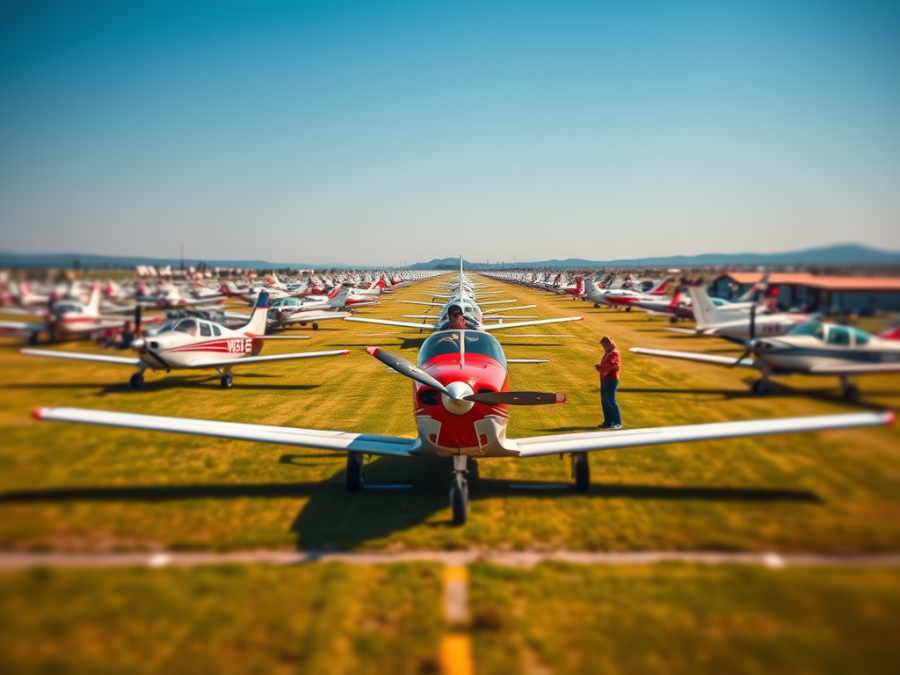
The month of May started out with such promise. We had a couple of weekends of tremendous weather with summer-like temperatures breaking old records! The first fly-in of the year, the Sundre Mother’s Day event, was an absolute smashing success. I’d estimate close to 200 aircraft made the trek. Runway operations seemed to run quite smoothly despite the fact that departing aircraft were taking off in the opposite direction to arriving aircraft. This prevented delays from arriving or departing traffic doing backtracks. Winds were pretty much directly across the runway, making either runway direction about the same. The grass strip was closed for the event for aircraft parking. Close monitoring by pilots and a ground controller kept the traffic flowing safely.
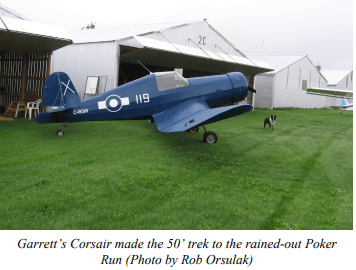
Since then, camping on the long weekend, evening TCU’s and CB’s combined with this past weekend’s RDF (Newfoundland acronym for Rain, Drizzle, and Fog) have all conspired to keep me grounded! The commercial training has been going fairly well, and I’ve nearly completed all the requirements for the night rating. I just need 0.1 of the 10 required hours under the hood and six solo touch-and-goes to complete it. Then it’s on to the actual commercial training, which entails another 30 hours solo and 35 hours dual, 10 of which are under the hood.
I was just reading through the May EAA Hotline in the Sport Aviation magazine and was quite excited to see that the Lone Star Flight Museum’s Hawker Hurricane will be in attendance at Oshkosh this summer! Most of you are probably thinking, “So what?!? Sure, the Hurricane is nice, but what’s the big deal?” Well, this particular Hurricane just happened to serve duty as my own personal Jungle Gym in the early 1970s!
One of the earliest memories I have is of climbing over and playing with the old Hurricane fuselage in my grandfather’s barn. Of course, I didn’t know what it was at the time, but it certainly was fun. Also, at the age of 5 years old, I didn’t understand how it came to rest in my grandfather’s barn, nor did I really care. What I did know was that it was an airplane, and I liked airplanes. Dad flew one, so they had to be good!
So, how did this vintage World War II fighter end up in an old barn in Newfoundland in 1972? For that, we need to look back a few years earlier. My father, Ken Sr., started flying in 1956 while attending the University of New Brunswick’s Forestry program. He correctly assumed that being able to fly would be an asset to a fledgling forester looking for work. Besides, the federal government was providing grants to young pilot wannabes once they successfully completed their license. Flight lessons were performed at the Fredericton Flying Club and the Halifax Flying Club while he was flying Champs and Cubs on floats and skis. He went on to earn his commercial license in 1963 before moving to Newfoundland in 1964 to work with the provincial Department of Forestry. The plan was to work there long enough to build experience and then move back to Nova Scotia. That was 42 years ago, and he still lives in Newfoundland. Meeting my mother in Newfoundland had a lot to do with his change in plans.
Dad became a competent bush pilot flying Cessna 180 floatplanes as part of his forestry duties. He became quite familiar with the Newfoundland backcountry and heard stories of numerous aircraft wrecks from the old bush pilots who flew the area. Fortunately, he had a pretty good idea of what rebuilding a warbird entailed and simply filed the information away.
This information was to resurface around Christmas 1971. My parents now had two kids, my sister (two years old) and I (four years old). One day near Christmas, Dad came racing into the house excitedly proclaiming that he had just seen a mosquito. Mom agreed that seeing a mosquito in December was indeed a rare event, but she couldn’t understand his enthusiasm for the discovery. Explaining that the “bug” he had seen was actually a World War II fighter bomber built by de Havilland did little to increase Mom’s enthusiasm, but she did agree that Dad could go and see the plane as long as he brought me along. This led to Dad meeting Dwayne Igly of Texas, the rebuilder and pilot of the Mosquito. It was returning home from a film shoot in England. Dwayne mentioned that he would be interested in acquiring a Hawker Hurricane wreck suitable for rebuilding. Dad thought he could produce one if the stories he had heard were accurate. Dwayne had an old basket-case Stearman that he would be interested in trading for a Hurricane project if Dad could produce one.

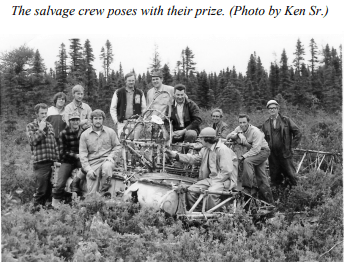
That started the search, and over the next few months, Dad visited most of the 21 wrecks on the island and selected the best one for recovery. Using a Bell 47 helicopter and a barge made from a couple of outboard boats lashed together with poles, they were able to get the wreck from its resting place on a bog to the side of a road, where it was trailered to my grandparents’ place for storage. When Dad contacted Dwayne, it turned out that the Stearman had already been restored, so that was offered to Dad. Dad decided that given the choice, he’d prefer a Super Cub or a Citabria that he could put on floats. Remember that this was the early 1970s before the Stearman gained the vintage status it has today. Dwayne came up with a relatively new Citabria complete with a full inverted fuel and oil system. Dad accepted the trade, and the Hurricane was off to Texas. Ironically, the Citabria turned out to be the only model never certified for floats! However, my father and his friends enjoyed flying the plane and taught themselves to be competent aerobatic pilots. This was the first of three airplanes Dad has owned since the Hurricane.
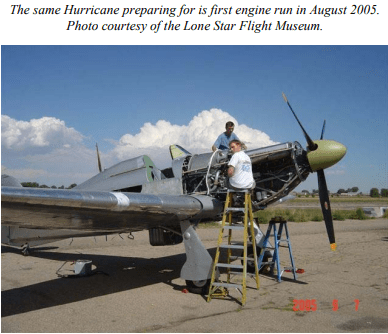
Dad followed the progress of the Hurricane after it traded hands from Dwayne Igly to Len Tanner in New England. In 1979, we had an opportunity to visit the Tanners and the Hurricane. The wings were well on their way to being restored. Len made a couple of trips to Newfoundland to look for parts before passing away in the mid-80s. After that, we lost track of the plane until it turned up in a warbird magazine a couple of years ago. We learned that it was now owned by the Lone Star Flight Museum in Texas and was being rebuilt in Colorado!
Last year, Dad was contacted by the owners asking for help with the paperwork trail detailing the chain of ownership. Dad has been helping out where he can and is very excited to be back involved with the plane. In September, we received pictures from the museum showing the first engine run, and now we see that she will be at Oshkosh! Dad has continued to foster a love of aviation and has been planning to make the pilgrimage to Oshkosh this summer. The trip was intended to facilitate shopping for items needed to complete his latest airplane, a Murphy Rebel. By coincidence, the same trip will also reunite him with his first airplane!
 Calgary Recreational Flying Club YYC